


Table of Contents
- Introduction
- What Are Autonomous Security Operations?
- How Does an Autonomous SOC Work?
- What Can an Autonomous SOC Do Without Humans?
- Where Human Intervention Is Still Necessary
- The Benefits of Autonomous Security Operations
- The Risks of a Fully Autonomous SOC
- What Is the Role of Agentic AI in the SOC?
- Autonomous SOC vs. Automated SOC
- What Does the Future SOC Look Like?
- How Organizations Can Build a Safe Autonomous SOC
- The Importance of Human-in-the-Loop Security
- Key Technologies Behind Autonomous Security Operations
- Measuring Autonomous SOC Performance
- Can SOCs Eventually Run Completely Without Humans?
- The Most Realistic Future: Autonomous Where Possible, Human Where Necessary
- Frequently Asked Questions About Autonomous Security Operations
- What is an autonomous SOC?
- Can AI completely replace SOC analysts?
- What is the difference between SOAR and an autonomous SOC?
- What security tasks can AI perform autonomously?
- Is an autonomous SOC secure?
- Will autonomous SOCs eliminate cybersecurity jobs?
- What is the biggest challenge with autonomous SOCs?
- Are LLMs enough to build an autonomous SOC?
- Conclusion
Introduction
Security Operations Centers (SOCs) are under increasing pressure. Security teams must monitor enormous volumes of alerts, investigate suspicious activity, correlate data from multiple security tools, respond to incidents in real time, and continuously adapt to increasingly sophisticated cyber threats.
At the same time, organizations are facing a shortage of experienced cybersecurity professionals and growing expectations for 24/7 security monitoring.
This has created a compelling question:
Can autonomous security operations enable a SOC to detect, investigate, and respond to cyber threats without human intervention?
The short answer is partially—but not reliably or safely for every situation.
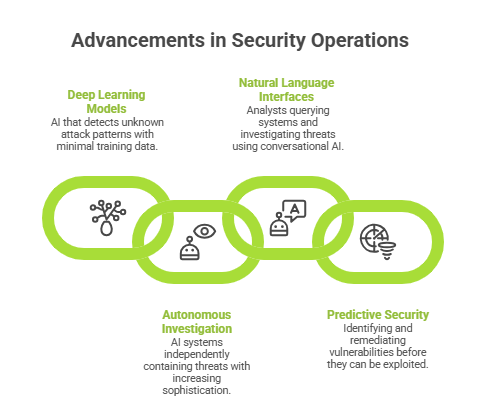
AI-powered security operations are moving beyond simple alert automation. Modern security platforms can use machine learning, large language models (LLMs), security orchestration, automation and response (SOAR), retrieval-augmented generation (RAG), and agentic AI to investigate alerts, gather evidence, prioritize threats, recommend actions, and execute predefined responses.
Research published in 2026 has also explored end-to-end autonomous SOC architectures that combine threat detection, automated query generation, evidence collection, and incident-resolution recommendations.
However, a fully autonomous SOC introduces another security problem: who supervises the system making security decisions?
AI systems can make mistakes, misinterpret context, act on incomplete information, or take an inappropriate action at high speed. NIST’s recent work on AI-agent security highlights that AI agents introduce novel security risks and that conventional cybersecurity practices need to be adapted for agentic systems.
The future is therefore unlikely to be a choice between “humans” and “AI.” Instead, the emerging model is a human-supervised autonomous SOC, where AI handles high-volume, repeatable security operations while human experts retain authority over high-impact decisions.
What Are Autonomous Security Operations?
Autonomous security operations refers to the use of AI, machine learning, automation, orchestration, and intelligent agents to perform security operations with minimal human involvement.
A traditional SOC generally follows a workflow like:
Alert → Analyst reviews → Investigation → Decision → Response → Documentation
An autonomous SOC aims to transform that process into:
Alert → AI detects → AI investigates → AI decides within policy → AI responds → AI documents → Human reviews exceptions
The key difference is not simply automation.
Traditional automation typically follows predefined rules.
For example:
If malware is detected on an endpoint, isolate the endpoint.
Autonomous security operations can potentially evaluate multiple signals before deciding what to do:
- Is the endpoint normally associated with this user?
- Was a suspicious PowerShell command executed?
- Has the device recently contacted a known malicious domain?
- Does the behavior match an active attack campaign?
- Is the affected user a privileged administrator?
- Is the endpoint business-critical?
- What does historical incident data suggest?
- What response is permitted under the organization’s security policy?
The system can then determine whether to automatically contain the device, gather additional evidence, escalate the case, or close the alert.
This is where agentic AI for cybersecurity becomes particularly important.
How Does an Autonomous SOC Work?
A mature autonomous SOC can be viewed as a closed-loop security system with several interconnected layers.
1. Data Collection and Security Telemetry
The first requirement is visibility.
An autonomous SOC needs access to relevant security telemetry, potentially including:
- SIEM logs
- Endpoint Detection and Response (EDR) data
- Network Detection and Response (NDR) telemetry
- Identity and access logs
- Cloud activity
- Firewall events
- Email security data
- Vulnerability information
- Threat intelligence
- Application logs
- Authentication events
- DNS activity
- SaaS activity
AI cannot make reliable decisions when the underlying data is incomplete or inaccurate.
This means that data quality is one of the foundations of autonomous security operations.
2. AI-Based Detection
The next layer identifies potentially malicious behavior.
Machine learning models can identify anomalies, while traditional detection rules can continue to identify known attack patterns.
LLMs can add another capability: understanding unstructured security information and translating technical data into useful investigative context.
For example, instead of simply reporting:
Suspicious PowerShell execution detected.
An AI system could correlate the event with:
- the user involved,
- the endpoint,
- recent authentication activity,
- command-line parameters,
- parent processes,
- network connections,
- threat intelligence,
- historical behavior,
- and similar incidents.
This allows the system to move from alert detection toward incident understanding.
3. Automated Investigation
Investigation is one of the most time-consuming SOC activities.
An autonomous security operations platform can automatically perform investigative tasks such as:
- Retrieve endpoint information.
- Query authentication logs.
- Search for related IP addresses.
- Check domain reputation.
- Investigate process trees.
- Search for similar events across the environment.
- Compare activity with known attack techniques.
- Identify affected accounts and systems.
- Build a timeline.
- Summarize the evidence.
This can significantly reduce the workload for security analysts.
A 2025 study of SOC analysts found that LLMs were primarily being used as cognitive aids for interpreting telemetry and building context rather than as replacements for analyst decision-making.
That distinction is important.
AI can automate investigation without necessarily eliminating human accountability.
What Can an Autonomous SOC Do Without Humans?
Not every security decision requires human judgment.
A well-designed autonomous SOC can potentially handle many low-risk and repetitive tasks independently.
Automated alert triage
AI can classify alerts as:
- benign
- suspicious
- malicious
- duplicate
- informational
- requiring escalation
This reduces alert fatigue.
Automated enrichment
The system can automatically gather:
- threat intelligence
- WHOIS information
- IP reputation
- domain reputation
- asset ownership
- user identity
- vulnerability information
- historical activity
Automated correlation
Instead of treating every alert independently, AI can identify relationships between multiple events.
For example:
Phishing email → credential theft → unusual login → MFA anomaly → cloud access → suspicious file download
Individually, these events might appear unrelated.
Together, they may represent a coordinated attack.
Automated containment
For predefined, low-risk scenarios, an autonomous SOC can potentially:
- isolate an endpoint,
- disable a compromised account,
- block a malicious domain,
- revoke a session,
- quarantine an email,
- block an IP address,
- terminate a suspicious process.
Automated reporting
AI can generate:
- incident summaries,
- investigation timelines,
- executive reports,
- analyst notes,
- remediation recommendations,
- compliance evidence,
- ticket updates.
These tasks are particularly suitable for automation because they are repetitive and generally have clearly defined outputs.
Where Human Intervention Is Still Necessary
The biggest mistake organizations can make is assuming that because AI can perform an action, it should always be allowed to perform that action autonomously.
Security decisions can have significant operational consequences.
Consider an AI system that identifies an administrator’s account as compromised.
Automatically disabling the account might prevent an attack.
But what if the account belongs to the person currently responsible for restoring a critical production system?
The security action could create an availability incident.
This is why risk-based autonomy is more realistic than unlimited autonomy.
High-risk decisions should usually involve humans
Human approval may be appropriate when an action could:
- shut down critical infrastructure,
- disable senior executives,
- affect production systems,
- delete data,
- modify security policies,
- change firewall architecture,
- terminate business-critical services,
- trigger legal or regulatory consequences,
- affect customers,
- or create significant financial impact.
The objective should not be to eliminate humans.
It should be to ensure that humans spend their time where human judgment provides the greatest value.
The Benefits of Autonomous Security Operations
1. Faster Incident Response
Humans work sequentially.
AI systems can perform multiple investigative operations in parallel.
An autonomous SOC can potentially detect an attack, gather evidence, correlate activity, and initiate containment within seconds.
This matters because attackers do not wait for an analyst’s next shift.
2. 24/7 Security Operations
Organizations often struggle to maintain experienced analysts around the clock.
Autonomous systems can continuously monitor infrastructure without fatigue, holidays, or shift changes.
This creates an important advantage for global organizations and smaller security teams.
3. Reduced Alert Fatigue
Alert volume is one of the major operational problems in SOC environments.
If analysts receive thousands of alerts, they cannot investigate every event with the same depth.
AI can filter and prioritize alerts before they reach human analysts.
The result is a more focused SOC where humans investigate the incidents that actually require expertise.
4. Consistent Incident Handling
Human analysts may investigate the same type of incident differently.
Autonomous workflows can apply the same investigation methodology repeatedly.
For example, every suspected credential compromise could trigger a standardized sequence:
Identity lookup → Login analysis → MFA review → Endpoint investigation → Threat intelligence check → Session review → Risk scoring → Containment
This improves consistency and auditability.
5. Lower Operational Costs
Automation can reduce the amount of manual work required for repetitive SOC activities.
Organizations may therefore be able to increase their security coverage without increasing headcount at the same rate.
However, this does not mean organizations can simply eliminate cybersecurity professionals.
Instead, the roles of those professionals are likely to change.
The Risks of a Fully Autonomous SOC
Autonomous security operations also create new risks.
1. False Positives
AI can incorrectly identify legitimate behavior as malicious.
A false positive that triggers an automated response could disrupt:
- employees,
- customers,
- applications,
- production systems,
- or business operations.
The faster the system acts, the greater the potential impact of an incorrect decision.
2. False Negatives
The opposite problem can be even more dangerous.
An autonomous SOC may decide that malicious activity is legitimate.
Attackers could exploit gaps in detection logic, manipulate telemetry, or behave in ways that fall outside the system’s training and validation assumptions.
3. AI Hallucinations
LLMs can generate plausible but incorrect conclusions.
In a cybersecurity environment, an incorrect explanation is not merely inconvenient.
It can lead to:
- incorrect prioritization,
- inappropriate containment,
- wasted investigation time,
- missed attacks,
- or unsafe remediation.
This is why security-focused AI systems should be grounded in authoritative telemetry, retrieval systems, deterministic controls, and validated security playbooks rather than relying on an LLM’s generated answer alone.
4. Prompt Injection and Data Manipulation
An autonomous security agent may consume information from emails, websites, tickets, logs, or other untrusted sources.
An attacker could attempt to manipulate that information.
For example, malicious content could attempt to influence an AI agent’s instructions or cause it to perform an unintended action.
NIST’s 2026 analysis of AI-agent security specifically highlights that AI agents introduce new security concerns requiring adaptation of existing cybersecurity practices.
This creates a critical principle:
The system responsible for defending the organization must itself be treated as a high-value attack surface.
What Is the Role of Agentic AI in the SOC?
Agentic AI differs from a conventional chatbot.
A chatbot generally responds to a user request.
An AI agent can potentially:
- Receive a goal.
- Analyze available information.
- Create a plan.
- Use security tools.
- Execute actions.
- Evaluate results.
- Continue until the task is completed or escalated.
In a SOC, this could create an autonomous investigation loop.
Example
Goal: Investigate a suspicious login.
The agent could:
- retrieve authentication events,
- identify the user’s normal location,
- check device information,
- investigate impossible travel,
- examine MFA events,
- search endpoint telemetry,
- query threat intelligence,
- identify related accounts,
- determine the probable attack technique,
- calculate risk,
- and recommend or execute containment according to policy.
Research into agentic SOC architectures is increasingly exploring precisely this type of perception, reasoning, evidence gathering, planning, and policy-constrained response.
Autonomous SOC vs. Automated SOC
These terms are often used interchangeably, but they are not identical.
| Capability | Automated SOC | Autonomous SOC |
|---|---|---|
| Rule-based response | Yes | Yes |
| Alert enrichment | Yes | Yes |
| Alert prioritization | Yes | Yes |
| Investigation | Partially | Increasingly |
| Dynamic reasoning | Limited | Yes |
| Tool selection | Usually predefined | Potentially dynamic |
| Decision-making | Rule-driven | AI-assisted/AI-driven |
| Response | Playbook-based | Policy-aware and adaptive |
| Human involvement | Frequent | Primarily exception-based |
| Learning/adaptation | Limited | Potentially continuous |
Automation generally executes predefined instructions.
Autonomy introduces a greater degree of independent reasoning and decision-making.
The difference matters because autonomy introduces additional safety, governance, and accountability requirements.
What Does the Future SOC Look Like?
The future SOC is unlikely to be a room filled with analysts manually reviewing alerts.
It is more likely to resemble a human-AI security team.
AI agents may specialize in different responsibilities:
Detection Agent
Identifies suspicious activity.
Investigation Agent
Collects and correlates evidence.
Threat Intelligence Agent
Researches indicators and attack techniques.
Response Agent
Executes approved containment actions.
Compliance Agent
Documents incidents and gathers evidence.
Security Engineering Agent
Recommends detection and control improvements.
Human Security Lead
Handles complex decisions, exceptions, risk acceptance, and strategic response.
These agents could operate through an orchestration layer that coordinates their activities.
The human analyst becomes less of a ticket processor and more of an incident commander and decision-maker.
How Organizations Can Build a Safe Autonomous SOC
Organizations should not attempt to move directly from manual SOC operations to complete autonomy.
A phased approach is safer.
Stage 1: Automate Repetitive Tasks
Start with low-risk processes:
- enrichment,
- ticket creation,
- alert deduplication,
- reporting,
- reputation lookups,
- basic investigation queries.
Stage 2: Add AI-Assisted Investigation
Allow AI to investigate incidents and provide evidence-backed conclusions.
Humans remain responsible for final decisions.
Stage 3: Introduce Limited Autonomous Response
Allow the system to execute predefined responses for high-confidence, low-impact incidents.
For example:
Automatically quarantine a confirmed malicious email.
Stage 4: Introduce Risk-Based Autonomy
Different actions receive different approval requirements.
For example:
| Action | Autonomy Level |
|---|---|
| Add context to alert | Fully autonomous |
| Create incident ticket | Fully autonomous |
| Query threat intelligence | Fully autonomous |
| Quarantine confirmed phishing email | Autonomous with controls |
| Isolate employee endpoint | Policy-dependent |
| Disable privileged account | Human approval |
| Shut down production system | Human approval |
| Modify security architecture | Human approval |
Stage 5: Continuous Monitoring and Testing
Autonomous systems must be monitored after deployment.
NIST emphasizes the importance of post-deployment AI monitoring because real-world environments can expose unexpected behavior and consequences that controlled pre-deployment testing does not capture.
Organizations should therefore continuously evaluate:
- false positives,
- false negatives,
- response accuracy,
- policy violations,
- unexpected actions,
- model drift,
- tool misuse,
- prompt injection,
- data poisoning,
- and operational impact.
The Importance of Human-in-the-Loop Security
Human oversight should not mean that an analyst manually approves every low-risk action.
That would eliminate much of the value of autonomy.
Instead, organizations should implement human-on-the-loop or human-over-the-loop models.
The AI system operates independently within clearly defined boundaries.
Humans intervene when:
- confidence is low,
- risk is high,
- the action is irreversible,
- business impact is significant,
- policy boundaries are exceeded,
- or the system detects something outside its normal operating conditions.
This creates a practical balance between speed and control.
NIST’s broader work on assured autonomy emphasizes the need for verification, validation, and continuous assurance when autonomous systems operate in complex environments.
Key Technologies Behind Autonomous Security Operations
A truly autonomous SOC typically requires more than an LLM.
It is an ecosystem of technologies.
SIEM
Provides centralized security event collection, correlation, search, and analysis.
EDR/XDR
Provides endpoint and broader detection and response capabilities.
SOAR
Automates security workflows and integrates multiple security tools.
Machine Learning
Detects anomalies and behavioral patterns.
Large Language Models
Help interpret complex security information and generate explanations, queries, and investigation summaries.
Retrieval-Augmented Generation
Connects AI reasoning to trusted organizational knowledge, documentation, threat intelligence, and security procedures.
AI Agents
Enable systems to perform multi-step tasks with greater autonomy.
Policy Engines
Define what an autonomous system is allowed to do.
Identity and Access Controls
Limit the tools and privileges available to AI agents.
Audit Logging
Creates a record of what the AI observed, decided, and executed.
Together, these technologies form the foundation of autonomous security operations.
Measuring Autonomous SOC Performance
Organizations should not measure an autonomous SOC simply by asking:
“How many analysts did AI replace?”
Better metrics include:
Mean Time to Detect (MTTD)
How quickly threats are identified.
Mean Time to Respond (MTTR)
How quickly incidents are contained and remediated.
Investigation Time
How long it takes to reach a defensible conclusion.
Alert Reduction
How many low-value alerts are filtered or automatically resolved.
Autonomous Resolution Rate
The percentage of eligible incidents handled without human intervention.
Escalation Accuracy
How effectively the system identifies incidents that genuinely require human expertise.
False-Positive Rate
How often the system incorrectly identifies legitimate activity as malicious.
Response Accuracy
How frequently autonomous actions are appropriate.
Business Impact
Whether automation reduces security risk without creating unacceptable operational disruption.
The goal should be better security outcomes, not maximum automation.
Can SOCs Eventually Run Completely Without Humans?
Technically, increasingly autonomous SOCs are possible.
Operationally, however, a completely human-free SOC remains a risky proposition.
The problem is not only whether AI can investigate an incident.
It is whether AI can reliably understand business context, organizational risk, legal requirements, strategic priorities, and consequences in every situation.
Imagine two alerts that look technically identical.
One affects a test server.
The other affects a critical healthcare, financial, manufacturing, or government system.
The correct response may be dramatically different.
Business context is therefore one of the strongest reasons humans will continue to matter.
AI can determine:
“This system appears compromised.”
A human leader may still need to decide:
“What level of business disruption are we willing to accept to contain it?”
That is a risk-management decision, not simply a detection problem.
The Most Realistic Future: Autonomous Where Possible, Human Where Necessary
The strongest model for modern security operations is neither:
100% manual SOC
nor
100% autonomous SOC.
It is:
AI-driven automation + autonomous investigation + policy-controlled response + human oversight.
AI should handle the work machines are good at:
- processing massive datasets,
- correlating events,
- searching logs,
- identifying patterns,
- executing repeatable workflows,
- maintaining continuous monitoring,
- and responding rapidly to known scenarios.
Humans should focus on areas where judgment matters:
- novel attacks,
- ambiguous situations,
- high-impact decisions,
- strategic risk,
- business context,
- incident leadership,
- governance,
- and accountability.
This approach also aligns with current evidence showing that LLMs are increasingly useful in SOC workflows while human analysts continue to play an important role in high-stakes decision-making.
Frequently Asked Questions About Autonomous Security Operations
What is an autonomous SOC?
An autonomous SOC is a security operations environment that uses AI, machine learning, automation, orchestration, and intelligent agents to detect, investigate, prioritize, and respond to cyber threats with minimal human intervention.
Can AI completely replace SOC analysts?
Not reliably for all security operations. AI can automate many repetitive SOC tasks, but humans remain important for complex investigations, high-risk decisions, business context, governance, and accountability.
What is the difference between SOAR and an autonomous SOC?
SOAR primarily automates predefined security workflows. An autonomous SOC adds AI-driven reasoning, investigation, dynamic decision-making, and potentially agentic behavior.
What security tasks can AI perform autonomously?
AI can potentially automate alert enrichment, triage, threat intelligence lookups, investigation, incident summarization, phishing analysis, endpoint isolation, account containment, and other policy-approved actions.
Is an autonomous SOC secure?
It can be secure if it is designed with strong access controls, monitoring, validation, auditability, policy enforcement, testing, and human oversight. An autonomous SOC can also introduce new risks if AI agents are given excessive privileges or allowed to make high-impact decisions without safeguards.
Will autonomous SOCs eliminate cybersecurity jobs?
They are more likely to change cybersecurity jobs than eliminate them entirely. Analysts may spend less time on repetitive alert handling and more time on threat hunting, incident leadership, security engineering, governance, and strategic risk management.
What is the biggest challenge with autonomous SOCs?
The biggest challenge is achieving trustworthy autonomy. An AI system must not only identify threats but also know when it lacks sufficient evidence, understand the consequences of its actions, stay within policy, and escalate high-risk situations appropriately.
Are LLMs enough to build an autonomous SOC?
No. LLMs are one component of an autonomous SOC. A production-grade system also requires security telemetry, detection engines, SIEM/XDR integrations, orchestration, identity controls, retrieval systems, policy enforcement, audit logs, and reliable response mechanisms.
Conclusion
Autonomous security operations are becoming technically feasible, but fully human-free SOCs are not yet the most responsible operating model.
AI can already transform major parts of security operations by reducing alert fatigue, accelerating investigations, correlating large volumes of telemetry, and automating routine responses.
The next evolution is agentic AI, where security systems can plan and execute multi-step investigations rather than simply recommend what an analyst should do.
But greater autonomy creates greater responsibility.
An AI agent with permission to investigate an environment is one thing. An AI agent with permission to disable accounts, isolate systems, modify security controls, or shut down production services is something very different.
The winning architecture will therefore be risk-based autonomy.
Low-risk and repetitive tasks can be fully automated. High-confidence security events can receive autonomous responses. High-impact or ambiguous decisions should remain under human supervision.
The ultimate goal of an autonomous SOC should not be to remove people from cybersecurity.
It should be to remove unnecessary manual work so security professionals can focus on the decisions that matter most.
As AI agents become more capable, the question will shift from “Can AI run the SOC?” to a more important one:
“Which SOC decisions should AI be trusted to make—and what controls should govern those decisions?”
That is likely to define the next generation of security operations.


Leave a Reply