

Table of Contents
- What Is Platform Engineering?
- Why Businesses Are Turning to Platform Engineering
- The Developer Experience Problem
- Platform Engineering vs DevOps
- Internal Developer Platforms
- Platform as a Product
- Golden Paths
- Platform Engineering and Developer Self-Service
- Security and Compliance by Design
- Platform Engineering Can Improve Engineering Efficiency
- Platform Engineering and Kubernetes
- The Role of Automation and Infrastructure as Code
- Measuring Platform Engineering Success
- Common Platform Engineering Mistakes
- How to Start a Platform Engineering Initiative
- The Future of Platform Engineering
- Conclusion
Software development has changed dramatically over the past decade.
Cloud computing has made infrastructure more accessible. Microservices have enabled teams to build applications as independent components. Kubernetes has transformed container orchestration. Infrastructure as code has made environments programmable. CI/CD has accelerated software delivery.
But there is a problem.
As engineering organizations adopt more tools and technologies, software development can become more complicated rather than simpler.
Developers may need to understand cloud infrastructure, containers, Kubernetes, networking, security policies, observability tools, deployment pipelines, databases, secrets management, and infrastructure configuration just to deploy a relatively straightforward application.
For businesses, this complexity can create slower delivery, inconsistent environments, increased operational risk, and higher engineering costs.
This is driving interest in platform engineering.
Platform engineering is changing how organizations think about the developer experience by creating internal platforms that provide developers with standardized, reusable, and self-service capabilities.
Instead of asking every development team to solve the same infrastructure problems independently, organizations are building platforms that provide the common capabilities developers need to build and deploy software efficiently.
What Is Platform Engineering?
Platform engineering is the practice of designing and maintaining internal developer platforms that provide reusable tools, workflows, infrastructure capabilities, and services to software development teams.
The objective is not simply to create another layer of infrastructure.
The goal is to create an internal platform that makes the right way to build and deploy software easier.
A platform might provide developers with self-service capabilities such as:
- Application templates
- Automated deployments
- Cloud infrastructure provisioning
- CI/CD pipelines
- Database provisioning
- Secrets management
- Logging and monitoring
- Security controls
- Environment creation
- Service catalogs
- Infrastructure automation
Instead of requiring developers to manually configure every component, the platform abstracts much of the underlying complexity.
The developer can focus more on the application and business problem while the platform handles common operational requirements.
Why Businesses Are Turning to Platform Engineering
The growing interest in platform engineering is closely connected to the increasing complexity of modern software environments.
A development team might use dozens of tools across the software lifecycle.
Consider a typical cloud-native application.
A developer may need to work with:
- Git
- CI/CD
- Docker
- Kubernetes
- Cloud infrastructure
- Infrastructure as code
- Databases
- API gateways
- Monitoring
- Logging
- Security scanning
- Identity management
- Secrets
- Networking
Each tool may be valuable individually.
The problem is the combined cognitive load.
Developers did not necessarily join an organization to become experts in every infrastructure technology.
Platform engineering attempts to reduce that cognitive burden.
The Developer Experience Problem
Developer experience, often called DevEx, has become an important consideration for technology organizations.
When developers spend significant time solving infrastructure and operational problems, less time is available for building customer-facing functionality.
For example, a developer might need several days to:
- Create a cloud environment
- Configure networking
- Set up deployment pipelines
- Configure monitoring
- Request database access
- Configure secrets
- Set up authentication
- Meet security requirements
A platform can turn much of this process into a standardized workflow.
Instead of manually completing each step, the developer might select an application template and provide a few configuration parameters.
The platform can then automatically provision the required resources.
This is one of the central ideas behind platform engineering:
Make complex infrastructure capabilities available through simple developer experiences.
Platform Engineering vs DevOps
Platform engineering is sometimes described as the next stage of DevOps, but the two concepts are not identical.
DevOps is a broader culture and set of practices focused on collaboration between development and operations, automation, continuous delivery, and shared responsibility.
Platform engineering focuses on creating an internal platform that enables development teams to use those capabilities more effectively.
A useful way to think about the relationship is:
DevOps establishes principles and practices. Platform engineering productizes those capabilities for developers.
Platform engineering can therefore support DevOps rather than replace it.
Internal Developer Platforms
At the center of platform engineering is the Internal Developer Platform (IDP).
An IDP provides a curated collection of tools, services, workflows, and automation that developers can use through self-service interfaces.
For example, a developer could request:
“Create a new production-ready service.”
The platform could automatically:
- Create a source-code repository
- Provision infrastructure
- Configure CI/CD
- Create development and production environments
- Set up monitoring
- Configure security controls
- Register the service
- Apply organizational policies
The developer does not necessarily need to understand every underlying implementation detail.
This creates an abstraction layer between developers and infrastructure complexity.
Platform as a Product
One of the most important ideas in platform engineering is to treat the internal platform as a product.
The developers using the platform are its customers.
That means platform teams need to understand:
- Developer needs
- Common workflows
- Friction points
- Usability
- Documentation
- Adoption
- Feedback
- Reliability
- Performance
A platform that technically works but developers dislike using is unlikely to succeed.
The platform team should therefore think beyond infrastructure.
The question becomes:
“How can we make developers more productive?”
rather than:
“How many infrastructure services can we expose?”
Golden Paths
A common concept in platform engineering is the golden path.
A golden path is a recommended, supported way for developers to accomplish a common task.
For example:
Create and deploy a production-ready web service.
The platform might provide a standardized template containing:
- Application structure
- CI/CD configuration
- Security controls
- Monitoring
- Logging
- Infrastructure configuration
- Deployment configuration
Developers can use the golden path when it meets their needs.
Importantly, golden paths should not necessarily become rigid rules that prevent legitimate exceptions.
The goal is to make the preferred path easier, not eliminate engineering judgment.
Platform Engineering and Developer Self-Service
Self-service is one of the major benefits of internal developer platforms.
In traditional environments, developers may need to submit tickets to multiple teams before launching an application.
For example:
“Can infrastructure provision a database?”
Then:
“Can security approve access?”
Then:
“Can DevOps configure the pipeline?”
Then:
“Can operations configure monitoring?”
Each dependency can introduce delays.
A well-designed platform can automate these workflows.
Developers can provision approved resources themselves while organizational policies are applied automatically.
This creates a balance between developer autonomy and enterprise governance.
Security and Compliance by Design
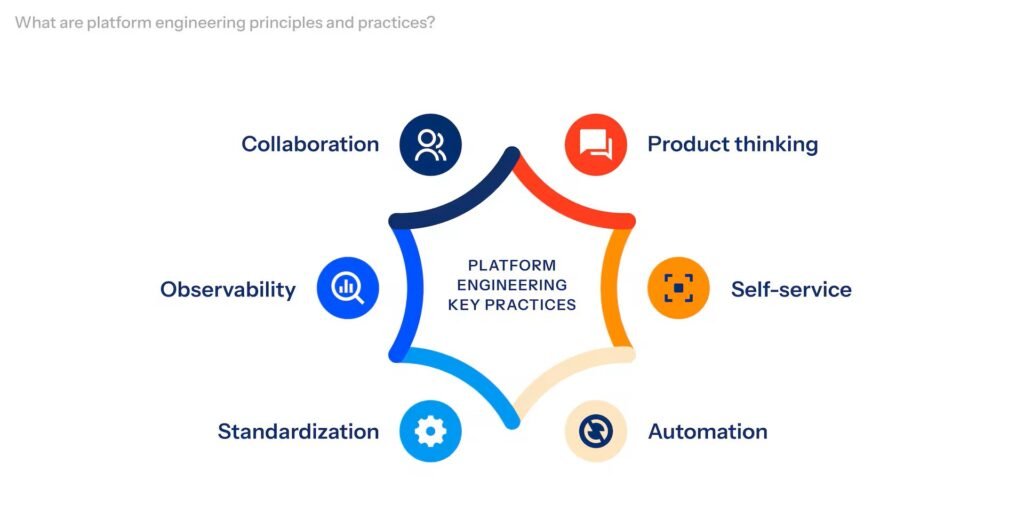
Platform engineering can also help businesses standardize security.
Instead of expecting every developer to remember every security requirement, platforms can incorporate controls into standard workflows.
For example, an application template could automatically include:
- Approved container images
- Security scanning
- Secret management
- Identity controls
- Network policies
- Logging
- Audit trails
- Compliance checks
This creates a model sometimes described as paved-road security.
Security becomes part of the development workflow rather than a separate process that happens after development.
Platform Engineering Can Improve Engineering Efficiency
The business case for platform engineering often comes down to reducing repetitive work and improving developer productivity.
Imagine an organization with 50 engineering teams.
If every team independently creates deployment pipelines, monitoring configurations, infrastructure modules, and security controls, the company may effectively solve the same problems dozens of times.
A platform team can centralize common capabilities.
This can reduce duplication and create consistency across the organization.
The value is not only infrastructure cost savings.
It can also come from:
- Faster development
- Faster deployment
- Reduced operational overhead
- Fewer configuration errors
- Better security consistency
- Easier onboarding
- Improved developer experience
Platform Engineering and Kubernetes
Kubernetes has played an important role in the rise of platform engineering.
Kubernetes provides powerful capabilities for deploying and managing containerized applications.
However, Kubernetes itself can be complex.
Developers may not need to understand every Kubernetes object or operational detail to deploy an application successfully.
A platform can provide higher-level abstractions.
For example, instead of asking a developer to write complex Kubernetes configurations, a platform could provide:
Application Name
Runtime
CPU
Memory
Environment
Database
Deployment Strategy
The platform translates these inputs into the necessary infrastructure configuration.
This makes Kubernetes capabilities more accessible without requiring every developer to become a Kubernetes specialist.
The Role of Automation and Infrastructure as Code
Platform engineering relies heavily on automation.
Infrastructure as code allows organizations to define infrastructure in reproducible, version-controlled configurations.
Automation can then use these definitions to create and manage environments consistently.
Common platform capabilities may include:
- Automated provisioning
- Environment creation
- Deployment automation
- Configuration management
- Policy enforcement
- Infrastructure testing
- Resource lifecycle management
This reduces the amount of manual work required to operate complex environments.
Measuring Platform Engineering Success
A platform should not be judged only by how much infrastructure it manages.
Organizations need to measure whether the platform actually improves developer outcomes.
Potential metrics include:
Developer Onboarding Time
How long does it take a new developer or team to become productive?
Time to First Deployment
How long does it take to create and deploy a new application?
Deployment Frequency
How frequently can teams safely release software?
Lead Time for Changes
How long does it take for code to move from development to production?
Platform Adoption
How many teams are actively using the platform?
Developer Satisfaction
Do developers find the platform useful and easy to use?
Operational Reliability
Does the platform reduce deployment failures and operational incidents?
These metrics help organizations determine whether platform engineering is solving real problems.
Common Platform Engineering Mistakes
Platform engineering can fail when organizations treat it purely as an infrastructure project.
One common mistake is building a platform without talking to developers.
Another is creating excessive abstraction.
If developers cannot understand what the platform is doing or cannot troubleshoot problems, the platform may create new frustrations.
Organizations can also build too much too early.
A platform does not need to provide every possible capability from day one.
It is often better to identify a small number of high-value developer workflows and improve them first.
Finally, platform teams should avoid forcing every team into an identical architecture when business requirements differ.
Standardization is valuable, but flexibility remains important.
How to Start a Platform Engineering Initiative
Organizations considering platform engineering can take a gradual approach.
1. Identify Developer Pain Points
Talk to developers and identify repetitive tasks that consume significant time.
2. Prioritize Common Workflows
Focus on workflows shared across multiple teams.
3. Build a Minimum Viable Platform
Start with a small number of useful capabilities.
For example:
- Application templates
- CI/CD
- Environment provisioning
- Observability
- Security defaults
4. Create Golden Paths
Build standardized workflows for common application types.
5. Gather Developer Feedback
Treat developers as platform customers and continuously collect feedback.
6. Measure Outcomes
Track deployment speed, adoption, reliability, and developer experience.
7. Expand Incrementally
Add capabilities based on actual demand rather than theoretical requirements.
The Future of Platform Engineering
The role of platform engineering is likely to expand as software environments become more sophisticated.
Cloud infrastructure, AI workloads, Kubernetes, distributed systems, data platforms, and security requirements all introduce additional complexity.
Organizations will need ways to make this complexity manageable for developers.
At the same time, internal platforms are likely to become increasingly intelligent and automated.
Developers may eventually interact with platforms through increasingly simple interfaces while automation handles provisioning, configuration, security, observability, and compliance behind the scenes.
The underlying infrastructure may become more complex while the developer experience becomes simpler.
That is one of the central promises of platform engineering.
Conclusion
Modern software development gives businesses enormous flexibility, but that flexibility can also create significant complexity.
Developers are increasingly expected to work across applications, infrastructure, cloud services, security, deployment systems, and operational tooling.
Platform engineering provides a way to manage that complexity.
By creating internal developer platforms, standardized workflows, automation, golden paths, and self-service capabilities, organizations can give developers more autonomy without abandoning governance or consistency.
The goal is not to hide infrastructure from developers completely.
It is to provide the right level of abstraction so developers can focus on building valuable software rather than repeatedly solving the same infrastructure problems.
For businesses investing in cloud-native development, platform engineering is therefore becoming more than an infrastructure trend.
It is a strategy for improving developer productivity, software delivery, operational consistency, security, and the overall economics of engineering.
The organizations that approach internal platforms as products—with developers as their customers—can create a development environment where complex technology becomes easier to use, easier to govern, and easier to scale.




Leave a Reply