

Table of Contents
- What Is an API-First Business?
- Why Connected Systems Matter More in B2B
- APIs Turn Business Functions Into Reusable Capabilities
- Faster Digital Product Development
- APIs Can Improve Customer Experience
- The Role of APIs in B2B Automation
- API-First Architecture and Artificial Intelligence
- APIs and the Rise of Digital Ecosystems
- APIs Can Reduce Integration Complexity
- The Importance of API Governance
- Security Must Be Built Into the Architecture
- APIs Support a More Flexible Technology Strategy
- Measuring the Business Impact
- Moving From Application-Centric to Capability-Centric Thinking
- The Future of B2B Technology Is Connected
- Conclusion: Connectivity Is Becoming a Competitive Advantage
For years, businesses invested in software to solve individual problems.
Customer relationship management systems helped sales teams manage leads. Enterprise resource planning platforms handled finance and operations. Human resource systems managed employees. E-commerce platforms supported digital sales while analytics platforms helped organizations understand their performance.
Each system served a purpose.
The challenge emerged when businesses needed these systems to work together.
A customer places an order on a website. The sales system needs to know about it. The inventory system needs to update stock levels. The finance platform needs transaction information. The warehouse needs fulfillment details. The customer service team needs visibility into the order.
If these systems cannot communicate efficiently, the business becomes dependent on manual processes, duplicate data and complex integrations.
This is why the API-first business model is becoming increasingly important.
An API-first approach puts connectivity at the center of technology architecture. Instead of treating integrations as something added after applications are built, businesses design APIs as core components of their digital infrastructure.
The result is an enterprise that can connect systems more easily, reuse existing capabilities and respond faster to changing business requirements.
In B2B markets where speed, efficiency and adaptability increasingly determine competitiveness, connected systems are becoming more than an IT advantage.
They are becoming a business advantage.
What Is an API-First Business?
An API, or application programming interface, allows different software systems to communicate with one another.
An API defines how one system can request information or perform an action through another system.
For example, an inventory API could allow a sales platform to check whether a product is available. A payment API could allow an e-commerce platform to initiate a transaction. A customer API could allow multiple applications to retrieve approved customer information.
The applications do not need to know how the underlying systems work.
They simply communicate through defined interfaces.
An API-first business takes this concept further.
Rather than building an application first and deciding later how it should connect to other systems, the organization considers APIs from the beginning.
Business capabilities are designed to be accessible, reusable and secure.
This creates a technology environment where applications are not isolated islands. They become connected components within a broader digital ecosystem.
Why Connected Systems Matter More in B2B
B2B organizations often operate with complex processes involving multiple departments, applications and external partners.
A single transaction can move through sales, finance, procurement, logistics, customer service and compliance.
When these functions depend on disconnected systems, every handoff creates friction.
Employees may need to copy information from one application to another. Teams may maintain separate versions of customer records. Partners may rely on spreadsheets or manual file exchanges.
These processes can work when transaction volumes are low.
As the business grows, however, manual coordination becomes expensive.
The problem is not simply inefficiency.
Disconnected systems can also slow down decision-making.
If a sales team does not have access to current inventory data, it may make inaccurate commitments. If customer service cannot see order information, representatives may struggle to resolve issues quickly. If finance receives transaction data late, reporting can become less timely.
Connectivity brings these processes closer together.
When systems can exchange information automatically, organizations can reduce unnecessary handoffs and create more consistent workflows.
APIs Turn Business Functions Into Reusable Capabilities
One of the most powerful ideas behind API-first architecture is that business capabilities can become reusable.
Consider a company that has developed a customer identity service.
Instead of building customer identity functionality separately into every application, the organization can expose that capability through an API.
The website can use it.
The mobile application can use it.
The customer service platform can use it.
Partner applications can potentially use it with appropriate authorization.
The same business capability becomes available across multiple channels.
This creates leverage.
Organizations do not have to rebuild the same functionality every time they introduce a new application or customer experience.
The same principle can apply to:
- Payments
- Customer profiles
- Product catalogs
- Pricing
- Inventory
- Shipping
- Authentication
- Notifications
- Order management
- Account management
When these capabilities are accessible through reliable APIs, new products can be assembled more quickly.
Faster Digital Product Development
Speed has become one of the strongest arguments for API-first architecture.
Traditional enterprise systems can be highly interconnected at the code and database level. A change in one application may require extensive coordination with another system.
This creates dependencies that slow development.
API-based architectures can provide a cleaner boundary between systems.
A development team can build a new application around existing APIs rather than recreating every business function from scratch.
Imagine a B2B company wants to launch a new customer portal.
The portal needs customer information, account details, order history, invoices and payment capabilities.
Without reusable APIs, the development team may need to build custom integrations for each requirement.
With an API-first architecture, the team can connect to existing services.
The result can be a shorter development cycle.
This does not mean APIs automatically make every project simple. Poorly designed APIs can create their own problems. However, well-designed interfaces can significantly reduce duplication and allow teams to work more independently.
APIs Can Improve Customer Experience
Customer experience is often discussed in terms of design, personalization and usability.
Technology connectivity is just as important.
A B2B customer may interact with a company through multiple channels. They might place an order through a portal, contact an account manager by email, speak to customer support and later access invoices through another system.
Customers do not think about these as separate applications.
They think about them as interactions with the same company.
If each system has different information, the experience can feel fragmented.
API-driven connectivity can help create a more consistent experience.
A customer service representative can access current order information. A customer portal can display the latest account status. A sales representative can see relevant customer activity.
The customer does not necessarily see the APIs.
They experience the result of the connections.
The Role of APIs in B2B Automation
Automation is another major benefit of connected systems.
Many enterprise processes involve repetitive actions between applications.
A new order is received.
Inventory needs to be updated.
A fulfillment request needs to be created.
The customer needs a notification.
Finance needs transaction information.
A shipment needs to be tracked.
Without system connectivity, employees may coordinate these actions manually.
With APIs, many of these steps can be automated.
For example, an order API can trigger downstream fulfillment processes. A payment confirmation can initiate an invoice workflow. A shipping API can provide real-time delivery updates.
The more business processes that can communicate automatically, the less employees need to spend time transferring information between systems.
This does not mean every process should be fully automated.
Human oversight remains important for decisions that require judgment.
The goal is to automate repetitive coordination while allowing employees to focus on higher-value activities.
API-First Architecture and Artificial Intelligence
The growth of enterprise AI is making API connectivity even more important.
AI systems need access to business data and business actions to become genuinely useful.
A large language model can understand a customer question.
But understanding the question is only the beginning.
To resolve the issue, an AI system may need to retrieve an account record, check an order, review a product’s availability or initiate an approved workflow.
APIs provide the connection between AI and those business capabilities.
This means an AI assistant does not necessarily need direct access to internal databases.
Instead, it can interact with controlled APIs.
For example, a customer service AI could:
- Understand the customer’s request.
- Authenticate the interaction.
- Retrieve relevant account information.
- Check order status through an API.
- Determine whether a predefined action is permitted.
- Initiate the action through an approved API.
- Communicate the result to the customer.
This architecture creates a clear separation between intelligence and execution.
The AI interprets and reasons.
APIs provide controlled access to business capabilities.
As AI agents become more common, this relationship will become increasingly important.
APIs and the Rise of Digital Ecosystems
Modern B2B businesses rarely operate alone.
They work with distributors, suppliers, marketplaces, logistics providers, technology vendors and other partners.
The ability to connect with these organizations can influence how quickly an ecosystem can grow.
APIs make these connections more scalable.
A logistics provider can expose shipment tracking capabilities to customers.
A financial services company can provide payment services to software platforms.
A manufacturer can make product information available to authorized distributors.
A SaaS company can allow customers to integrate its functionality into their own applications.
This creates a shift from software as a standalone product toward software as a connected capability.
The API becomes a bridge between organizations.
In some cases, APIs can even become part of a company’s commercial strategy.
A business can create new revenue opportunities by allowing partners to access specific capabilities through controlled interfaces.
APIs Can Reduce Integration Complexity
Enterprise integration has traditionally been complicated.
Different systems may use different technologies, data structures and communication standards.
APIs can provide standardized interfaces that reduce some of this complexity.
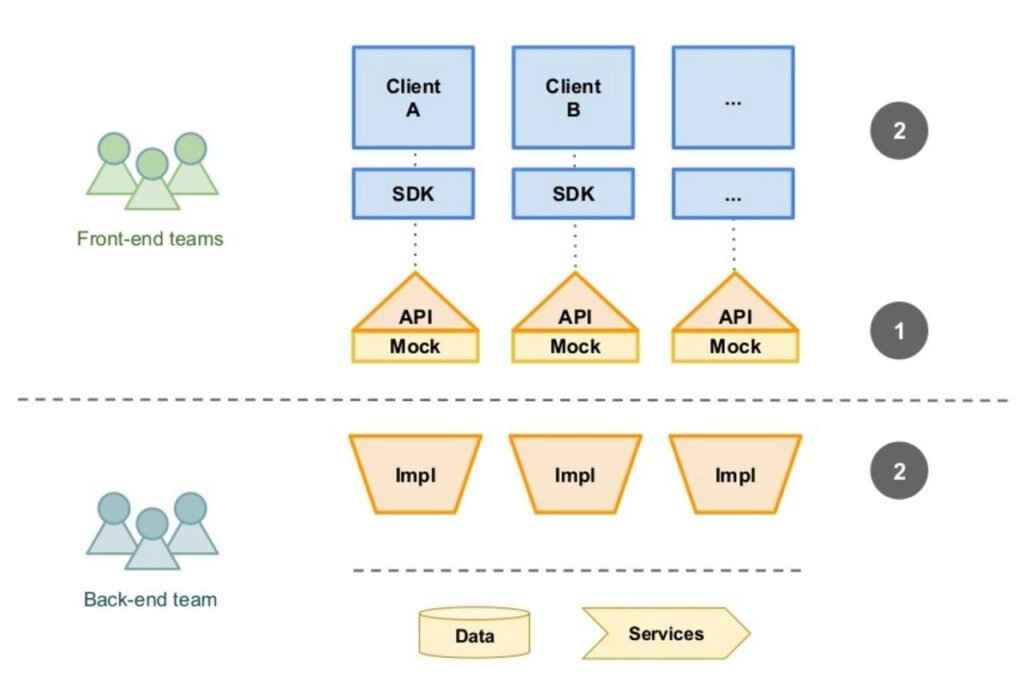
Instead of requiring one system to understand the internal architecture of another, each system can interact through a defined contract.
This abstraction is important.
A company may eventually replace its underlying customer database.
If other applications interact through a stable customer API, those applications may not need to change significantly.
The interface remains consistent while the implementation evolves behind it.
This creates a degree of technological flexibility.
Businesses can modernize individual systems without necessarily rebuilding the entire technology environment at once.
The Importance of API Governance
The more APIs an organization creates, the more important governance becomes.
An enterprise cannot simply create hundreds of interfaces without standards.
APIs need clear ownership, documentation, security policies and lifecycle management.
Organizations should establish standards for:
- API naming
- Authentication
- Authorization
- Versioning
- Documentation
- Monitoring
- Error handling
- Rate limiting
- Data access
- Deprecation
An API catalog can also help developers discover existing capabilities.
This is particularly important in large organizations.
Without visibility, multiple teams may create similar APIs because they do not know that another team has already built the required capability.
Good governance turns a collection of APIs into an organized digital platform.
Security Must Be Built Into the Architecture
Connectivity creates opportunities, but it also creates risk.
Every API can become a potential access point to business systems and data.
Security therefore needs to be considered from the beginning.
Authentication should establish who is making a request.
Authorization should determine what that user or application is allowed to access.
Sensitive information should be protected during transmission and storage.
Organizations should also monitor API activity for unusual patterns and potential abuse.
Access should follow the principle of least privilege.
If an application only needs to retrieve order status, it should not automatically have permission to modify customer accounts or initiate refunds.
A connected enterprise needs controlled connectivity.
The goal is not simply to connect everything to everything.
It is to create secure and purposeful connections.
APIs Support a More Flexible Technology Strategy
One of the hidden benefits of API-first architecture is flexibility.
Technology changes quickly.
Businesses may replace CRM platforms, modernize ERP systems, adopt new AI solutions or introduce new customer channels.
A tightly coupled environment can make these changes difficult.
A well-designed API layer can create a level of abstraction between applications.
This allows organizations to modernize incrementally.
For example, a company may replace its legacy payment system without forcing every application that processes payments to be rewritten immediately.
If those applications communicate through a stable payment API, the underlying payment service can potentially change behind the interface.
This can reduce the risk and complexity associated with modernization.
Measuring the Business Impact
API-first initiatives should not be evaluated solely by technical metrics.
Business leaders need to understand what the architecture enables.
Useful measures can include:
- Time to launch new digital products
- Time required to integrate new partners
- Development effort per integration
- Percentage of automated processes
- Developer productivity
- Customer service resolution time
- Digital transaction completion rates
- Number of reusable business capabilities
- Cost of maintaining integrations
- System availability
For example, if an organization can onboard a new B2B partner in days rather than weeks because standardized APIs are available, that is a measurable business benefit.
If developers can launch a new customer experience by reusing existing services, that creates another source of value.
Technology becomes strategically important when it changes the speed and economics of the business.
Moving From Application-Centric to Capability-Centric Thinking
Perhaps the biggest change introduced by API-first architecture is a shift in mindset.
Traditional enterprise thinking often starts with applications.
What CRM should we buy?
What ERP platform should we implement?
What customer portal should we build?
An API-first approach encourages organizations to think in terms of capabilities.
How should customer identity work?
How should pricing be accessed?
How should orders be created?
How should inventory information be shared?
How should payments be processed?
Once these capabilities are clearly defined, applications become consumers of those capabilities.
This makes the architecture more modular.
It also changes how organizations approach innovation.
Instead of building every new digital experience from scratch, teams can combine existing capabilities in new ways.
That can make experimentation faster and less expensive.
The Future of B2B Technology Is Connected
The B2B technology landscape is becoming increasingly interconnected.
AI agents need access to business systems.
Digital products need to communicate with backend services.
Partners need real-time information.
Customers expect consistent experiences across channels.
Employees need access to accurate data wherever they work.
None of these trends can be addressed effectively through isolated applications.
Connectivity has become foundational.
APIs provide one of the most important mechanisms for creating that connectivity.
But the larger opportunity is not simply technical.
An API-first business can become more responsive because its systems can communicate more effectively. It can launch products faster because teams can reuse existing capabilities. It can automate processes because applications can trigger actions across systems. It can integrate partners more efficiently because standardized interfaces reduce friction.
These capabilities can compound over time.
Every reusable API can become a building block for future products and processes.
Every successful integration can reduce future integration effort.
Every automated workflow can free employees from repetitive coordination.
The value grows as the network of connected capabilities grows.
Conclusion: Connectivity Is Becoming a Competitive Advantage
The next generation of B2B technology will not be defined simply by how many applications an organization uses.
It will be defined by how effectively those applications, services and data sources work together.
An API-first approach provides a foundation for that connected enterprise.
It allows organizations to expose business capabilities in reusable ways. It can accelerate product development, improve customer experiences, enable automation and simplify ecosystem integration.
It also creates a stronger foundation for emerging technologies such as AI.
The organizations that benefit most will not necessarily be those that connect everything indiscriminately.
They will be the ones that identify their most valuable business capabilities, expose them securely and make them reusable across the enterprise.
That is the real promise of the API-first business.
It is not simply about better integrations.
It is about building a business that can adapt faster.
In a B2B environment where customers expect seamless experiences, partners expect instant connectivity and technology changes at an accelerating pace, the ability to connect systems effectively can become a defining competitive advantage.
The future belongs to businesses that do not just have digital systems.
It belongs to businesses whose digital systems can work together.





Leave a Reply