


Table of Contents
- What Is Just-in-Time Access?
- Understanding Standing Privileges
- Why Standing Privileges Are Dangerous
- How Just-in-Time Access Works
- Key Components of a JIT Access System
- Benefits of Just-in-Time Access
- JIT Access and Zero Trust Security
- High-Risk Environments That Need JIT
- Common Challenges and How to Overcome Them
- Best Practices for Just-in-Time Access
- Real-World Use Cases
- The Role of AI and Automation in JIT Access
- Just-in-Time Access and Compliance
- Measuring the Success of JIT Access
- Future Trends in Just-in-Time Access
- Conclusion
What Is Just-in-Time Access?
Just-in-Time (JIT) Access is a security model that provides users with elevated permissions only when they need them and revokes those permissions automatically after a predefined duration.
Instead of assigning permanent administrator rights, users request temporary access for a specific task. The request typically goes through authentication, authorization, approval workflows, and policy evaluation before access is granted.
For example:
A database administrator needs elevated privileges to perform server maintenance.
Instead of maintaining 24/7 administrator rights, they submit an access request.
The request is approved.
Administrator rights are granted for one hour.
After maintenance is complete—or when the time expires—the elevated privileges are automatically removed.
The result is dramatically lower security risk while maintaining operational efficiency.
Understanding Standing Privileges
Standing privileges are permanent or long-term administrative permissions assigned to users, applications, or service accounts.
Examples include:
- Domain Administrators
- Cloud Subscription Owners
- Database Administrators
- Linux Root Access
- Network Administrator Accounts
- Kubernetes Cluster Admins
- Azure Global Administrators
- AWS IAM Administrators
Many organizations grant these permissions once and never review them again.
Employees change roles.
Contractors leave.
Projects end.
Applications evolve.
Yet privileged accounts often remain active for months—or years.
This accumulation of unnecessary privileges creates significant cybersecurity risks.
Why Standing Privileges Are Dangerous
1. Increased Attack Surface
Every privileged account becomes a potential entry point for attackers.
Even one compromised administrator account can lead to:
- Full domain compromise
- Data theft
- Ransomware deployment
- Cloud takeover
- Credential harvesting
The more standing privileges exist, the larger the attack surface.
2. Credential Theft
Cybercriminals actively target privileged credentials through:
- Phishing attacks
- Malware
- Keyloggers
- Browser credential theft
- Password spraying
- Session hijacking
If those credentials belong to a permanent administrator account, attackers immediately gain elevated access.
3. Insider Threats
Not every threat originates outside the organization.
Disgruntled employees, careless administrators, or malicious contractors may misuse privileged access to:
- Delete critical data
- Copy confidential information
- Disable security controls
- Install unauthorized software
Limiting privileged access windows greatly reduces these risks.
4. Compliance Issues
Many regulations require organizations to minimize privileged access, including:
- GDPR
- HIPAA
- PCI DSS
- ISO 27001
- SOC 2
- NIST Cybersecurity Framework
Standing privileges often violate least privilege principles, making compliance audits more difficult.
How Just-in-Time Access Works
A mature JIT access workflow generally follows these steps.
Step 1: User Requests Access
An employee requests temporary elevated permissions.
The request specifies:
- Resource
- Duration
- Reason
- Required role
Example:
“I need administrator rights for the finance server for 45 minutes to install a security patch.”
Step 2: Identity Verification
The identity platform verifies:
- User identity
- Multi-factor authentication
- Device trust
- Geographic location
- Risk score
High-risk requests may require additional verification.
Step 3: Policy Evaluation
Access policies determine whether the request meets organizational requirements.
Policies may consider:
- Business hours
- Device compliance
- User department
- Security clearance
- Sensitivity of the resource
- Threat intelligence
Step 4: Approval
Organizations may implement:
- Automatic approval
- Manager approval
- Security approval
- Change management approval
Low-risk requests are often automated.
Critical systems may require multiple approvers.
Step 5: Temporary Privilege Assignment
The system grants elevated permissions.
Examples include:
- Local administrator rights
- Azure role assignment
- AWS IAM role
- Kubernetes admin role
- Database administrator role
Importantly, the permissions are temporary.
Step 6: Session Monitoring
Modern PAM platforms monitor privileged sessions in real time.
They record:
- Commands executed
- Files accessed
- Configuration changes
- Login activity
- Screen recordings
- Session duration
Continuous monitoring supports forensic investigations and accountability.
Step 7: Automatic Revocation
After the approved time expires:
- Administrator rights disappear
- Tokens expire
- Sessions terminate
- Temporary credentials become invalid
No manual cleanup is required.
Key Components of a JIT Access System
Successful JIT implementations rely on several interconnected technologies.
Identity and Access Management (IAM)
IAM verifies user identities and manages authentication before granting access.
It acts as the foundation of JIT security.
Privileged Access Management (PAM)
PAM solutions manage privileged accounts, monitor administrator activity, and automate temporary privilege assignments.
JIT is often delivered as a core capability within modern PAM platforms.
Multi-Factor Authentication (MFA)
MFA ensures attackers cannot obtain privileged access using stolen passwords alone.
Common authentication factors include:
- Authenticator apps
- Hardware security keys
- Biometrics
- SMS codes (where appropriate)
- Push notifications
Policy Engine
A policy engine determines whether access should be granted based on predefined rules.
Examples include:
- Time restrictions
- Device health
- Risk score
- User role
- Resource sensitivity
Audit Logging
Every privileged request should generate detailed logs including:
- Who requested access
- When access was granted
- Why it was needed
- Duration
- Activities performed
- Automatic revocation time
These logs simplify compliance and incident investigations.
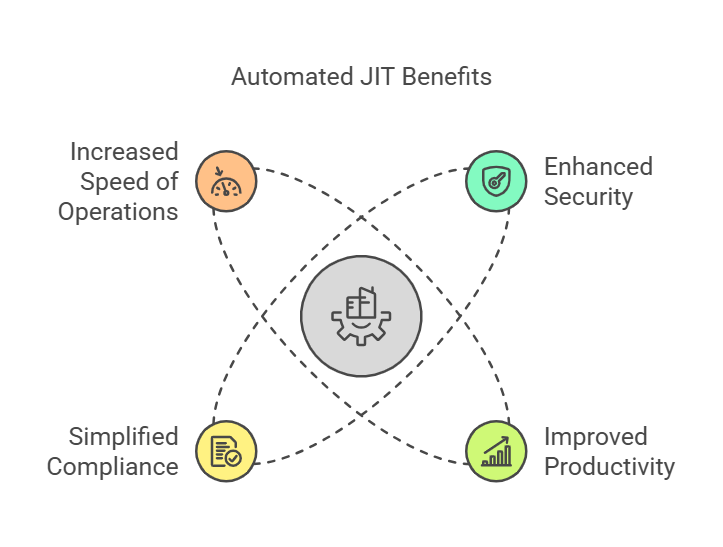
Benefits of Just-in-Time Access
1. Reduced Attack Surface
Since privileged accounts exist only temporarily, attackers have fewer opportunities to exploit them.
This significantly lowers organizational risk.
2. Stronger Security
JIT limits privilege escalation.
Even if attackers steal user credentials, they still need to obtain temporary approval before receiving administrative rights.
3. Improved Compliance
JIT supports compliance requirements by demonstrating:
- Least privilege
- Access control
- Auditability
- Accountability
- Continuous monitoring
Organizations can produce detailed audit records during assessments.
4. Lower Insider Risk
Employees receive administrative rights only when necessary.
This minimizes opportunities for accidental or intentional misuse of privileged access.
5. Better Operational Visibility
Security teams gain complete visibility into:
- Who accessed privileged systems
- Why access was requested
- What actions were performed
- When privileges expired
This improves governance and simplifies investigations.
JIT Access and Zero Trust Security
Zero Trust is based on the principle of “never trust, always verify.” Every access request is continuously evaluated rather than assumed to be safe.
Just-in-Time access complements Zero Trust by ensuring that privileged permissions are not permanently assigned. Each request is verified in real time using factors such as user identity, device health, location, risk signals, and authentication strength.
For example, a cloud engineer who normally works from a managed corporate laptop may receive temporary administrative access after successfully completing MFA. However, if the same request originates from an unmanaged device in an unfamiliar location, the policy engine can deny or require additional approval before granting access.
Together, Zero Trust and JIT reduce both the likelihood and impact of credential compromise by making privileged access contextual, temporary, and continuously validated.
High-Risk Environments That Need JIT
While JIT access is valuable across industries, it is especially important in environments where privileged accounts can have widespread consequences.
Financial Services
Banks, insurance providers, and payment processors manage highly sensitive customer and financial data. Temporary privileged access helps reduce fraud risks and supports compliance with stringent regulatory requirements.
Healthcare
Hospitals and healthcare providers store electronic health records, medical imaging, and research data. Limiting administrative privileges protects patient privacy and helps meet healthcare security standards.
Government and Defense
Government agencies often manage classified systems and critical infrastructure. JIT access limits unnecessary exposure of high-value administrative accounts and strengthens national security operations.
Cloud-Native Organizations
Organizations running workloads across multiple cloud platforms frequently use privileged identities for infrastructure management. JIT minimizes long-lived cloud permissions, reducing the risk of cloud account compromise.
Critical Infrastructure
Energy providers, utilities, transportation networks, and manufacturing facilities rely on operational technology (OT) and industrial control systems (ICS). Temporary privileged access reduces the chances of unauthorized changes that could disrupt essential services.
Implementing Just-in-Time Access Successfully
Adopting Just-in-Time (JIT) access is more than deploying a new security tool—it requires a thoughtful strategy that aligns people, processes, and technology. Organizations should begin by understanding where privileged access exists, who uses it, and whether those permissions are truly necessary.
1. Discover Privileged Accounts
The first step is to identify all privileged identities across the organization. These may include:
- Domain administrator accounts
- Cloud administrators
- Database administrators
- Linux root accounts
- Service accounts
- Application accounts
- Emergency or “break-glass” accounts
- Third-party vendor accounts
Many organizations are surprised to discover hundreds or even thousands of privileged accounts that have accumulated over time.
2. Inventory Critical Systems
Not every system requires the same level of protection. Prioritize resources based on business impact and sensitivity, such as:
- Active Directory
- Cloud management consoles
- Production databases
- Financial systems
- HR platforms
- Customer data repositories
- Kubernetes clusters
- Network infrastructure
- Backup systems
Classifying assets helps define where JIT access should be implemented first.
3. Define Access Policies
Well-defined policies ensure consistency and reduce unnecessary approvals. Policies should specify:
- Who can request privileged access
- Which systems require approval
- Maximum access duration
- Required authentication methods
- Conditions for automatic approval
- Circumstances requiring manual review
For example, a policy may allow developers to receive temporary access to development servers automatically while requiring security team approval for production environments.
4. Integrate Multi-Factor Authentication
JIT access should always be paired with strong authentication. Even if an attacker steals a user’s password, additional verification significantly reduces the likelihood of unauthorized privileged access.
Organizations should require MFA before granting elevated permissions, especially for sensitive systems.
5. Automate Provisioning and Revocation
Automation is essential for an effective JIT strategy.
Instead of manually assigning administrator rights, organizations should automate:
- Access requests
- Policy validation
- Role assignments
- Session creation
- Session recording
- Automatic privilege removal
Automation minimizes human error while improving operational efficiency.
6. Monitor and Audit Every Session
Every privileged session should be logged and monitored.
Key audit information includes:
- User identity
- Request justification
- Approval details
- Session start and end time
- Commands executed
- Files accessed
- Configuration changes
- Privilege expiration
Detailed audit logs improve incident response, compliance reporting, and forensic investigations.
Common Challenges and How to Overcome Them
Although JIT access provides substantial security benefits, organizations may encounter challenges during implementation.
User Resistance
Employees accustomed to permanent administrator rights may perceive JIT as an obstacle.
Solution:
Provide training, explain the security benefits, and streamline approval workflows to minimize delays.
Legacy Applications
Older applications may rely on permanent administrative privileges.
Solution:
Modernize applications where possible or implement compensating controls until permanent changes can be made.
Operational Delays
Manual approval processes can slow down critical maintenance activities.
Solution:
Use risk-based policies and automated approvals for low-risk requests while reserving manual approvals for highly sensitive resources.
Complex Hybrid Environments
Organizations often operate across on-premises infrastructure, multiple cloud providers, and SaaS applications.
Solution:
Choose identity and privileged access solutions capable of managing permissions consistently across hybrid and multi-cloud environments.
Emergency Access Requirements
Critical incidents sometimes require immediate administrative access.
Solution:
Implement secure “break-glass” accounts with strict monitoring, time limitations, and post-incident reviews.
Best Practices for Just-in-Time Access
To maximize the effectiveness of JIT access, organizations should follow these best practices:
Apply the Principle of Least Privilege
Grant only the minimum permissions necessary to complete a task. Avoid assigning broad administrator roles when limited permissions are sufficient.
Keep Access Windows Short
Shorter access durations reduce opportunities for misuse. Whenever possible, grant privileges for minutes rather than hours.
Require Strong Authentication
Use phishing-resistant MFA, device compliance checks, and conditional access policies before granting elevated permissions.
Continuously Review Policies
Business requirements change over time. Regularly review access policies to ensure they remain appropriate and aligned with organizational needs.
Monitor User Behavior
Behavior analytics can detect unusual activities such as:
- Privileged access at unusual hours
- Access from unfamiliar locations
- Excessive privilege requests
- Unusual command execution
- Rapid configuration changes
Early detection enables security teams to investigate suspicious behavior before it escalates.
Record Privileged Sessions
Session recording provides valuable evidence during investigations and promotes accountability among privileged users.
Remove Unused Privileges
Conduct periodic reviews to eliminate dormant accounts, obsolete roles, and unnecessary permissions.
Real-World Use Cases
Cloud Infrastructure Management
A cloud engineer needs temporary access to deploy updates to a production environment.
Instead of maintaining permanent cloud administrator privileges, they request a one-hour administrative role. Once deployment is complete, the privileges are automatically revoked.
Database Maintenance
A database administrator performs scheduled maintenance during a maintenance window.
JIT grants elevated permissions only for the approved maintenance period, reducing the risk of credential misuse outside that window.
Third-Party Vendor Support
An external vendor requires temporary access to troubleshoot an application.
Rather than creating a permanent privileged account, the organization grants time-limited access that expires automatically after the support session ends.
DevOps Operations
Developers occasionally need elevated permissions to troubleshoot production issues.
With JIT access, they receive temporary privileges only after approval, ensuring development teams retain agility without compromising security.
Incident Response
During a cybersecurity incident, responders often require rapid administrative access to isolate systems, collect forensic evidence, and restore operations.
JIT enables fast, monitored, and temporary privilege elevation while maintaining accountability throughout the response process.
The Role of AI and Automation in JIT Access
Artificial intelligence is increasingly enhancing identity security by making privileged access decisions more adaptive and risk-aware.
AI can:
- Analyze user behavior patterns
- Detect anomalous login attempts
- Evaluate device trust
- Calculate real-time risk scores
- Recommend approval decisions
- Trigger additional authentication when needed
- Identify privilege misuse
For example, if an employee typically requests administrator access during business hours from a managed corporate device, an identical request may be approved automatically. However, if the same employee requests access at an unusual time from an unfamiliar device in another country, AI-driven risk analysis can require additional verification or deny the request altogether.
Machine learning also improves privileged access governance by identifying unused permissions and recommending role optimization based on historical usage.
Just-in-Time Access and Compliance
Many regulatory frameworks emphasize strict control over privileged access. JIT helps organizations demonstrate compliance by providing:
- Time-bound administrative permissions
- Detailed audit trails
- Access request documentation
- Approval records
- Automated privilege revocation
- Continuous monitoring
- Strong authentication controls
These capabilities simplify audits and help organizations prove that privileged access is granted only when justified.
Measuring the Success of JIT Access
Organizations should establish key performance indicators (KPIs) to evaluate the effectiveness of their JIT implementation.
Common metrics include:
- Reduction in standing privileged accounts
- Number of temporary access requests
- Average approval time
- Percentage of automated approvals
- Privileged session duration
- Number of denied requests
- Privileged access policy violations
- Security incidents involving privileged accounts
- Audit findings related to privileged access
Tracking these metrics over time helps organizations identify improvement opportunities and demonstrate measurable security gains.
Future Trends in Just-in-Time Access
The future of privileged access management is increasingly intelligent, automated, and identity-centric.
Emerging trends include:
AI-Driven Risk Assessment
Artificial intelligence will continue to evaluate user behavior, contextual signals, and threat intelligence in real time to make more accurate access decisions.
Passwordless Privileged Access
Modern authentication methods such as biometrics, hardware security keys, and passkeys are reducing dependence on traditional passwords.
Continuous Authorization
Instead of evaluating access only at login, future systems will continuously assess user risk throughout the session and adjust permissions dynamically.
Identity Threat Detection and Response (ITDR)
Organizations are increasingly combining JIT with ITDR capabilities to detect identity-based attacks faster and respond before attackers can establish persistence.
Cloud-Native Privileged Access
As organizations expand across public, private, and hybrid cloud environments, JIT solutions will become more integrated with cloud identity platforms and infrastructure-as-code workflows.
Conclusion
Standing privileges have long been one of the most significant weaknesses in enterprise security. Permanent administrator rights increase the attack surface, create opportunities for insider misuse, and provide attackers with valuable targets. In today’s threat landscape, relying on always-on privileged access is no longer a sustainable security strategy.
Just-in-Time access offers a smarter approach by granting elevated permissions only when they are genuinely required and automatically removing them once the task is complete. Combined with the principles of least privilege, Zero Trust, multi-factor authentication, continuous monitoring, and privileged session auditing, JIT dramatically reduces organizational risk without sacrificing operational efficiency.
As cyber threats continue to evolve, organizations that embrace temporary, context-aware privileged access will be better positioned to protect critical assets, meet compliance requirements, and build a resilient identity security framework. Implementing JIT access is not merely a technological upgrade—it is a strategic investment in modern cybersecurity that strengthens both security and business continuity.




Leave a Reply