


Cybersecurity has reached an undeniable inflection point. For decades, the perimeter was king. Organizations built thick firewalls, monitored network boundaries, and assumed that once a user made it past the gateway, they were safe. Today, that perimeter has dissolved. With remote work, cloud migration, multi-cloud architectures, and the explosive growth of automated workflows, identity has become the new perimeter.
Unfortunately, threat actors have received the memo. Modern cyberattacks rarely rely on crashing through high-tech technical vulnerabilities or smashing zero-days. Instead, adversaries simply “log in” using valid credentials harvested via phishing, credential stuffing, session hijacking, or malicious OAuth applications. Once inside, they abuse overly permissive entitlements to move laterally, escalate privileges, and establish persistence before security teams even realize they have been breached.
Faced with a tsunami of identity alerts, security operations center (SOC) teams are drowning in noise. Traditional static reviews and rigid role-based access controls (RBAC) are no longer enough to protect modern enterprises. Enter Identity Risk Scoring—a dynamic, real-time approach that evaluates risk across all user and machine identities, allowing security teams to pinpoint, prioritize, and neutralize threats instantly.
The Anatomy of Modern Identity Threats
To understand why identity risk scoring is essential, we must first examine the shifting threat landscape. Attackers no longer need to break your security architecture; they manipulate it by targeting the weakest links in your identity ecosystem.
1. Human vs. Non-Human Identities (NHIs)
When most people think of identities, they think of human users: employees, contractors, and partners. However, modern enterprises are increasingly driven by Non-Human Identities (NHIs)—service accounts, API keys, bots, microservices, and CI/CD pipelines.
- The NHI Blind Spot: Non-human identities often outnumber human users by a factor of 10 to 1. They frequently possess high-level, persistent privileges and rarely undergo routine password rotations or multi-factor authentication (MFA) challenges. If a single service token is compromised, attackers gain unfettered, long-term access to backend infrastructure.
2. Credential Theft and Session Hijacking
Phishing has evolved far beyond poorly spelled emails. Modern adversaries use adversary-in-the-middle (AitM) phishing kits that bypass traditional MFA by intercepting session cookies in real-time. Once an attacker steals a valid session token, they can impersonate the user seamlessly, completely bypassing login screens and authentication challenges.
3. Rogue and Malicious Applications
Cloud ecosystems like Microsoft 365 and Google Workspace rely heavily on third-party integrations. Cybercriminals routinely deploy rogue OAuth applications that trick users into granting broad permissions (“Read all your emails,” “Access all files”). Once authorized, these apps act as silent, persistent backdoors that bypass standard conditional access policies.
What Is Identity Risk Scoring?
Identity Risk Scoring is the dynamic, continuous process of evaluating, quantifying, and ranking the risk level associated with every identity (human and non-human) within an organization.
Unlike legacy security assessments that rely on periodic, point-in-time audits (such as quarterly access reviews), real-time identity risk scoring leverages behavioral analytics, machine learning, and contextual intelligence to calculate a living risk score for every account.
Key Components of an Identity Risk Engine
An effective identity risk scoring framework does not look at login events in isolation. Instead, it aggregates and analyzes multiple dimensions of risk:
- Privilege Scope: What can this identity actually touch? An account with administrative access or “shadow admin” rights inherently carries a higher baseline risk score than a standard read-only user.
- Behavioral Baseline (Behavioral Entropy): How does this user normally behave? Machine learning models map typical login hours, geographical locations, device fingerprints, and application usage patterns. Deviations—such as a login from an unusual country combined with an immediate mass download of files—drastically spike the risk score.
- Asset Sensitivity: What is the value of the resources the identity is trying to access? Accessing a low-tier marketing folder generates minimal risk, whereas querying core financial databases or production source code repositories elevates the threat score immediately.
- Environmental and Contextual Anomalies: Factors such as impossible travel, concurrent sessions from disparate continents, or access requests originating from unmanaged, unpatched devices feed directly into the real-time calculation.
Why Traditional Access Reviews Fall Short
For years, compliance frameworks forced organizations to conduct periodic access reviews—often every 90 or 180 days. While these audits satisfy regulatory check-boxes, they are fundamentally broken when it comes to stopping active cyber threats.
[Static Quarterly Audit] ──> Too slow for modern attacks (Takes months)
[Real-Time Risk Scoring] ──> Instant detection & response (Takes seconds)
- The Speed Gap: Attackers move at machine speed. If an account is compromised on Tuesday, waiting until a quarterly review three months later to notice excessive privileges is catastrophic.
- The “Rubber Stamp” Problem: IT managers facing hundreds of line items during an access review often default to clicking “approve” on everything just to clear their queues, missing dangerous privilege creep.
- Lack of Context: Static reviews look at what permissions were assigned, not how those permissions are being used. A developer might legitimately need wide access, but if their account starts behaving erratically at 3:00 AM, a static review will never catch it.
The Business Value of Real-Time Threat Prioritization
Implementing identity risk scoring transforms a security operations center from a reactive, alert-fatigued group into a proactive, resilient defense unit.
1. Eliminating Alert Fatigue
Security teams are overwhelmed by thousands of low-fidelity alerts every day. Identity risk scoring acts as a smart filter. By consolidating disparate signals into a single, cohesive risk score per identity, analysts can immediately focus on the top 1% of anomalies that genuinely threaten the business, drastically reducing Mean Time to Detect (MTTD) and Mean Time to Respond (MTTR).
2. Transitioning to Adaptive Zero Trust
The core tenet of Zero Trust is “Never trust, always verify.” However, verifying every single transaction with maximum friction frustrates employees and stalls business productivity. Identity risk scoring enables adaptive trust. When a user’s risk score is low, they flow through their workday smoothly. When anomalous behavior causes their risk score to spike mid-session, the system dynamically enforces step-up authentication, restricts privileges, or terminates the session entirely.
3. Protecting the Cloud and Hybrid Attack Surface
As workloads shift fluidly across on-premises Active Directory (AD) and cloud identity providers like Microsoft Entra ID or Okta, unified risk scoring provides a single pane of glass. It bridges the visibility gap between legacy systems and modern SaaS applications, ensuring that orphaned accounts, stale credentials, and misconfigured permissions are flagged before exploitation occurs.
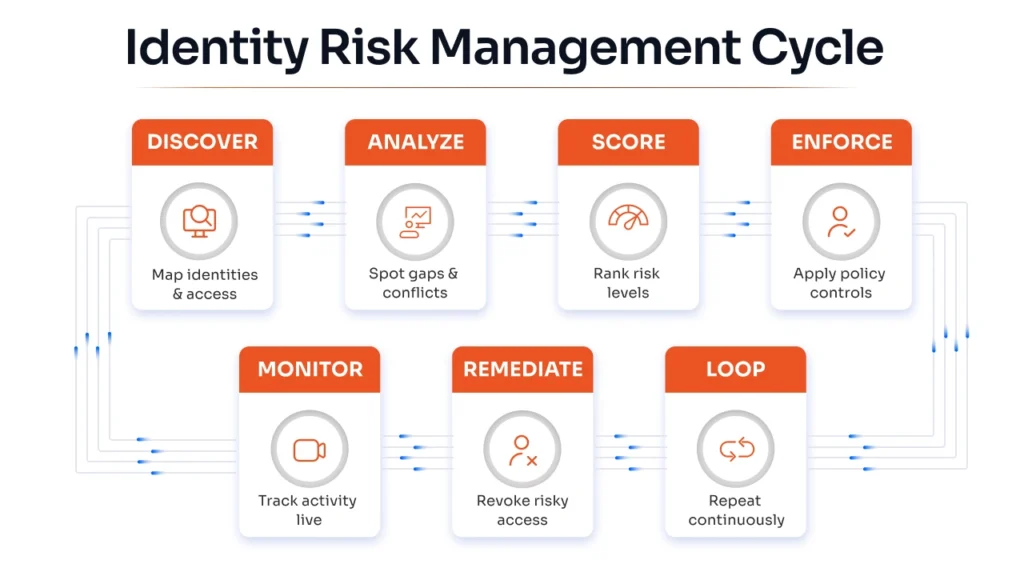
Step-by-Step Implementation Framework
Deploying an identity risk scoring model requires a structured, strategic approach. Organizations should avoid boiling the ocean and instead follow a phased implementation plan:
[1. Asset & Identity Discovery]
       │
       ▼
[2. Define Baseline Context]
       │
       ▼
[3. Integrate Telemetry Sources]
       │
       ▼
[4. Establish Automated Remediation]
Step 1: Comprehensive Discovery (Human & Non-Human)
You cannot secure what you cannot see. Begin by mapping out every single identity across your entire ecosystem—including cloud apps, service accounts, contractor logins, and legacy directories. Pay special attention to non-human identities and forgotten service tokens that often hold elevated privileges.
Step 2: Establish Context and Risk Thresholds
Work collaboratively with business units to classify data sensitivity and critical assets. Define what constitutes acceptable behavior versus anomalous deviation for different roles. Establish clear thresholds for your risk scores (e.g., Low, Medium, High, Critical).
Step 3: Integrate Telemetry and Security Tools
Feed real-time telemetry into your identity risk engine from multiple security layers, including:
- Endpoint Detection and Response (EDR)
- Security Information and Event Management (SIEM)
- Cloud Access Security Brokers (CASB)
- Identity Governance and Administration (IGA) platforms
Step 4: Enable Automated Remediation Playbooks
Detection without swift action leaves a massive window of opportunity for attackers. Configure automated response workflows for high-severity identity risk scores:
- Automatically revoke active sessions upon detection of impossible travel or token theft.
- Trigger mandatory step-up MFA when behavioral entropy spikes.
- Temporarily quarantine or reduce privileges for compromised service accounts pending human review.
Conclusion
Identity has officially replaced the network perimeter as the primary battleground in cybersecurity. As threat actors pivot heavily toward credential harvesting, session hijacking, and non-human identity exploitation, traditional static defenses and periodic audits are no longer sufficient.
Identity Risk Scoring provides the visibility, context, and agility required to outpace modern adversaries. By continuously evaluating behavioral patterns, privilege scopes, and environmental anomalies in real time, organizations can cut through alert noise, prioritize critical threats instantly, and transition toward a truly adaptive Zero Trust security model. In a world where attackers only need one compromised login to breach your network, real-time identity risk scoring ensures you are always one step ahead




Leave a Reply