


Table of Contents
- Introduction
- What is Privilege Creep?
- Why Privilege Creep is a Serious Enterprise Risk
- Root Causes of Privilege Creep in Enterprises
- How Privilege Creep Develops Over Time
- How to Detect Privilege Creep in Enterprises
- Tools Used to Detect Privilege Creep
- How to Eliminate Privilege Creep
- 1. Enforce the Principle of Least Privilege
- 2. Implement Role-Based and Attribute-Based Access Control
- 3. Automate Access Revocation
- 4. Conduct Continuous Access Reviews
- 5. Use Just-in-Time (JIT) Access
- 6. Adopt Zero Trust Architecture
- 7. Implement Strong Privileged Access Management (PAM)
- 8. Standardize Joiner-Mover-Leaver (JML) Processes
- 9. Reduce Manual Permission Grants
- 10. Eliminate Stale Permissions
- Best Practices to Prevent Privilege Creep
- Real-World Scenario of Privilege Creep
- The Role of Automation in Managing Privilege Creep
- Future of Privilege Management
- Conclusion
Introduction
Modern enterprises operate in highly dynamic digital environments where employees, contractors, service accounts, and third-party vendors continuously interact with critical systems. As organizations scale, so does their identity footprint. Employees change roles, projects evolve, tools get added or removed, and access permissions accumulate over time.
Amid this complexity lies a silent but dangerous security issue: privilege creep in enterprises.
Privilege creep occurs when users gradually accumulate access rights beyond what is necessary for their current job responsibilities. It often happens unintentionally and remains unnoticed until it creates a significant security risk. In many real-world breaches, privilege creep is not the direct cause—but it becomes the enabler that attackers exploit.
In this comprehensive guide, we will explore what privilege creep is, why it happens, how to detect it, and most importantly, how to eliminate it using modern identity and access management (IAM) strategies.
What is Privilege Creep?
Privilege creep refers to the gradual accumulation of unnecessary access rights by users over time. Instead of permissions being revoked when roles change or projects end, they continue to stack up.
For example:
- A developer temporarily granted admin access for debugging retains it long after the task is complete.
- An employee moves from finance to marketing but still retains access to financial systems.
- Contractors maintain access to internal tools even after their engagement ends.
Over time, these excess privileges create a broad attack surface.
In cybersecurity terms, privilege creep violates the principle of least privilege, which states that users should only have the minimum level of access required to perform their tasks.
Why Privilege Creep is a Serious Enterprise Risk
Privilege creep may seem harmless at first, but its long-term impact can be severe.
1. Expanded Attack Surface
The more privileges a user has, the more systems an attacker can access if that account is compromised. A single breached account can lead to lateral movement across the network.
2. Increased Risk of Insider Threats
Employees with excessive access may intentionally or unintentionally misuse sensitive data. Even well-meaning users can make mistakes that result in data exposure.
3. Regulatory Non-Compliance
Frameworks like GDPR, HIPAA, ISO 27001, and SOC 2 require strict access control mechanisms. Privilege creep can lead to audit failures and penalties.
4. Data Breaches and Financial Loss
Excess privileges increase the likelihood of unauthorized access to sensitive data, intellectual property, and financial systems.
5. Operational Complexity
Unmanaged permissions make it difficult for IT and security teams to track who has access to what, leading to inefficiencies and misconfigurations.
Root Causes of Privilege Creep in Enterprises
Understanding why privilege creep occurs is essential to preventing it.
1. Role Changes Without Access Reviews
Employees frequently shift roles, but their previous permissions are rarely revoked systematically.
2. Temporary Access That Becomes Permanent
IT teams often grant elevated privileges for short-term tasks but fail to remove them afterward.
3. Lack of Centralized IAM Governance
Without a centralized identity system, permissions become fragmented across systems.
4. Overly Permissive Default Policies
Some organizations grant broad access to avoid workflow delays, unintentionally encouraging privilege accumulation.
5. Shadow IT and Untracked Accounts
Employees create accounts in SaaS tools without IT oversight, leading to unmanaged permissions.
6. Infrequent Access Reviews
Periodic audits are often delayed, inconsistent, or manually intensive, leading to oversight.
How Privilege Creep Develops Over Time
Privilege creep does not happen overnight. It follows a predictable lifecycle:
- Initial Access Grant – User receives necessary permissions.
- Temporary Elevation – Additional privileges are granted for specific tasks.
- Role Transition – User changes role or project.
- Access Retention – Old permissions are not revoked.
- Accumulation Phase – Multiple unrevoked permissions stack up.
- Exposure Phase – Excess privileges are discovered during audits or breaches.
By the time it is detected, the risk has already multiplied.
How to Detect Privilege Creep in Enterprises
Detecting privilege creep requires a combination of tools, processes, and analytics.
1. Conduct Regular Access Reviews
One of the most effective methods is periodic access certification. Managers and system owners should verify:
- Who has access to what
- Whether access is still required
- Whether privileges align with job roles
2. Implement Role-Based Access Control (RBAC)
RBAC assigns permissions based on job roles instead of individuals. This makes it easier to detect deviations.
3. Use Identity and Access Management (IAM) Tools
Modern IAM solutions can:
- Track user permissions across systems
- Highlight unused or excessive privileges
- Automate access reviews
4. Analyze Activity Logs
Security Information and Event Management (SIEM) systems help identify:
- Rarely used privileged accounts
- Suspicious access patterns
- Dormant elevated permissions
5. Identify Orphaned and Dormant Accounts
Accounts that are inactive but still privileged are major risks.
6. Apply Access Mining Techniques
Access mining tools analyze real usage patterns to determine:
- What permissions users actually use
- Which privileges are unnecessary
7. Monitor Privileged Account Usage
Privileged Access Management (PAM) systems help track and control high-level access in real time.
Tools Used to Detect Privilege Creep
Enterprises often rely on a combination of tools:
- Identity Governance and Administration (IGA) platforms
- IAM solutions
- SIEM tools
- PAM systems
- Cloud security posture management (CSPM) tools
These tools work together to provide visibility into identity sprawl and privilege accumulation.
How to Eliminate Privilege Creep
Detection alone is not enough. Enterprises must actively eliminate and prevent privilege creep.
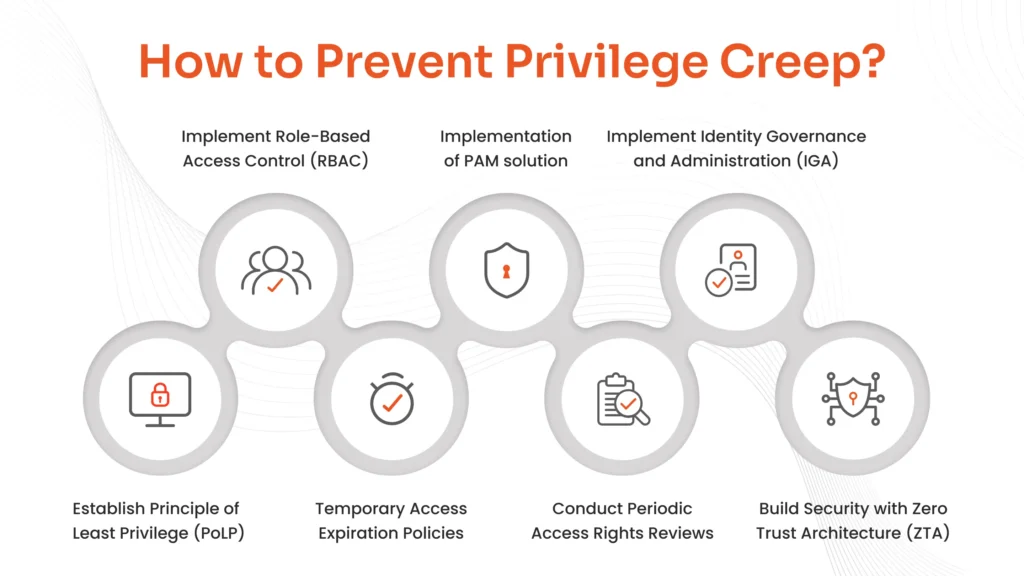
1. Enforce the Principle of Least Privilege
Every user should only have the minimum access required. This reduces unnecessary exposure.
2. Implement Role-Based and Attribute-Based Access Control
- RBAC: Access based on job role
- ABAC: Access based on attributes like location, device, and time
3. Automate Access Revocation
When employees change roles or leave the organization, their access should be automatically updated or revoked.
4. Conduct Continuous Access Reviews
Instead of annual audits, enterprises should adopt continuous monitoring systems.
5. Use Just-in-Time (JIT) Access
JIT access provides temporary elevated privileges that expire automatically after use.
6. Adopt Zero Trust Architecture
In a Zero Trust model:
- No user is trusted by default
- Access is continuously verified
- Least privilege is strictly enforced
7. Implement Strong Privileged Access Management (PAM)
PAM solutions help:
- Control admin accounts
- Monitor privileged sessions
- Enforce approval workflows
8. Standardize Joiner-Mover-Leaver (JML) Processes
A structured lifecycle management system ensures:
- Joiners get appropriate access
- Movers get updated access
- Leavers lose access immediately
9. Reduce Manual Permission Grants
Automating access provisioning reduces human error and inconsistency.
10. Eliminate Stale Permissions
Regular cleanup of unused permissions reduces risk exposure.
Best Practices to Prevent Privilege Creep
1. Maintain a Centralized Identity System
All access should flow through a single IAM system for visibility and control.
2. Define Clear Access Policies
Policies should define:
- Who gets access
- Why access is granted
- When access should be revoked
3. Educate Employees
Security awareness training helps employees understand the risks of excessive privileges.
4. Integrate IAM with HR Systems
Automating access changes based on HR events ensures real-time updates.
5. Regularly Audit Cloud Permissions
Cloud environments often suffer from unnoticed privilege accumulation.
6. Use Segregation of Duties (SoD)
No single user should have conflicting privileges that could enable fraud or abuse.
Real-World Scenario of Privilege Creep
Consider a mid-sized SaaS company:
- A developer is granted admin access to production systems during an emergency.
- After the issue is resolved, access is never revoked.
- Over time, the developer switches teams but retains admin privileges.
- A phishing attack compromises the developer’s account.
- The attacker gains full access to production data.
This scenario highlights how privilege creep can turn a minor oversight into a major breach.
The Role of Automation in Managing Privilege Creep
Automation is critical in modern IAM strategies. It enables:
- Real-time access provisioning and deprovisioning
- Continuous monitoring of privilege usage
- Automated alerts for unusual access patterns
- Policy-based access enforcement
Without automation, privilege creep detection becomes reactive instead of proactive.
Future of Privilege Management
The future of enterprise security is moving toward:
- AI-driven access analytics
- Continuous adaptive trust models
- Fully automated identity lifecycle management
- Zero standing privileges architectures
Organizations that adopt these models will significantly reduce the risk of privilege creep.
Conclusion
Privilege creep in enterprises is a silent but serious security threat that develops gradually through unmanaged permissions and weak access governance. While it may not immediately cause visible damage, it significantly increases the risk of data breaches, insider threats, and compliance violations.
The good news is that privilege creep is entirely preventable.
By enforcing least privilege principles, implementing strong IAM frameworks, automating access controls, and adopting Zero Trust architecture, enterprises can dramatically reduce hidden identity risks.
In a world where identity has become the new security perimeter, controlling privilege creep is no longer optional—it is essential for long-term cybersecurity resilience.





Leave a Reply