

Table of Contents
- Introduction
- Understanding Traditional Network Security
- Why Network Security Alone Is No Longer Enough
- What Is Identity-Centric Zero Trust?
- The Core Principle: Never Trust, Always Verify
- Key Components of Identity-Centric Zero Trust
- Why Identity Is the New Security Perimeter
- Common Threats Identity-Centric Zero Trust Helps Prevent
- Benefits of Identity-Centric Zero Trust
- Implementing Identity-Centric Zero Trust
- Challenges of Adopting Identity-Centric Zero Trust
- Best Practices for Success
- The Future of Identity-Centric Security
- Conclusion
Introduction
The cybersecurity landscape has changed dramatically over the past decade. Organizations no longer operate within well-defined network perimeters where employees access applications solely from office locations using company-managed devices. Today’s businesses rely on cloud computing, remote work, hybrid workplaces, Software-as-a-Service (SaaS) applications, mobile devices, APIs, and third-party vendors to conduct daily operations. While these advancements have improved flexibility and productivity, they have also expanded the attack surface, making traditional network security insufficient on its own.
For many years, organizations focused heavily on securing their networks through firewalls, virtual private networks (VPNs), intrusion detection systems (IDS), intrusion prevention systems (IPS), and network segmentation. These technologies remain important, but they are no longer enough to defend against modern cyber threats. Attackers have shifted their focus from exploiting network vulnerabilities to targeting identities. Stolen credentials, compromised accounts, phishing attacks, and insider threats have become some of the most common causes of security breaches.
This shift has given rise to Identity-Centric Zero Trust, a modern security approach that places digital identity at the center of every access decision. Rather than assuming users inside a network are trustworthy, Identity-Centric Zero Trust follows the principle of “never trust, always verify.” Every user, device, application, and workload must continuously prove its identity and authorization before accessing resources.
In this comprehensive guide, we’ll explore why network security alone is no longer enough, how Identity-Centric Zero Trust works, its key components, implementation strategies, benefits, challenges, and best practices for building a resilient cybersecurity framework.
Understanding Traditional Network Security
Traditional network security was built around the concept of a secure perimeter.
Organizations protected internal systems by creating a trusted network surrounded by defensive technologies such as:
- Firewalls
- VPNs
- Network Access Control (NAC)
- Intrusion Detection Systems (IDS)
- Intrusion Prevention Systems (IPS)
- Secure gateways
- Network segmentation
The assumption was straightforward:
If someone successfully entered the corporate network, they were generally trusted.
This “castle-and-moat” model worked well when:
- Employees worked primarily in offices.
- Applications were hosted in on-premises data centers.
- Devices were company-owned.
- Internet access was limited.
- Business operations occurred within a defined perimeter.
Unfortunately, today’s IT environments no longer fit this model.
Why Network Security Alone Is No Longer Enough
Modern organizations operate in decentralized environments where users, devices, and applications exist far beyond the corporate network.
Several trends have rendered perimeter-based security inadequate.
1. The Rise of Remote and Hybrid Work
Employees now connect from:
- Home networks
- Coffee shops
- Airports
- Hotels
- Client offices
- Coworking spaces
These environments often lack enterprise-grade security, making network location an unreliable indicator of trust.
2. Cloud Computing Has Eliminated the Traditional Perimeter
Businesses increasingly rely on cloud platforms and SaaS applications such as:
- Customer relationship management (CRM)
- Collaboration tools
- Human resource systems
- Project management software
- Cloud storage
Users access these services directly over the internet without passing through the corporate network.
Securing only the network leaves many cloud-based assets exposed.
3. Identity Has Become the Primary Attack Target
Cybercriminals increasingly focus on stealing identities rather than bypassing firewalls.
Common identity-based attacks include:
- Phishing
- Credential stuffing
- Password spraying
- Business Email Compromise (BEC)
- Session hijacking
- MFA fatigue attacks
- Social engineering
Once attackers compromise a legitimate identity, they often gain access without triggering traditional network defenses.
4. Insider Threats Bypass Perimeter Security
Not every threat comes from outside an organization.
Employees, contractors, vendors, or compromised insiders may intentionally or unintentionally misuse legitimate access.
Firewalls cannot distinguish between appropriate and inappropriate use of valid credentials.
5. Lateral Movement Remains a Major Risk
After gaining initial access, attackers frequently move laterally across networks.
Traditional security often assumes internal traffic is trustworthy, allowing attackers to:
- Escalate privileges
- Access sensitive systems
- Exfiltrate data
- Deploy ransomware
Identity verification at every step helps limit lateral movement.
What Is Identity-Centric Zero Trust?
Identity-Centric Zero Trust is a security model that continuously verifies every identity requesting access to organizational resources.
Instead of trusting users because they are connected to the corporate network, Zero Trust evaluates multiple contextual factors before granting access.
These include:
- User identity
- Device health
- Authentication strength
- User behavior
- Geographic location
- Time of access
- Risk level
- Requested resource
- Least-privilege permissions
Every access request is treated as potentially hostile until verified.
The Core Principle: Never Trust, Always Verify
The foundation of Zero Trust is simple:
No user, device, workload, or application is automatically trusted.
Every access request must be authenticated, authorized, and continuously validated.
This applies equally to:
- Employees
- Contractors
- Vendors
- Customers
- Administrators
- Applications
- APIs
- Devices
Trust is never permanent—it is continuously evaluated.
Key Components of Identity-Centric Zero Trust
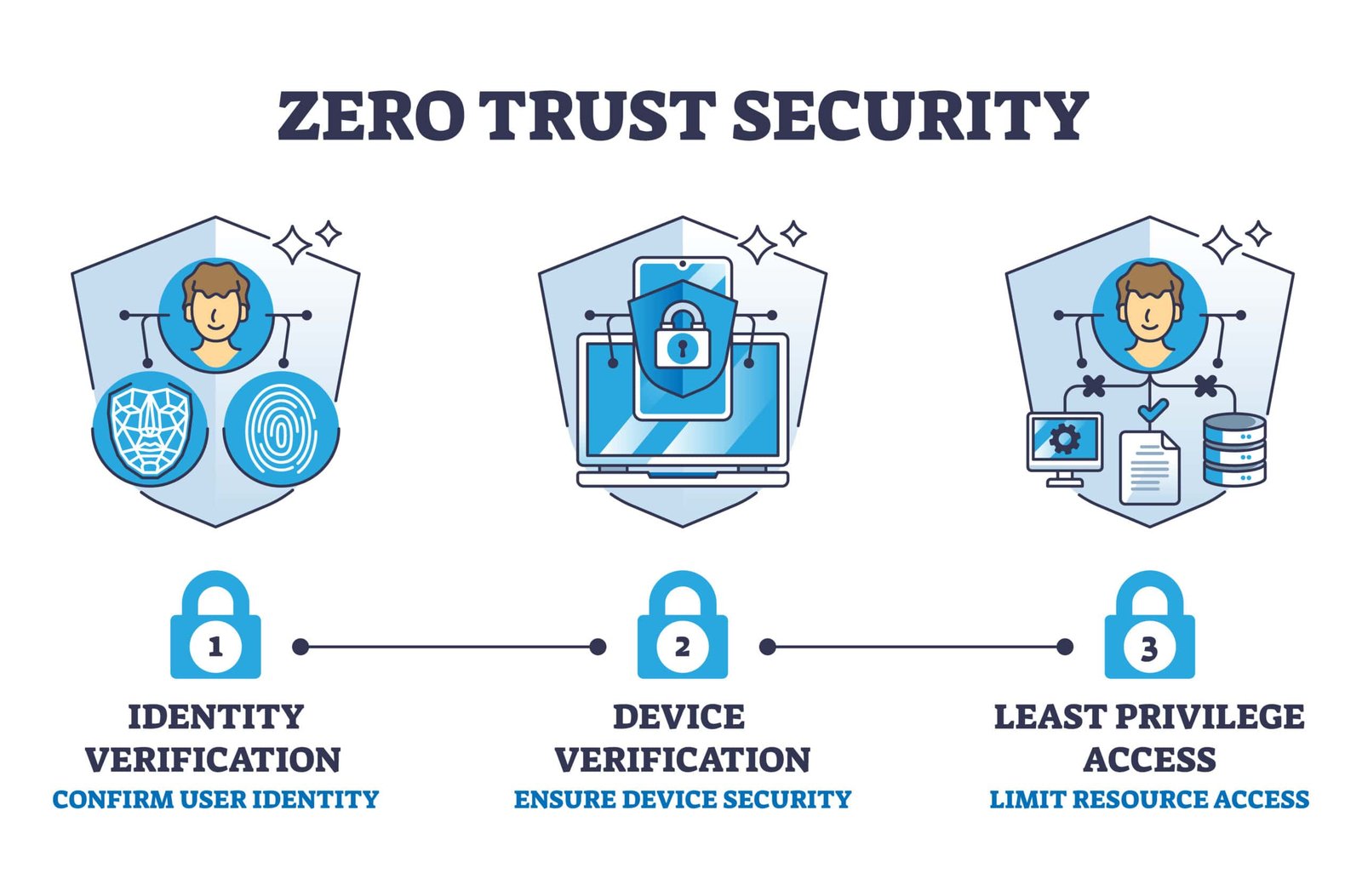
1. Strong Identity Verification
Every user must prove their identity before accessing resources.
Modern authentication methods include:
- Multi-Factor Authentication (MFA)
- Passwordless authentication
- Biometrics
- Security keys
- Certificate-based authentication
These methods reduce the risk of credential theft.
2. Continuous Authentication
Identity verification should not stop after login.
Modern Zero Trust platforms continuously evaluate:
- User behavior
- Device status
- Session risk
- Location changes
- Privilege escalation
If risk increases during a session, access can be restricted or terminated immediately.
3. Least Privilege Access
Users receive only the minimum permissions necessary to perform their work.
Instead of broad administrative rights, organizations grant:
- Role-based access
- Time-limited privileges
- Just-in-Time (JIT) access
- Just-Enough Administration (JEA)
Reducing unnecessary permissions limits potential damage from compromised accounts.
4. Identity Governance and Administration (IGA)
IGA ensures identities are created, managed, reviewed, and removed appropriately.
Key processes include:
- User provisioning
- Role management
- Access certification
- Separation of duties
- Automated deprovisioning
This reduces the risk of orphaned or excessive accounts.
5. Privileged Access Management (PAM)
Administrative accounts are high-value targets.
PAM solutions secure privileged credentials by:
- Rotating passwords
- Recording sessions
- Requiring approval workflows
- Enforcing temporary privileges
- Monitoring privileged activity
6. Device Trust
Identity alone isn’t enough.
Organizations must also verify:
- Device compliance
- Operating system updates
- Endpoint protection
- Encryption status
- Security configuration
Trusted users on compromised devices still present security risks.
7. Risk-Based Access Control
Modern Zero Trust platforms dynamically adjust access based on risk.
For example:
Low-risk login:
- Office location
- Managed device
- Normal behavior
Result:
Access granted.
High-risk login:
- Unknown country
- New device
- Impossible travel
- Suspicious behavior
Result:
Additional authentication or blocked access.
Why Identity Is the New Security Perimeter
Digital identities now protect access to:
- Cloud applications
- Databases
- APIs
- File storage
- Collaboration tools
- Financial systems
- Development environments
Attackers increasingly seek identities because they provide legitimate access.
Instead of attacking networks directly, cybercriminals simply log in using stolen credentials.
Protecting identity therefore becomes the first line of defense.
Common Threats Identity-Centric Zero Trust Helps Prevent
Phishing Attacks
Even if credentials are stolen, MFA, passwordless authentication, and behavioral analytics reduce the likelihood of unauthorized access.
Credential Stuffing
Attackers frequently reuse credentials from previous breaches.
Adaptive authentication detects unusual login patterns and blocks suspicious attempts.
Insider Threats
Least privilege and continuous monitoring reduce the damage insiders can cause.
Ransomware
Zero Trust limits attacker movement by requiring identity verification between systems and restricting excessive permissions.
Supply Chain Attacks
Third-party vendors receive only the access necessary for their responsibilities, minimizing risk if their accounts are compromised.
Benefits of Identity-Centric Zero Trust
Organizations implementing Identity-Centric Zero Trust experience numerous advantages.
Improved Security
Continuous verification reduces unauthorized access and strengthens defenses against identity-based attacks.
Reduced Attack Surface
Limiting permissions and validating every request minimizes opportunities for attackers.
Better Compliance
Identity controls help organizations meet regulatory requirements such as:
- GDPR
- HIPAA
- PCI DSS
- ISO 27001
- SOC 2
Enhanced User Experience
Modern authentication methods, including passwordless technologies and adaptive authentication, improve security while reducing user friction.
Stronger Visibility
Centralized identity management provides detailed insights into who is accessing resources, when, from where, and under what conditions.
Implementing Identity-Centric Zero Trust
Transitioning to Zero Trust requires careful planning and phased implementation.
Step 1: Inventory Identities
Catalog all identities, including:
- Employees
- Contractors
- Vendors
- Service accounts
- Applications
- APIs
- Devices
You cannot secure what you cannot identify.
Step 2: Classify Resources
Identify critical assets such as:
- Customer data
- Financial systems
- Intellectual property
- Administrative tools
- Cloud workloads
Prioritize protection based on business impact.
Step 3: Strengthen Authentication
Implement:
- Multi-factor authentication
- Passwordless login
- Single Sign-On (SSO)
- Adaptive authentication
Reduce reliance on passwords wherever possible.
Step 4: Apply Least Privilege
Review user permissions regularly.
Remove unnecessary:
- Administrative rights
- Shared accounts
- Dormant accounts
- Excessive permissions
Step 5: Continuously Monitor Access
Use security analytics to detect:
- Abnormal login behavior
- Privilege misuse
- Impossible travel
- Device anomalies
- Suspicious session activity
Step 6: Automate Identity Lifecycle Management
Ensure:
- New employees receive appropriate access.
- Departing employees lose access immediately.
- Role changes automatically update permissions.
Automation reduces human error.
Challenges of Adopting Identity-Centric Zero Trust
While highly effective, implementation comes with challenges.
Legacy Systems
Older applications may not support modern authentication protocols.
User Resistance
Employees may initially view additional verification steps as inconvenient.
Complex Environments
Large organizations often manage thousands of identities across on-premises and cloud systems.
Integration Requirements
Zero Trust requires coordination among identity providers, endpoint management, security tools, cloud platforms, and monitoring solutions.
Despite these challenges, phased implementation can significantly reduce complexity.
Best Practices for Success
Organizations should follow these best practices:
- Enforce MFA across all users.
- Eliminate unnecessary administrative privileges.
- Conduct regular access reviews.
- Monitor identities continuously.
- Secure privileged accounts with PAM.
- Adopt passwordless authentication where feasible.
- Train employees to recognize phishing attempts.
- Protect APIs and machine identities.
- Verify device compliance before granting access.
- Automate identity provisioning and deprovisioning.
These measures strengthen security while supporting business agility.
The Future of Identity-Centric Security
Identity security will continue to evolve alongside emerging technologies.
Key trends include:
AI-Driven Risk Analysis
Artificial intelligence will analyze user behavior in real time to detect subtle anomalies and automate responses to potential threats.
Passwordless Authentication
Biometrics, hardware security keys, and passkeys will increasingly replace traditional passwords, reducing the risks associated with credential theft.
Machine Identity Management
As organizations deploy more APIs, containers, and Internet of Things (IoT) devices, securing non-human identities will become just as important as protecting user accounts.
Continuous Adaptive Trust
Future Zero Trust models will continuously recalculate trust levels based on changing context, rather than relying on one-time authentication events.
Unified Identity Platforms
Organizations will adopt integrated identity platforms that combine Identity Governance and Administration (IGA), Privileged Access Management (PAM), Identity Threat Detection and Response (ITDR), and access management into a single ecosystem for greater visibility and control.
Conclusion
Traditional network security remains an essential component of cybersecurity, but it is no longer sufficient to defend against today’s identity-driven threats. As organizations embrace cloud computing, hybrid work, mobile access, and interconnected digital ecosystems, the traditional network perimeter has largely disappeared. At the same time, cybercriminals have shifted their focus toward exploiting identities through phishing, credential theft, insider abuse, and account compromise.
Identity-Centric Zero Trust addresses this reality by placing identity verification at the heart of every access decision. Through continuous authentication, least-privilege access, adaptive risk assessment, device validation, and comprehensive identity governance, organizations can significantly reduce their exposure to modern cyber threats while enabling secure access for employees, partners, and customers.
The journey to Identity-Centric Zero Trust is not a one-time project but an ongoing strategy that evolves alongside technology and emerging risks. Organizations that invest in robust identity security today will be better prepared to protect critical assets, meet regulatory requirements, support digital transformation, and build resilience against the ever-changing threat landscape. In an era where identities have become the new perimeter, securing who and what can access your resources is no longer optional—it is the foundation of modern cybersecurity.





Leave a Reply