
Table of Contents
- Introduction: Digital Twins Are Expanding Beyond Manufacturing
- What Is Digital Twin Technology?
- How Does Digital Twin Technology Work?
- Why Digital Twins Are Expanding Beyond Manufacturing
- 10 Emerging Digital Twin Applications Across B2B Industries
- 1. Healthcare: Improving Hospital Operations and Patient Care
- 2. Construction and Real Estate: Creating Smarter Buildings
- 3. Energy and Utilities: Optimising Infrastructure and Resource Management
- 4. Logistics and Supply Chain: Building More Resilient Distribution Networks
- 5. Banking and Financial Services: Understanding Complex Financial Systems
- 6. Retail and E-commerce: Improving Store and Fulfilment Performance
- 7. Transportation and Infrastructure: Improving Mobility and Asset Performance
- 8. Telecommunications: Optimising Network Infrastructure
- 9. Agriculture and Food Supply Chains: Improving Resource Efficiency
- 10. Education and Corporate Training: Creating Intelligent Learning Environments
- Digital Twins of Assets, Processes, Systems, and Organisations
- How AI Is Making Digital Twins More Intelligent
- Digital Twins vs IoT vs Simulation: Understanding the Differences
- Business Benefits of Digital Twins for B2B Enterprises
- How to Implement Digital Twin Technology in a B2B Organisation
- Step 1: Identify a High-Value Business Use Case
- Step 2: Define the Scope of the Digital Twin
- Step 3: Identify and Integrate Data Sources
- Step 4: Build the Digital Representation
- Step 5: Integrate AI and Analytics
- Step 6: Establish Governance and Security
- Step 7: Validate the Digital Twin
- Step 8: Monitor Performance and Expand Gradually
- Challenges in Digital Twin Adoption
- Measuring the Success of a Digital Twin Initiative
- The Future of Digital Twins Across B2B Industries
- Conclusion: Digital Twins Are Becoming a Strategic Business Capability
- Frequently Asked Questions (FAQs)
- 1. What are digital twins beyond manufacturing?
- 2. Which industries are adopting digital twin technology?
- 3. How are digital twins used in healthcare?
- 4. What is the difference between a digital twin and a 3D model?
- 5. How do digital twins improve supply chain management?
- 6. What role does AI play in digital twins?
- 7. Can digital twins be used in financial services?
- 8. What technologies are required to build a digital twin?
- 9. What are the biggest challenges of digital twin implementation?
- 10. What is a Digital Twin of an Organisation (DTO)?
- 11. Are digital twins suitable for small and medium-sized businesses?
- 12. What is the future of digital twins in B2B industries?
Introduction: Digital Twins Are Expanding Beyond Manufacturing
Digital twin technology has traditionally been associated with manufacturing, industrial automation, and product engineering. Manufacturers have used virtual representations of physical assets to monitor equipment performance, simulate operating conditions, predict maintenance requirements, and optimise production processes.
However, the application of digital twins is expanding well beyond factory environments.
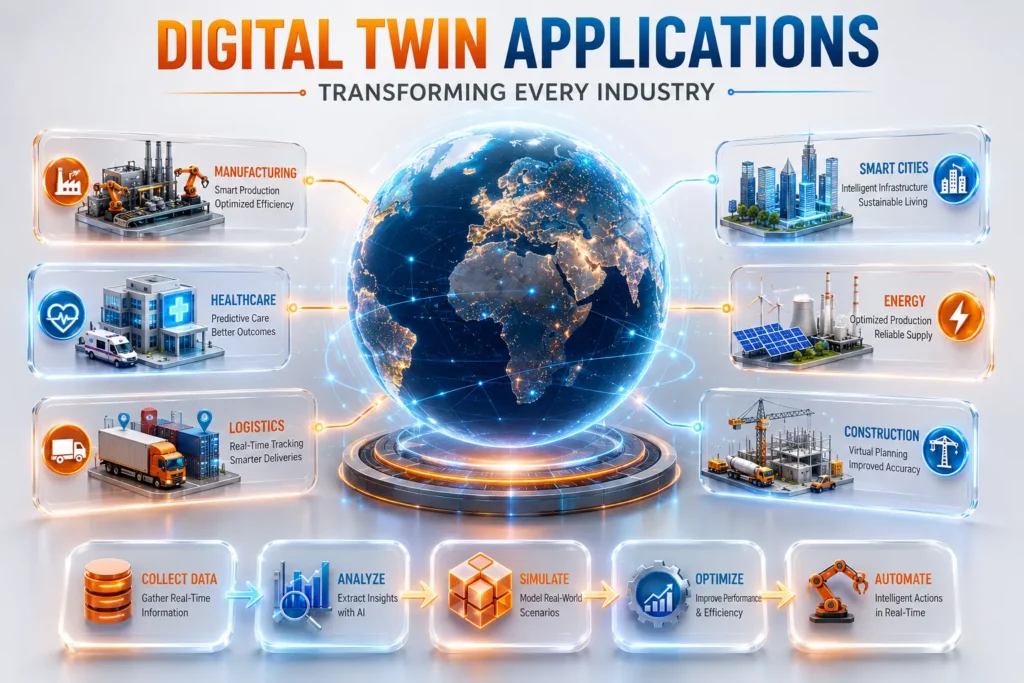
Today, organisations across healthcare, construction, energy, logistics, transportation, financial services, retail, and telecommunications are exploring how digital representations of physical assets, systems, and processes can improve business performance.
This shift is changing how B2B organisations approach digital transformation.
Consider a hospital that wants to optimise the utilisation of its facilities, a logistics company looking to simulate its distribution network, or an energy provider trying to predict the impact of changing demand on its infrastructure.
Each organisation faces a different operational challenge, but all can benefit from a connected digital representation of their real-world environment.
By combining data from sensors, enterprise applications, operational systems, artificial intelligence, and simulation technologies, digital twins allow businesses to understand existing conditions and evaluate potential future scenarios.
Instead of relying entirely on historical reports or static models, decision-makers can explore how assets and systems behave under different conditions.
This capability is particularly valuable for B2B enterprises managing complex infrastructure, interconnected operations, and large-scale service delivery.
The growing adoption of cloud computing, the Internet of Things (IoT), artificial intelligence, and advanced analytics is making digital twin technology more accessible across industries.
For businesses, the opportunity extends beyond monitoring physical equipment. It involves creating intelligent digital representations of buildings, supply chains, healthcare systems, energy networks, transportation infrastructure, and even entire business operations.
In this article, we explore what digital twins are, how they work, their emerging applications across B2B industries, the technologies driving their evolution, and what organisations should consider when implementing digital twin solutions.
What Is Digital Twin Technology?
A digital twin is a dynamic digital representation of a physical asset, process, system, or environment that uses data to reflect its real-world state and behaviour.
Unlike a traditional 3D model or static simulation, a digital twin can incorporate continuously updated information from connected systems, sensors, operational databases, and other data sources.
This allows organisations to monitor performance, analyse behaviour, simulate scenarios, and support more informed decisions.
For example, a digital twin of a commercial building may combine information about:
- Building layout and structural components.
- Heating, ventilation, and air conditioning systems.
- Electricity consumption.
- Occupancy levels.
- Equipment performance.
- Maintenance history.
- Environmental conditions.
By bringing this information together, facility managers can develop a more complete understanding of building operations.
Similarly, a digital twin of a supply chain can represent suppliers, warehouses, transportation routes, inventory levels, and distribution activities.
The organisation can then evaluate how disruptions or operational changes may affect the wider network.
Digital Twin vs Traditional Digital Model
It is important to understand that not every digital representation qualifies as a digital twin.
A static digital model represents an object or system without necessarily receiving continuously updated operational information.
A simulation allows users to explore how a system might behave under different conditions.
A digital twin goes further by connecting the digital representation with relevant real-world data and, in more advanced implementations, supporting feedback between the physical and digital environments.
| Traditional Digital Model | Simulation | Digital Twin |
|---|---|---|
| Represents an object or system | Models possible behaviour | Represents real-world conditions and behaviour |
| May remain static | Uses defined assumptions and inputs | Can incorporate changing operational data |
| Primarily used for visualisation | Used for scenario analysis | Used for monitoring, analysis, prediction, and optimisation |
| Limited connection to live systems | May operate independently of physical assets | Connected to real-world data sources |
| Provides a reference representation | Evaluates potential outcomes | Supports ongoing operational intelligence |
The distinction matters because organisations should select the appropriate level of digital representation based on their actual business requirements.
Not every use case requires a sophisticated, continuously synchronised digital twin.
How Does Digital Twin Technology Work?
Digital twin technology combines several capabilities to connect physical environments with digital representations.
Although implementations differ across industries, most digital twin architectures contain the following components.
1. Physical Assets and Systems
The physical environment is the foundation of a digital twin.
It may include buildings, medical equipment, vehicles, energy infrastructure, transportation networks, warehouses, or other operational assets.
2. Data Collection and IoT Sensors
Sensors and connected devices collect information from physical environments.
Common data points include:
- Temperature.
- Pressure.
- Vibration.
- Humidity.
- Equipment utilisation.
- Energy consumption.
- Location.
- Movement.
- Environmental conditions.
Not all digital twins require IoT sensors. Some use information from enterprise applications, operational databases, engineering systems, and external data sources.
3. Data Integration Layer
Data collected from different sources must be integrated into a consistent environment.
This may involve information from:
- ERP systems.
- Enterprise asset management platforms.
- Building management systems.
- CRM applications.
- Geographic Information Systems (GIS).
- IoT platforms.
- Supply chain management software.
- Cloud databases.
Data integration enables the digital twin to represent a more complete view of the underlying system.
4. Digital Representation and Modelling
The digital representation describes the structure, relationships, and behaviour of the physical asset or system.
Depending on the use case, it may include 3D models, engineering models, mathematical representations, spatial information, and operational relationships.
5. AI and Analytics
Artificial intelligence and advanced analytics help organisations interpret incoming information.
These technologies can support:
- Predictive maintenance.
- Anomaly detection.
- Performance forecasting.
- Scenario simulation.
- Resource optimisation.
- Risk analysis.
For example, a digital twin of an energy network may use predictive analytics to evaluate how changing demand could affect system performance.
6. Visualisation and Decision Support
Digital twin platforms present information through dashboards, interactive visualisations, 3D environments, and analytical interfaces.
Decision-makers can examine current conditions, compare scenarios, and identify opportunities for improvement.
7. Feedback and Operational Action
In more advanced implementations, insights generated through the digital twin can inform changes to the physical system.
Depending on safety and governance requirements, this may involve recommendations, human-approved adjustments, or automated control actions.
The result is a connected approach to monitoring and improving real-world operations.
Why Digital Twins Are Expanding Beyond Manufacturing
Several technological and business developments are accelerating the adoption of digital twins across industries.
1. Growing Availability of Connected Data
Businesses increasingly collect operational information through IoT devices, enterprise applications, connected infrastructure, and digital platforms.
This provides the data foundation needed to create more accurate digital representations of real-world environments.
2. Increasing Complexity of Business Operations
Many B2B organisations operate across interconnected systems, locations, assets, and external partners.
Managing these environments through isolated dashboards can make it difficult to understand how changes in one area affect the wider organisation.
Digital twins provide an integrated view that can help businesses understand these relationships.
3. Demand for Predictive Decision-Making
Traditional business reporting focuses heavily on historical performance.
Digital twins allow organisations to explore potential future scenarios using operational data, simulations, and predictive models.
This is particularly useful when decisions involve significant financial investments or operational risks.
4. Advances in Artificial Intelligence
AI is improving the ability to analyse complex data, identify patterns, predict outcomes, and recommend potential actions.
When integrated with digital twins, these capabilities can support more intelligent operational planning.
5. Growth of Cloud and Edge Computing
Cloud platforms provide scalable infrastructure for managing large datasets and running complex simulations.
Edge computing allows certain data processing activities to take place closer to connected devices and physical assets.
Together, these technologies can support digital twin applications that require both scalability and timely operational insights.
6. Focus on Sustainability and Resource Efficiency
Organisations face increasing pressure to manage energy consumption, resource utilisation, waste, and environmental performance.
Digital twins can help evaluate resource usage and test alternative operating scenarios before changes are implemented.
10 Emerging Digital Twin Applications Across B2B Industries
Digital twin technology is becoming relevant across a growing range of enterprise environments.
Here are ten important industry applications beyond traditional manufacturing.
1. Healthcare: Improving Hospital Operations and Patient Care
<Healthcare digital twins in hospitals and patient monitoring>
Healthcare is one of the most promising areas for digital twin applications beyond manufacturing.
Hospitals manage complex environments involving medical equipment, clinical facilities, patient flows, staff resources, and critical infrastructure.
Digital twins can help healthcare organisations understand and optimise these interconnected systems.
Key applications include:
- Hospital facility management.
- Medical equipment monitoring.
- Operating room utilisation.
- Patient flow simulation.
- Hospital energy management.
- Personalised healthcare modelling.
- Clinical workflow optimisation.
For example, a hospital could develop a digital twin of its facility to analyse occupancy, equipment utilisation, environmental conditions, and patient movement.
This could help administrators identify bottlenecks in patient movement, optimise resource allocation, and evaluate alternative facility management strategies.
Another emerging application involves patient-specific digital representations.
These models may combine medical imaging, physiological information, and clinical data to support research, treatment planning, and disease modelling.
However, patient-specific digital twins remain a developing area, and their clinical use requires careful validation, privacy protection, and medical oversight.
B2B business opportunity: Healthcare technology providers, hospital operators, medical equipment companies, and healthcare infrastructure consultants can explore digital twin solutions for facility optimisation and operational intelligence.
2. Construction and Real Estate: Creating Smarter Buildings
<Digital twin of a commercial building with BIM and IoT data>
The construction and real estate sectors are increasingly using digital technologies to improve how buildings and infrastructure are designed, constructed, operated, and maintained.
Digital twins extend the capabilities of Building Information Modelling (BIM) by connecting digital building representations with operational information.
A BIM model primarily provides structured information about the physical design and components of a building.
A building digital twin can incorporate additional information about how the building performs throughout its operational lifecycle.
Key applications include:
- Smart building management.
- Energy consumption optimisation.
- HVAC performance monitoring.
- Predictive maintenance.
- Occupancy analysis.
- Facility management.
- Construction progress monitoring.
- Infrastructure lifecycle management.
For example, a commercial property operator could use a digital twin to monitor energy consumption across different floors, analyse occupancy patterns, and evaluate HVAC operating strategies.
This can help identify inefficient energy usage and improve facility management decisions.
Construction companies can also use digital twins to compare actual project progress against planned schedules and identify potential coordination issues.
A 2026 review published in Automation in Construction highlights the growing integration of BIM, IoT, and AI in digital twins for buildings and infrastructure, while identifying interoperability, cost, and technical complexity as important challenges.
B2B business opportunity: Real estate developers, engineering firms, construction companies, facility management providers, and infrastructure operators can use digital twins to improve asset visibility and lifecycle management.
3. Energy and Utilities: Optimising Infrastructure and Resource Management
<Digital twin of an energy grid and utility infrastructure>
Energy providers and utility companies manage large networks of interconnected physical assets.
These include power generation facilities, electricity grids, substations, pipelines, water distribution networks, and renewable energy installations.
Digital twins can provide a connected view of these environments.
Key applications include:
- Smart grid monitoring.
- Electricity demand forecasting.
- Renewable energy integration.
- Infrastructure performance analysis.
- Predictive maintenance.
- Water distribution monitoring.
- Energy consumption optimisation.
- Network resilience planning.
For example, an electricity provider could use a digital twin of its distribution network to evaluate how changes in demand may affect different parts of the grid.
It could also simulate the impact of integrating additional renewable energy capacity or changing the distribution of electricity across the network.
In water utilities, digital twins can help model network behaviour, examine pressure variations, and support investigations into potential leakage.
B2B business opportunity: Energy companies, utility operators, renewable energy developers, infrastructure technology providers, and engineering consultants can use digital twins to improve asset management and operational planning.
4. Logistics and Supply Chain: Building More Resilient Distribution Networks
<Digital twin of a global logistics and supply chain network>
Supply chains are complex systems involving suppliers, warehouses, transportation providers, distribution centres, inventory, and customers.
Disruptions in one part of the network can affect multiple business functions.
Digital twins can help organisations create virtual representations of supply chain operations and evaluate how different events may influence overall performance.
Key applications include:
- Warehouse optimisation.
- Distribution network simulation.
- Inventory planning.
- Shipment tracking.
- Transportation route analysis.
- Supplier risk assessment.
- Demand scenario modelling.
- Logistics capacity planning.
For example, a logistics provider could create a digital twin of its distribution network using warehouse capacity, shipment information, transportation schedules, and demand forecasts.
If a major distribution centre becomes unavailable, the organisation could simulate alternative routes and evaluate how different decisions may affect delivery times and operating costs.
Similarly, a retailer could examine how changing inventory levels across warehouses might affect fulfilment performance.
B2B business opportunity: Third-party logistics providers, freight companies, supply chain consultants, warehouse operators, and enterprise retailers can use digital twins to improve network visibility and planning.
5. Banking and Financial Services: Understanding Complex Financial Systems
<Digital twin concept for banking operations and financial infrastructure>
Financial services organisations operate through interconnected processes involving customer accounts, transactions, payment systems, risk management, compliance, and technology infrastructure.
Digital twin applications in this sector are emerging and require careful distinction between operational simulations and representations of real financial systems.
Rather than assuming that a digital twin can replicate every aspect of a financial institution, businesses can begin with specific operational environments.
Potential applications include:
- Banking infrastructure monitoring.
- Data centre performance modelling.
- Branch network optimisation.
- Payment system simulation.
- Operational risk scenario analysis.
- Financial service workflow modelling.
- ATM network optimisation.
- IT infrastructure resilience planning.
For example, a bank could develop a digital representation of its branch network using customer traffic, service utilisation, staffing levels, and location information.
It could then evaluate alternative branch layouts, staffing arrangements, or service distribution models.
Another application involves simulating IT infrastructure performance to understand how increased transaction volumes could affect system capacity.
Digital twins may also support scenario analysis for operational resilience, although they should not be treated as substitutes for established financial risk models or regulatory stress-testing frameworks.
B2B business opportunity: Banks, insurance companies, financial technology providers, payment infrastructure operators, and enterprise technology consultants can investigate digital twins for operational optimisation and resilience.
6. Retail and E-commerce: Improving Store and Fulfilment Performance
<Digital twin of a retail store and e-commerce fulfilment operation>
Retailers are managing increasingly interconnected physical and digital operations.
These include retail stores, warehouses, inventory systems, customer interactions, online platforms, and fulfilment networks.
Digital twins can help organisations understand how these environments interact.
Key applications include:
- Store layout optimisation.
- Inventory management.
- Warehouse operations.
- Customer movement analysis.
- Energy management.
- Fulfilment simulation.
- Distribution planning.
- Omnichannel operations.
For example, a retail organisation could develop a digital twin of a physical store using floor layouts, inventory information, occupancy patterns, and sales data.
It could evaluate alternative store layouts and understand how product placement may influence customer movement and operational efficiency.
In e-commerce, digital twins can help model warehouse capacity, order fulfilment processes, and distribution requirements.
B2B business opportunity: Retail technology providers, e-commerce platforms, warehouse operators, retail consultants, and enterprise software companies can explore digital twin applications for connected retail operations.
7. Transportation and Infrastructure: Improving Mobility and Asset Performance
<Digital twin of transportation infrastructure and smart city systems>
Transportation networks involve roads, bridges, tunnels, railways, airports, ports, and traffic management systems.
These assets require continuous monitoring and long-term maintenance planning.
Digital twins can combine geospatial information, infrastructure models, sensor data, and operational records to provide a more complete view of transportation environments.
Key applications include:
- Traffic flow simulation.
- Road infrastructure monitoring.
- Bridge condition assessment.
- Railway performance analysis.
- Airport operations planning.
- Port logistics management.
- Infrastructure maintenance.
- Urban mobility planning.
For example, a city transportation authority could use a digital twin to simulate how changes in traffic signals, road closures, or public transport schedules might influence congestion.
Infrastructure operators could also use connected asset information to identify potential maintenance requirements and prioritise inspections.
B2B business opportunity: Transportation authorities, engineering companies, infrastructure operators, smart city solution providers, and geospatial technology firms can use digital twins to support infrastructure planning and asset management.
8. Telecommunications: Optimising Network Infrastructure
<Telecommunications digital twin with network towers and connectivity infrastructure>
Telecommunications providers operate extensive networks involving cell towers, fibre infrastructure, data centres, network equipment, and connected devices.
As demand for connectivity increases, maintaining network performance and capacity becomes more complex.
Digital twins can provide a virtual representation of network infrastructure and its operational behaviour.
Key applications include:
- Network performance monitoring.
- Coverage planning.
- Capacity management.
- Infrastructure maintenance.
- Network configuration simulation.
- Data centre optimisation.
- Connectivity planning.
- Service disruption analysis.
For example, a telecom operator could use a digital twin to simulate the impact of adding new network infrastructure in a particular geographical area.
It could evaluate coverage, capacity, and potential interference before implementing changes.
Digital representations of network environments may also help operators examine how equipment failures or changing demand could affect service availability.
B2B business opportunity: Telecommunications operators, network equipment providers, infrastructure management companies, and enterprise connectivity providers can use digital twins to improve network planning and reliability.
9. Agriculture and Food Supply Chains: Improving Resource Efficiency
<Digital twin of smart agriculture with crop monitoring and irrigation systems>
Agriculture and food production involve changing environmental conditions, resource constraints, equipment requirements, and complex supply chains.
Digital twins can help agricultural businesses combine information about soil conditions, weather, irrigation, crop development, and equipment performance.
Key applications include:
- Precision agriculture.
- Irrigation optimisation.
- Crop growth modelling.
- Greenhouse management.
- Agricultural equipment monitoring.
- Resource utilisation.
- Food storage monitoring.
- Agricultural supply chain planning.
For example, an agricultural enterprise could create a digital representation of a farm by combining weather information, soil measurements, irrigation data, and crop observations.
The organisation could use this information to evaluate alternative irrigation schedules and resource allocation strategies.
Food processing and distribution businesses may also use digital twins to model storage environments, logistics conditions, and distribution operations.
B2B business opportunity: Agritech providers, food processing companies, agricultural equipment manufacturers, farm management platforms, and agricultural supply chain operators can explore digital twins for operational planning and resource optimisation.
10. Education and Corporate Training: Creating Intelligent Learning Environments
<Digital twin of a university campus and corporate training environment>
Digital twins are also creating opportunities in education, professional training, and enterprise learning environments.
Universities, technical institutes, and large corporate campuses manage buildings, laboratories, equipment, energy systems, and shared facilities.
Digital representations can help administrators understand how these environments are used.
Key applications include:
- Campus infrastructure management.
- Laboratory equipment monitoring.
- Facility utilisation.
- Energy optimisation.
- Safety scenario simulation.
- Technical training environments.
- Engineering education.
- Virtual operational training.
For example, an engineering institution could develop a digital twin of a laboratory environment where students can explore equipment behaviour and evaluate operational scenarios.
A corporate organisation could also use digital simulations to train employees on complex operational procedures.
B2B business opportunity: Universities, corporate training providers, enterprise learning platforms, engineering institutions, and educational technology companies can investigate digital twins for infrastructure management and experiential learning.
Digital Twins of Assets, Processes, Systems, and Organisations
Digital twin technology is not limited to creating virtual representations of individual physical objects.
Its scope can extend across different levels of business complexity.
Understanding these levels helps organisations identify the most appropriate implementation approach.
1. Asset Digital Twins
Asset digital twins represent individual physical assets.
Examples include:
- Medical equipment.
- Commercial buildings.
- Vehicles.
- Power generators.
- Railway infrastructure.
- Telecommunications towers.
They are useful for monitoring performance, tracking conditions, and planning maintenance.
2. Process Digital Twins
Process digital twins represent operational workflows and the relationships between different activities.
Examples include:
- Hospital patient flows.
- Warehouse fulfilment.
- Banking operations.
- Customer onboarding.
- Transportation processes.
- Utility service delivery.
They help organisations evaluate how changes in workflow design, resources, and operating conditions may influence outcomes.
3. System Digital Twins
System digital twins represent interconnected groups of assets and processes.
Examples include:
- Electricity distribution networks.
- Hospital infrastructure.
- Logistics networks.
- Smart cities.
- Telecommunications infrastructure.
- Transportation systems.
They provide a broader understanding of how individual components interact.
4. Digital Twins of Organisations
A Digital Twin of an Organisation (DTO) aims to represent an organisation’s operations, resources, processes, and relationships through connected data and analytical models.
For example, an enterprise DTO could combine information about:
- Financial performance.
- Supply chain operations.
- Customer activity.
- Workforce capacity.
- Business processes.
- Infrastructure utilisation.
- Operational risks.
This could help executives explore the potential effects of strategic decisions across different business functions.
However, a comprehensive organisational digital twin is considerably more complex than an asset-level implementation. It requires strong data integration, governance, process modelling, and clear definitions of the decisions it is intended to support.
How AI Is Making Digital Twins More Intelligent
Artificial intelligence is expanding what digital twins can do.
Traditional digital twins can monitor physical assets and compare their performance against predefined models.
AI adds capabilities that help organisations analyse larger datasets, identify patterns, predict future conditions, and evaluate alternative scenarios.
Here are five important developments.
1. Predictive Analytics
AI models can analyse historical and current operational information to estimate future behaviour.
For example, a digital twin of a building may use equipment performance data to identify patterns associated with potential HVAC failures.
This can help facility managers investigate maintenance requirements before equipment performance deteriorates significantly.
2. Anomaly Detection
AI can identify unusual patterns in operational data.
For example, an energy provider may use anomaly detection to identify unexpected changes in electricity consumption or equipment behaviour.
These findings can be investigated to determine whether they indicate operational problems.
3. Generative AI and Natural Language Interaction
Generative AI is making digital twin environments easier to interact with.
Instead of manually navigating multiple dashboards, users may be able to ask questions such as:
- Why has energy consumption increased in this building?
- Which distribution centre is approaching capacity?
- What could happen if demand increases by 15%?
- Which infrastructure assets require further inspection?
- How would a transportation disruption affect delivery schedules?
AI assistants can help interpret information from digital twin platforms and present analytical findings in natural language.
The reliability of these answers depends on data quality, model validation, and the context available to the AI system.
4. Scenario Simulation and Optimisation
AI can help evaluate different operational scenarios using information from digital twin environments.
For example, a logistics company could compare alternative warehouse configurations, delivery routes, or inventory allocation strategies.
Simulation results can help management evaluate possible outcomes before implementing changes in the physical environment.
5. Autonomous and AI-Assisted Operations
More advanced digital twin environments may support automated operational recommendations and controlled actions.
For example, a building management system could recommend adjustments to HVAC settings based on occupancy and environmental conditions.
In safety-critical environments, such as hospitals, energy infrastructure, and transportation systems, automated actions require strict validation, permissions, and human oversight.
Digital Twins vs IoT vs Simulation: Understanding the Differences
These technologies are closely connected but serve different purposes.
| Technology | Primary Purpose | Business Application |
|---|---|---|
| Internet of Things (IoT) | Collects data from connected physical devices | Equipment and environmental monitoring |
| Simulation | Evaluates possible system behaviour | Scenario testing and planning |
| Digital Twin | Connects a digital representation with real-world data | Continuous monitoring and operational intelligence |
| Artificial Intelligence | Identifies patterns and supports predictions | Predictive analytics and optimisation |
| Digital Thread | Connects information across an asset or product lifecycle | Lifecycle data continuity |
These capabilities can work together.
IoT provides operational data, simulation supports scenario analysis, AI helps interpret information, and the digital twin provides a connected representation of the real-world system.
Business Benefits of Digital Twins for B2B Enterprises
Digital twin technology can deliver value beyond technical visualisation.
Its business benefits depend on the quality of the underlying data, the complexity of the use case, and the organisation’s ability to act on the insights.
1. Better Operational Visibility
Digital twins provide a connected view of assets, infrastructure, and processes.
This can help business teams identify operational issues and understand how different components influence overall performance.
2. Improved Predictive Maintenance
By analysing operational data and equipment behaviour, digital twins can support more informed maintenance planning.
This may reduce unnecessary maintenance activities and help organisations investigate potential failures earlier.
3. More Effective Resource Utilisation
Digital twins can help businesses evaluate how facilities, equipment, energy, staff, and infrastructure resources are being used.
This supports more informed resource allocation.
4. Reduced Operational Risk
Simulation allows businesses to examine possible scenarios before making significant operational changes.
This can support resilience planning and improve preparedness for disruptions.
5. Better Strategic Decision-Making
Digital twins can provide decision-makers with a more detailed understanding of operational relationships and potential outcomes.
This helps connect strategic planning with actual business conditions.
6. Improved Sustainability
By analysing energy consumption, resource utilisation, and operational performance, digital twins can help organisations identify opportunities to reduce waste and improve environmental efficiency.
7. Stronger Customer Experience
In industries such as healthcare, logistics, telecommunications, and financial services, improved operational visibility can support more consistent service delivery.
How to Implement Digital Twin Technology in a B2B Organisation
Implementing a digital twin requires more than purchasing a software platform.
Organisations need to establish the right business objectives, data foundation, technical architecture, and operational governance.
The following framework provides a practical starting point.
Step 1: Identify a High-Value Business Use Case
Begin with a specific business challenge rather than attempting to create a digital twin of the entire organisation.
Potential starting points include:
- Building energy optimisation.
- Warehouse capacity management.
- Hospital facility utilisation.
- Utility infrastructure monitoring.
- Transportation network planning.
- Telecommunications infrastructure management.
Prioritise use cases with measurable business value and accessible data.
Step 2: Define the Scope of the Digital Twin
Determine what the digital twin needs to represent.
Will it model an individual asset, an operational process, an entire facility, or a connected network?
Clearly defining the scope prevents unnecessary technical complexity.
Step 3: Identify and Integrate Data Sources
Identify the systems that contain relevant information.
These may include IoT platforms, ERP applications, GIS systems, engineering models, building management systems, and operational databases.
Establish how information will be collected, standardised, and updated.
Step 4: Build the Digital Representation
Develop the digital model using appropriate modelling and visualisation technologies.
Depending on the use case, this could involve:
- 3D modelling.
- Building Information Modelling.
- Geospatial models.
- Mathematical simulations.
- Process models.
- Asset relationship models.
The representation should be detailed enough to support the intended business decisions without introducing unnecessary complexity.
Step 5: Integrate AI and Analytics
Introduce analytical capabilities that support the use case.
These may include predictive maintenance models, anomaly detection, forecasting, optimisation, or scenario simulation.
AI should be introduced where it provides measurable value rather than simply because it is available.
Step 6: Establish Governance and Security
Digital twins can involve sensitive operational, customer, employee, and infrastructure information.
Organisations should establish:
- Data ownership.
- Role-based access controls.
- Data privacy policies.
- Cybersecurity measures.
- Data quality standards.
- Model validation procedures.
- Audit trails.
- Appropriate retention policies.
Step 7: Validate the Digital Twin
Compare the digital representation against real-world observations.
Check whether the model reflects actual asset conditions, operational behaviour, and system relationships accurately enough for its intended purpose.
For high-impact applications, validation should include domain experts and relevant operational teams.
Step 8: Monitor Performance and Expand Gradually
Track whether the digital twin delivers measurable business improvements.
Once the initial implementation demonstrates value, consider expanding it to additional assets, facilities, processes, or business units.
This incremental approach reduces implementation risk and makes it easier to establish a sustainable operating model.
Challenges in Digital Twin Adoption
Although digital twins offer significant opportunities, implementation can be challenging.
B2B organisations should understand the following barriers before investing in the technology.
1. Data Integration Complexity
Digital twins frequently depend on information from multiple applications and physical systems.
Different data formats, identifiers, and update frequencies can make integration difficult.
Solution: Establish a structured data integration architecture and consistent information standards.
2. High Implementation Costs
Creating and maintaining sophisticated digital twin environments can require significant investment in sensors, software, modelling, infrastructure, and specialist expertise.
Solution: Start with a clearly defined use case and evaluate expected business value before expanding the implementation.
3. Data Quality and Model Accuracy
A digital twin is only as reliable as its underlying information and models.
Incomplete sensor readings, inaccurate asset records, and outdated assumptions can affect analytical results.
Solution: Introduce data validation, model calibration, quality monitoring, and regular updates.
4. Cybersecurity Risks
Connected digital environments may expose sensitive operational information and create additional cybersecurity considerations.
This is especially important for critical infrastructure, healthcare, energy, and transportation.
Solution: Apply strong authentication, network segmentation, encryption, access controls, monitoring, and appropriate security testing.
5. Lack of Interoperability
Different vendors and systems may use incompatible data formats, communication protocols, and modelling standards.
Solution: Prioritise open interfaces, standardised data structures, and integration capabilities when designing the architecture.
6. Shortage of Specialist Skills
Digital twin implementation combines expertise in data engineering, simulation, domain operations, IoT, cloud infrastructure, and AI.
Solution: Build cross-functional teams and invest in training, technical partnerships, and knowledge transfer.
7. Difficulty Demonstrating ROI
Some digital twin projects begin as technology experiments without clearly defined business outcomes.
Solution: Establish baseline metrics and connect implementation objectives to measurable operational or financial improvements.
Measuring the Success of a Digital Twin Initiative
Digital twin projects should be evaluated through metrics that reflect their intended business purpose.
The most appropriate KPIs will vary across industries.
| Business Area | Example KPI | What It Measures |
|---|---|---|
| Asset management | Asset availability | Operational reliability |
| Maintenance | Unplanned downtime | Equipment performance |
| Energy | Energy consumption per unit | Resource efficiency |
| Construction | Schedule variance | Project performance |
| Healthcare | Facility utilisation | Resource allocation |
| Logistics | Order fulfilment time | Distribution efficiency |
| Transportation | Infrastructure availability | Network reliability |
| Telecommunications | Network availability | Service performance |
| Retail | Inventory turnover | Inventory efficiency |
| Financial services | System availability | Operational resilience |
| Sustainability | Resource consumption | Environmental performance |
For example, a commercial building operator implementing a digital twin could measure energy consumption, HVAC performance, maintenance response time, and facility utilisation before and after implementation.
This provides a more objective way to assess whether the investment is delivering value.
Where possible, organisations should also consider changes in operating conditions and other contributing factors when evaluating results.
The Future of Digital Twins Across B2B Industries
Digital twin technology is likely to become increasingly connected with artificial intelligence, enterprise data platforms, automation, and advanced simulation.
Several developments are particularly important.
1. AI-Powered Digital Twins
AI will increasingly help digital twins interpret complex operational data, identify emerging patterns, and recommend possible interventions.
2. Digital Twins of Entire Business Ecosystems
Organisations may increasingly connect individual asset and process twins into broader representations of facilities, infrastructure, supply chains, and business operations.
3. Integration With Generative AI
Natural language interfaces could make digital twin insights more accessible to business executives, operations managers, and other non-technical users.
4. Greater Adoption in Healthcare
Research and development in patient-specific modelling, hospital operations, medical equipment, and healthcare infrastructure may expand the role of digital twins in clinical and administrative environments.
5. Smart Cities and Connected Infrastructure
Digital twins may play an increasingly important role in integrating information about buildings, transportation, utilities, public infrastructure, and environmental conditions.
6. More Advanced Simulation Capabilities
Improvements in computing infrastructure, AI, and modelling techniques may allow organisations to evaluate increasingly complex operational scenarios.
7. Greater Emphasis on Standards and Interoperability
As digital twins expand across industries, organisations will need more consistent approaches to data exchange, model integration, cybersecurity, and lifecycle management.
The broader direction is clear: digital twins are evolving from specialised engineering tools into more versatile enterprise intelligence capabilities.
Conclusion: Digital Twins Are Becoming a Strategic Business Capability
Digital twin technology is no longer limited to manufacturing environments.
Its expanding applications across healthcare, construction, energy, logistics, financial services, retail, telecommunications, and infrastructure demonstrate its potential to transform how B2B organisations manage complex operations.
By creating connected digital representations of real-world assets, systems, and processes, businesses can improve visibility, evaluate scenarios, identify potential problems, and make more informed decisions.
The combination of IoT, artificial intelligence, cloud computing, simulation, and enterprise data integration is making these capabilities increasingly accessible.
However, successful adoption depends on more than advanced technology.
Organisations need reliable data, accurate models, clear business objectives, strong governance, and the ability to translate digital insights into operational improvements.
For B2B enterprises, the opportunity is to move beyond isolated digital models and develop connected environments that support better planning, more efficient resource utilisation, and greater operational resilience.
The real value of digital twins lies not in creating a virtual copy of the physical world, but in using connected digital intelligence to make better decisions about the real world.
As digital twin technology continues to evolve, businesses that identify practical applications and build the right data foundations will be better positioned to benefit from the next generation of enterprise digital transformation.
Frequently Asked Questions (FAQs)
1. What are digital twins beyond manufacturing?
Digital twins beyond manufacturing refer to the use of dynamic digital representations in industries such as healthcare, construction, energy, logistics, financial services, retail, telecommunications, and transportation. They help organisations monitor assets, simulate scenarios, analyse performance, and optimise operations.
2. Which industries are adopting digital twin technology?
Industries exploring digital twin technology include healthcare, construction, real estate, energy, utilities, transportation, logistics, banking, financial services, retail, telecommunications, agriculture, and education.
3. How are digital twins used in healthcare?
Healthcare organisations can use digital twins for hospital facility management, patient flow analysis, medical equipment monitoring, infrastructure optimisation, and research into patient-specific modelling.
4. What is the difference between a digital twin and a 3D model?
A 3D model is generally a visual representation of an object or environment. A digital twin incorporates relevant real-world data to represent the changing state and behaviour of an asset, process, or system.
5. How do digital twins improve supply chain management?
Digital twins can represent suppliers, warehouses, inventory, transportation routes, and distribution networks. Businesses can use them to simulate disruptions, evaluate alternative routes, optimise capacity, and improve supply chain planning.
6. What role does AI play in digital twins?
AI supports predictive analytics, anomaly detection, forecasting, scenario optimisation, and intelligent recommendations. It helps digital twin platforms interpret operational information and support more informed decisions.
7. Can digital twins be used in financial services?
Yes. Potential applications include banking infrastructure monitoring, branch network optimisation, payment system simulation, IT resilience planning, and operational risk scenario analysis.
8. What technologies are required to build a digital twin?
Common technologies include IoT sensors, cloud computing, data integration platforms, simulation software, AI and machine learning, 3D modelling, geospatial systems, and visualisation tools. The specific technology requirements depend on the use case.
9. What are the biggest challenges of digital twin implementation?
Major challenges include data integration, implementation costs, model accuracy, cybersecurity, interoperability, specialist skill requirements, and demonstrating measurable business value.
10. What is a Digital Twin of an Organisation (DTO)?
A Digital Twin of an Organisation is a connected digital representation of business operations, resources, processes, and relationships. It aims to help organisations understand how different business functions interact and evaluate the potential impact of strategic decisions.
11. Are digital twins suitable for small and medium-sized businesses?
Yes. Smaller organisations can begin with focused applications such as building energy monitoring, warehouse optimisation, equipment performance tracking, or logistics simulation. They do not necessarily need enterprise-wide digital twin infrastructure.
12. What is the future of digital twins in B2B industries?
The future will likely involve greater integration with AI, real-time analytics, generative AI, connected infrastructure, predictive modelling, and enterprise data platforms. These developments can make digital twins more useful for operational planning and business decision-making.

Leave a Reply