

Table of Contents
- What Are Small Language Models?
- What Are Large AI Models and LLMs?
- Small Language Models vs. Large AI Models: Key Differences
- 1. Cost: Which Model Offers Better Business Value?
- 2. Performance and Accuracy: Does Bigger Always Mean Better?
- 3. Speed and Latency: Why Response Time Matters
- 4. Data Privacy and Security in Enterprise AI
- 5. Scalability and Deployment Flexibility
- 6. Customization and Domain-Specific Knowledge
- 7. Business Use Cases: Where Each Model Makes Sense
- 8. Why a Hybrid AI Strategy May Be Better Than Choosing One Model
- 9. Common Mistakes Businesses Make When Choosing AI Models
- 10. A Practical Framework for Choosing the Right AI Model
- 11. The Future of Small Language Models and Enterprise AI
- Conclusion: Choose the Model That Delivers Business Value
Choosing the right AI model is becoming a critical business decision for technology companies. As organizations move beyond AI experiments and begin integrating artificial intelligence into everyday operations, one question keeps coming up: should you invest in a powerful large language model or choose a smaller, more focused alternative?
For many businesses, the answer is not as straightforward as it seems.
Large language models (LLMs) have attracted attention for their ability to write content, analyze complex information, generate code and handle a wide range of tasks. However, they can also introduce higher operating costs, greater infrastructure demands and additional concerns around data privacy. Small Language Models (SLMs), on the other hand, offer a more targeted approach. They can be faster, less expensive to run and easier to deploy in environments where businesses need tighter control over their data.
Neither option is automatically better. The right choice depends on what your business needs AI to accomplish, how much complexity your workflows involve and what you can realistically spend on implementation and ongoing operations.
For founders, CMOs, CTOs and enterprise technology leaders, understanding these differences can help prevent an expensive mistake: investing in a model that is more powerful than necessary or choosing a smaller model that cannot reliably handle the work.
In this guide, we will compare Small Language Models and large AI models across performance, cost, security, scalability and practical business applications. You will also learn how to evaluate both options, when a hybrid approach makes sense and how to choose an AI strategy that delivers measurable business value.
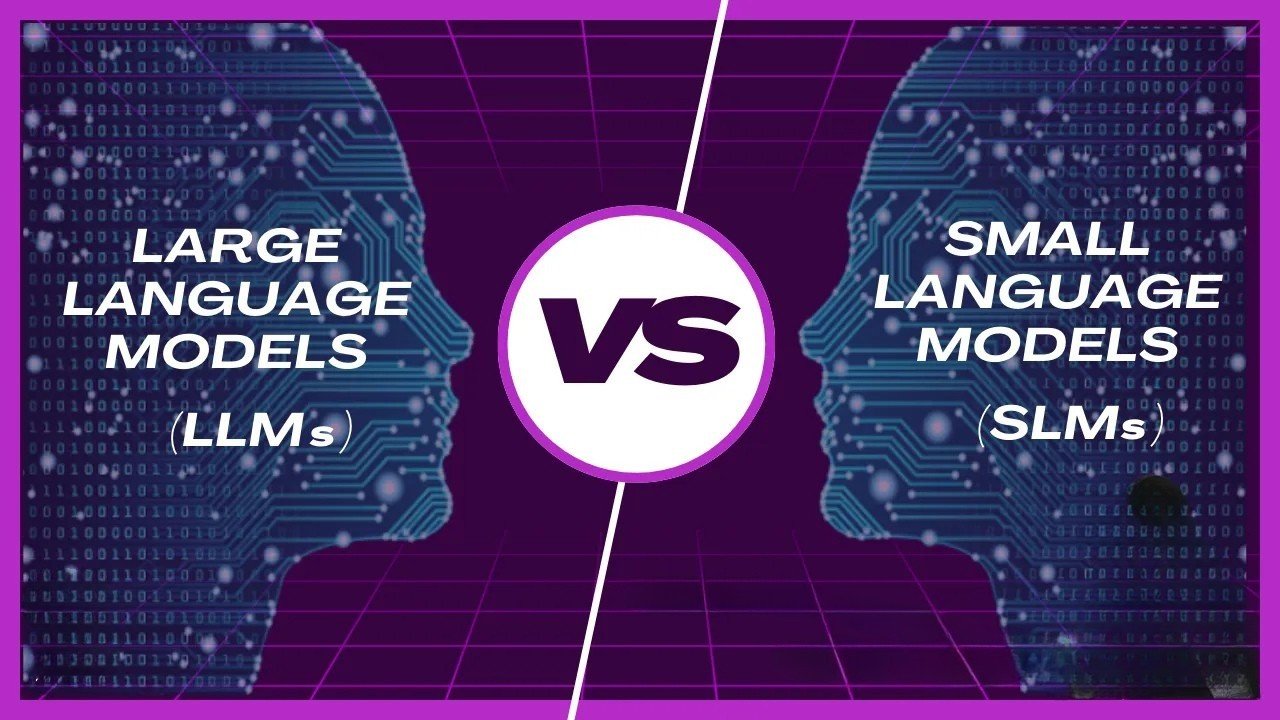
What Are Small Language Models?
Small Language Models are AI models designed to perform language-related tasks with comparatively fewer parameters and lower computational requirements than large language models.
Parameters are the internal values a model learns during training. They help determine how the model recognizes patterns, interprets language and generates responses. Although parameter count is a useful indicator of model size, it does not tell the whole story. Training data, model architecture, fine-tuning and the task itself all influence performance.
An SLM may be designed to classify customer messages, extract information from invoices, summarize internal documents or answer questions within a specific business domain.
For example, imagine a B2B SaaS company receiving thousands of support tickets every week. Most tickets concern familiar issues such as password resets, billing questions and integration errors. A well-trained small model may be sufficient to categorize these requests, identify their urgency and direct them to the right team.
The company does not necessarily need an expensive, general-purpose model to process every ticket.
How Small Language Models Work
Small Language Models learn patterns from training data, much like their larger counterparts. They can then generate text, classify information and respond to prompts.
Businesses can also adapt certain SLMs to specific tasks using fine-tuning. This process involves further training a model on carefully selected examples so it performs better in a particular setting.
Consider a cybersecurity software company that needs to classify incoming security alerts. Rather than asking a general-purpose AI model to interpret every alert from scratch, the company could adapt a smaller model using labeled examples from its own alert categories.
The result could be a focused system that identifies routine cases quickly and flags uncertain cases for further review.
Microsoft’s Phi family of small language models is one example of this model category. These models demonstrate how smaller models can support language, reasoning and other AI tasks without requiring the scale of the largest general-purpose systems.
The important distinction is that smaller does not automatically mean less useful. For a well-defined business task, a smaller model can be a practical choice when it meets the required accuracy and reliability standards.
What Are Large AI Models and LLMs?
Large Language Models are trained on extensive datasets and generally have more parameters and broader capabilities than smaller models. They are built to handle a wide range of language tasks rather than focusing exclusively on one narrow workflow.
LLMs can write and edit content, summarize lengthy reports, answer questions, analyze complex information, generate code and assist with research. Some modern models can also work with images, audio and other types of input.
This versatility makes them attractive to organizations that need AI to support several departments or handle requests that vary considerably in complexity.
For example, a B2B technology company might use an LLM to:
- Analyze customer feedback from multiple channels.
- Help sales teams prepare for complex enterprise negotiations.
- Summarize lengthy RFPs and identify relevant requirements.
- Assist developers with code generation and troubleshooting.
- Support marketing teams with research, messaging and content development.
- Help employees find information across a large collection of internal documents.
Google Cloud’s overview of large language models describes common applications including text generation, summarization, translation and question answering.
Why Businesses Choose Large Language Models
The primary advantage of LLMs is flexibility.
A single model can support multiple workflows, understand varied instructions and handle requests that do not fit a rigid template. This can reduce the need to build a separate model for every application.
However, flexibility comes with trade-offs. Depending on the model and deployment method, businesses may face higher usage costs, greater computing requirements and additional work around access controls, monitoring and data protection.
A larger model can also generate a confident but incorrect answer. Its size does not eliminate the need for validation, human oversight or sound AI governance.
For enterprise leaders, the goal should not be to choose the model with the broadest capabilities. It should be to determine which capabilities are actually necessary for the business problem.
Small Language Models vs. Large AI Models: Key Differences
Small Language Models and LLMs share the same broad purpose of processing and generating language. Their differences become clearer when you evaluate them against business requirements.
| Comparison factor | Small Language Models | Large Language Models |
|---|---|---|
| Task focus | Often suited to specific, well-defined tasks | Better suited to a broad range of tasks |
| Operating cost | Often lower for suitable workloads | Can be higher, depending on usage and model |
| Response speed | Often faster for simpler tasks | Can require more processing time |
| Computing requirements | Generally lower | Generally higher |
| Complex reasoning | Can be limited on difficult tasks | Often stronger on complex, open-ended tasks |
| Customization | Can be adapted for focused business needs | Can also be customized, sometimes with greater complexity |
| Deployment | May run locally or on smaller infrastructure | Often uses substantial cloud or server resources |
| Data control | Local deployment can provide greater control | Depends on the hosting arrangement and data policies |
| Best fit | Repetitive, bounded workflows | Complex tasks requiring broader capabilities |
These are general tendencies rather than universal rules. A well-designed SLM can outperform a larger model on a narrow task, while a well-optimized LLM may be fast and economical enough for many business applications.
The right comparison is not model size alone. It is performance under the conditions in which your company intends to use the model.
1. Cost: Which Model Offers Better Business Value?
Cost is often the first consideration for companies moving AI from a pilot project into production.
An AI feature that works well for a few hundred test requests may become expensive when thousands of employees or customers begin using it daily.
Why Small Language Models Can Be More Cost-Effective
SLMs typically require less computing power than larger models. Depending on the model and workload, they may run on smaller machines, use less memory or process requests at a lower cost.
This makes them attractive for high-volume tasks that do not require sophisticated reasoning.
Consider a B2B software company processing 50,000 support messages every month. If most messages involve straightforward classification, an SLM could handle the initial categorization while sending unusual or ambiguous cases to a larger model.
This approach can reduce the number of expensive model calls without sacrificing the quality of responses that genuinely need deeper analysis.
However, lower model costs do not automatically translate into lower total costs. Businesses must also account for implementation, infrastructure, monitoring, maintenance and quality testing.
When Large Language Models Justify the Cost
LLMs may deliver better value when a task is complex enough that a smaller model frequently makes mistakes.
Imagine an enterprise software provider that uses AI to analyze long RFP documents. The system must interpret customer requirements, compare them against product capabilities, identify gaps and prepare a detailed response.
A smaller model may handle straightforward extraction tasks, but a larger model may be better suited to synthesizing conflicting requirements and producing a coherent analysis.
If the smaller model requires repeated corrections or substantial human intervention, its apparent savings may disappear.
Practical takeaway: Measure cost per successful business outcome, not just cost per AI request.
A cheaper model that produces unreliable results can be more expensive in practice than a larger model that gets the job done correctly.
2. Performance and Accuracy: Does Bigger Always Mean Better?
Large models often have an advantage when a task requires broad knowledge, nuanced interpretation or multi-step reasoning. They can be particularly useful when instructions are unclear or the information needed to answer a question is spread across several documents.
Small Language Models can be highly effective when the task is predictable and the expected output is clearly defined.
Where Small Models Perform Well
SLMs are worth testing for tasks such as:
- Categorizing customer support requests.
- Extracting names, dates and contract fields.
- Identifying sentiment in customer feedback.
- Routing sales leads to the appropriate team.
- Detecting missing information in structured forms.
- Summarizing short internal updates.
- Converting unstructured text into a predefined format.
For these tasks, success can often be measured using a clear set of examples and evaluation criteria.
A lead qualification system, for instance, might need to identify a prospect’s industry, company size, buying intent and expected budget. If those fields are clearly defined, a focused model may deliver sufficient accuracy without requiring a larger general-purpose system.
Where Large Models Have an Advantage
LLMs are often better suited to work involving ambiguity, multiple sources of information or several connected reasoning steps.
Examples include analyzing a complex commercial agreement, developing a strategic response to a competitor’s market entry or synthesizing customer feedback from different regions and product lines.
Even here, model selection should be based on testing rather than assumptions.
A model that performs well on a public benchmark may struggle with your company’s terminology, document formats or customer conversations.
Before choosing a model, create an evaluation dataset from real business examples. Measure accuracy, consistency and the frequency of errors that could cause meaningful harm.
3. Speed and Latency: Why Response Time Matters
Latency refers to the time between sending a request to an AI system and receiving its response.
In business applications, latency affects both user experience and operating efficiency.
A customer support assistant that takes several seconds to categorize a simple request may slow down an otherwise automated workflow. An AI-powered sales tool that helps a representative prepare for an important meeting may have more flexibility if the analysis is valuable enough.
Why SLMs Can Be Faster
Smaller models generally require fewer computational resources to process a request. When deployed on suitable infrastructure, they can deliver quick responses and support high volumes of routine work.
This is particularly useful for:
- Real-time customer support.
- AI features embedded in SaaS products.
- On-device assistants.
- High-volume document classification.
- Automated workflow routing.
- Applications that need to operate with limited network connectivity.
When Speed Should Not Be the Only Priority
Fast responses are not valuable if they are incorrect.
A financial software company might use AI to extract information from invoices. Speed matters, but incorrectly identifying a payment amount could create operational problems.
The better approach is to define a minimum acceptable accuracy level first, then optimize latency within that boundary.
Also remember that total response time depends on more than model size. Network delays, data retrieval, prompt length, hardware and system design all play a role.
4. Data Privacy and Security in Enterprise AI
Data protection is a major consideration for companies using AI with customer records, financial information, internal documents or proprietary business knowledge.
However, it is important to understand one distinction: a small model is not automatically more secure than a large model. Deployment architecture and data handling practices matter just as much.
How Small Language Models Can Improve Data Control
Some SLMs can run within a company’s own infrastructure or on devices controlled by the organization. This can reduce the need to send sensitive information to an external AI service.
For example, a healthcare technology provider may need to summarize internal operational documents containing sensitive information. A locally deployed model could help the organization maintain tighter control over where data is processed.
A similar approach may suit legal technology companies, financial service providers and enterprise SaaS businesses working with confidential customer records.
Still, local deployment does not eliminate security risks. Businesses must manage access permissions, model updates, logging, infrastructure security and unauthorized data exposure.
Can Large Language Models Be Used Securely?
Yes. Enterprise LLM services can offer security controls, access management and contractual data protections. The specific safeguards depend on the provider, service tier and configuration.
Before deployment, decision-makers should establish:
- What information the model receives.
- Where that information is processed and stored.
- Whether prompts and outputs are retained.
- Who can access logs and generated responses.
- What contractual and regulatory requirements apply.
- How sensitive information is removed or restricted.
- How the system is monitored for misuse.
The decision should reflect your organization’s security requirements, not assumptions based on model size.
5. Scalability and Deployment Flexibility
Scalability means your AI system can handle increasing demand without unacceptable increases in cost, response time or operational complexity.
For a B2B technology company, this could mean supporting more customers, processing additional documents or expanding an AI feature across multiple departments.
Scaling with Small Language Models
SLMs can be attractive when businesses need to process large numbers of similar requests. Their lower computing requirements may make it easier to run multiple instances or deploy them closer to where data is generated.
For example, a logistics software company might use an SLM to classify delivery exceptions across thousands of daily transactions. Because the task follows predictable patterns, the company can potentially scale the workflow without relying on a large model for every event.
SLMs can also support edge computing, where AI processing happens on a local device or near the source of the data rather than entirely in a centralized cloud environment.
Scaling with Large Language Models
LLMs can be valuable when a business needs one AI platform to support diverse teams and workflows.
A growing technology company could use a large model for internal knowledge search, sales assistance, technical documentation and customer communication. Instead of building a separate model for every task, the company can use one capable model as a shared foundation.
The trade-off is that broader usage can increase infrastructure demands and create more complex governance requirements.
The key is to forecast demand using actual usage patterns. Estimate how many requests the system will process, how long those requests will be and how much information each request will contain.
That forecast will provide a more useful basis for choosing between SLMs, LLMs and a combination of both.
6. Customization and Domain-Specific Knowledge
Many enterprise AI projects require more than general knowledge. They need an understanding of a company’s products, internal terminology, processes and customer requirements.
Both small and large models can be adapted to business needs, but the most effective method depends on the problem.
When Small Models Are a Good Fit for Customization
An SLM can be a practical choice when the task has a narrow scope and the organization has reliable examples of the desired output.
Consider a B2B cybersecurity company that wants to classify incident reports into a fixed set of categories. Its internal experts could provide labeled examples showing how different incidents should be classified.
The company could then evaluate whether a suitably adapted small model performs accurately enough for production.
This approach is especially useful when the output needs to follow a consistent format or business-specific classification system.
When a Large Model Is More Appropriate
An LLM may be better when a task requires broad context and the ability to interpret unfamiliar questions.
For example, an enterprise software sales team might need to analyze RFPs from different industries. Each document could use different terminology, priorities and evaluation criteria.
A larger model may be better equipped to interpret those variations and produce a useful response.
There is also an important distinction between teaching a model new behavior and giving it access to updated information.
Fine-tuning changes how a model responds through additional training. Retrieval-augmented generation, commonly called RAG, allows a model to retrieve relevant information from an external knowledge source when answering a question.
For many enterprise applications, connecting a model to an approved knowledge base is more practical than attempting to teach it every internal fact through fine-tuning.
7. Business Use Cases: Where Each Model Makes Sense
The most effective way to evaluate Small Language Models versus LLMs is to examine the work your organization actually needs to complete.

Customer support automation
Often a good starting point for SLMs
A software company can use a small model to classify incoming tickets, detect urgency and direct requests to the right department. A larger model can handle complicated troubleshooting questions or synthesize information from multiple support documents.

Sales and lead qualification
Often suitable for SLMs
A small model can extract company details from lead forms, classify buying intent and route prospects according to predefined criteria. An LLM can help prepare account research, interpret complex objections and develop tailored proposals.

Marketing and content operations
A combination can work well
SLMs can classify feedback, tag content assets and organize campaign responses. LLMs can assist with market research, content planning and adapting messaging for different industries or buyer personas. Human review remains important for accuracy and brand consistency.

Software development
Depends on task complexity
A smaller model may assist with code completion, documentation formatting or repetitive code transformations. Larger models may be preferable for understanding unfamiliar codebases, debugging complex problems and planning changes across multiple components.

Document processing and analysis
Often best with task-based routing
An SLM can extract defined fields from standard documents. An LLM may be more useful when the system needs to compare contract clauses, interpret exceptions or summarize complex requirements across several documents.
These examples are starting points, not fixed rules. The best model for each application depends on the quality of the available data, the complexity of the task and the consequences of an incorrect answer.
8. Why a Hybrid AI Strategy May Be Better Than Choosing One Model
One of the most useful shifts in Enterprise AI planning is to stop treating model selection as a permanent, all-or-nothing decision.
Most organizations have a mixture of simple, repetitive work and complex tasks that require more sophisticated reasoning.
Using the same large model for every request can waste resources. Using only a small model can create quality problems when the system encounters an unfamiliar or difficult request.
A hybrid architecture allows businesses to use both.
How a Hybrid Model Strategy Works
Imagine a B2B SaaS company building an AI assistant for its customer success team.
The system could follow this process:
- An SLM receives an incoming customer request.
- It identifies the request type and checks whether it falls into a known category.
- If the task is straightforward, the system uses the SLM to classify the request or prepare a basic response.
- If the request is ambiguous, involves several documents or requires more complex reasoning, the system routes it to an LLM.
- A validation layer checks the result and sends uncertain or sensitive cases to a human reviewer.
- The company tracks accuracy, response time, cost and escalation rates to improve the system.
This approach allows the company to reserve more expensive model calls for situations where they provide meaningful value.
The Business Case for Model Routing
The benefit of a hybrid approach is not simply that small models are cheaper. It is that the company can allocate computing resources according to the difficulty of each task.
For example, suppose a support team receives 10,000 monthly requests. If 80% involve straightforward questions and 20% require deeper analysis, the business can test whether an SLM can reliably handle the routine portion while an LLM handles the rest.
Those percentages are illustrative, not a prediction of actual savings. The business would need to measure its own request distribution, routing accuracy and operating costs.
A hybrid strategy also introduces complexity. Teams need to maintain multiple models, design reliable routing rules and monitor whether the smaller model is escalating difficult requests appropriately.
The right decision is therefore based on the total cost and quality of the system, not on the number of models used.
9. Common Mistakes Businesses Make When Choosing AI Models
Even companies with strong technical teams can make avoidable mistakes when selecting models for enterprise use.
Mistake 1: Assuming a Bigger Model Is Always Better
A large model may be impressive in a product demonstration, but that does not mean it is the right choice for every production workflow.
If the task involves identifying a category, extracting a known field or routing a support request, a smaller model may deliver the required result with less cost and complexity.
What to do instead: Define the task and success criteria before comparing models.
Mistake 2: Choosing Based on API Pricing Alone
The cost of an AI model is only one part of the overall investment. Businesses also need to consider infrastructure, integration, testing, monitoring and human review.
A lower-cost model that requires frequent corrections may create more work for employees than a more capable alternative.
What to do instead: Calculate the total cost per successful task, including the cost of errors and rework.
Mistake 3: Ignoring Real-World Testing
Public benchmarks can help narrow your options, but they cannot fully predict performance on your company’s data.
A model that performs well on general questions may struggle with your product terminology, customer records or internal processes.
What to do instead: Test shortlisted models using representative business examples, including unusual inputs and difficult edge cases.
Mistake 4: Treating Data Privacy as a Model-Size Question
A smaller model hosted by an external provider may not provide the same data control as a locally deployed model. Similarly, a properly configured enterprise LLM service may offer safeguards that meet a company’s requirements.
What to do instead: Evaluate the complete deployment architecture, data policies, access controls and compliance obligations.
Mistake 5: Automating High-Risk Decisions Without Oversight
AI can assist with financial analysis, security reviews and contract processing, but an incorrect output can have serious consequences.
What to do instead: Establish confidence thresholds, validation rules and human review processes appropriate to the risk of each task.
10. A Practical Framework for Choosing the Right AI Model
If your organization is deciding between Small Language Models and LLMs, use this six-step process to turn the decision into a measurable business evaluation.
Step 1: Define the business problem
Identify the workflow you want to improve. Are you reducing support response times, processing documents faster or helping sales teams qualify leads? Define the expected business outcome before choosing a model.
Step 2: Classify task complexity
Separate predictable tasks with clear outputs from ambiguous tasks requiring interpretation or multi-step reasoning. This helps identify where an SLM may be sufficient and where an LLM may be necessary.
Step 3: Establish security requirements
Determine whether the application handles confidential information, regulated data or sensitive customer records. Decide what deployment and data-handling controls are required.
Step 4: Test both model types
Where practical, evaluate a suitable SLM and an LLM against the same set of real examples. Measure accuracy, latency, consistency and the amount of human intervention required.
Step 5: Calculate total operating cost
Include model usage, infrastructure, implementation, maintenance, monitoring and error correction. Compare the cost of producing a successful outcome rather than simply comparing the price of individual requests.
Step 6: Launch a controlled pilot
Start with a limited workflow, establish a baseline and track results over time. Expand deployment only when the system meets your quality, security and cost requirements.
This framework helps prevent a common enterprise AI problem: investing in technology before confirming that it solves a sufficiently important business need.
11. The Future of Small Language Models and Enterprise AI
The conversation around AI is gradually becoming more focused on practical deployment rather than model size alone.
As organizations introduce AI into customer-facing products and internal workflows, they need systems that balance capability with cost, speed, security and reliability.
Small Language Models are likely to remain important for focused workloads, especially where high request volumes and predictable outputs make efficiency valuable. Large models will continue to play a major role in applications requiring broad knowledge, complex reasoning and flexible interaction.
Another important development is the growing use of specialized AI systems. Instead of relying on a single model to do everything, businesses can combine models with search tools, internal databases, workflow software and human review.
For B2B technology companies, this creates an opportunity to build AI features around specific customer problems rather than competing solely on access to the largest model.
Consider a SaaS platform serving enterprise finance teams. Its competitive advantage may not come from using the most powerful available LLM. It may come from combining a smaller model for routine document extraction, a larger model for complex financial explanations and carefully designed validation rules that make the overall experience reliable.
The value comes from how well the system fits the workflow.
This also means AI leaders should revisit their model choices regularly. Model capabilities, pricing, infrastructure options and business requirements change over time. An architecture that makes sense today may need adjustment as usage grows or better alternatives become available.
Conclusion: Choose the Model That Delivers Business Value
The debate around Small Language Models vs. large AI models is not really about deciding whether smaller or larger technology is inherently better. It is about choosing the right level of capability for a specific business problem.
Small Language Models offer an attractive option for predictable, high-volume workflows where efficiency, speed and deployment control matter. Large Language Models are valuable when tasks demand broader understanding, flexible responses and more sophisticated reasoning. A hybrid approach can bring these strengths together while helping organizations manage costs.
For founders, CMOs, CTOs and marketing leaders, the practical next step is to identify one workflow where AI could deliver a measurable improvement. Define what success looks like, test the available options against real examples and calculate the full cost of delivering a reliable result.
The businesses that get the most from Enterprise AI will not necessarily be those using the biggest models. They will be the ones that match the right technology to the right task, measure the outcome and improve the system as their needs evolve.
Start with the problem, validate the results and let business value guide your model selection.


Leave a Reply