

Table of Contents
- What Is a Data Contract?
- Why Enterprise Data Sharing Is Difficult
- The Problem With Schema Changes
- Data Contracts Create Shared Expectations
- Key Components of a Data Contract
- Data Contracts vs. Traditional Data Schemas
- Data Contracts and Data Mesh
- Data Contracts Improve Data Quality
- Data Contracts Enable Better Automation
- Data Contracts and Data Observability
- Data Contracts Reduce the Cost of Data Integration
- Challenges of Implementing Data Contracts
- How to Implement Data Contracts
- Data Contracts Are the Data Equivalent of APIs
- The Future of Enterprise Data Sharing
- Conclusion
Enterprise organizations are generating more data than ever.
Customer transactions, product events, application logs, operational systems, IoT devices, financial platforms, marketing tools, and business applications all contribute to an increasingly complex data ecosystem.
But having more data does not necessarily mean having better data.
As organizations scale, one problem appears repeatedly: data consumers cannot always trust the data they receive from upstream systems.
A column changes without warning. A field suddenly becomes nullable. A timestamp switches formats. A producer removes an attribute that another team depends on. A pipeline continues running successfully while quietly delivering incorrect information.
These problems can create significant downstream consequences.
This is where data contracts are becoming an important approach to building reliable enterprise data platforms.
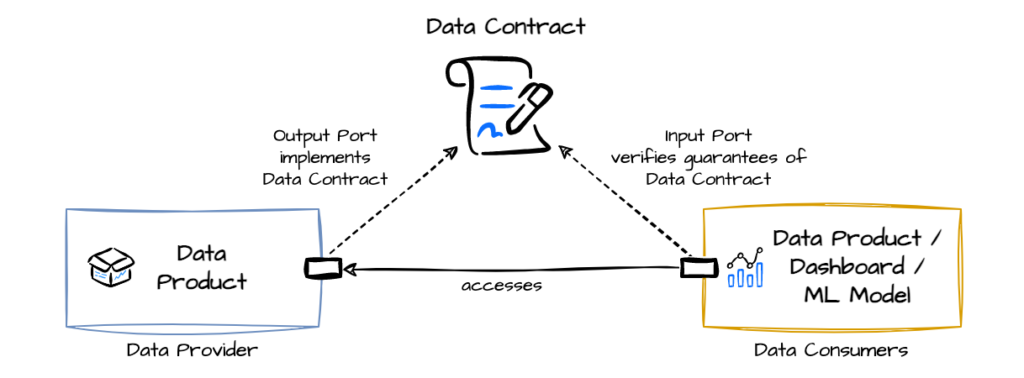
A data contract establishes an explicit agreement between data producers and data consumers about what data should look like, what it means, how it should behave, and what quality standards it should meet.
Rather than treating data as an informal output of an application or pipeline, data contracts treat it as a product with defined expectations.
What Is a Data Contract?
A data contract is a formal, machine-readable agreement between data producers and data consumers that defines the expected structure, semantics, quality, and behavior of a data product or data interface.
In simple terms, a data contract answers questions such as:
- What fields are available?
- What data types do they use?
- Which fields are required?
- What does each field mean?
- What values are considered valid?
- How frequently is the data updated?
- What quality standards must the data meet?
- What happens when the schema changes?
- Who owns the data?
- Who should consumers contact when something goes wrong?
For example, an enterprise customer data contract might define:
customer_id: string, required
customer_name: string, required
email: string, optional
account_status: enum
created_at: ISO 8601 timestamp
The contract could also specify that customer_id must be unique, account_status can only contain approved values, and the dataset must be updated within a defined time window.
The important point is that these expectations are explicit rather than implicit.
Why Enterprise Data Sharing Is Difficult
Enterprise data environments often involve many teams, systems, and technologies.
A typical organization may have:
- Hundreds of applications
- Multiple databases
- Data warehouses
- Data lakes
- SaaS applications
- Streaming platforms
- ETL and ELT pipelines
- Business intelligence tools
- Machine learning systems
- External data providers
Different teams may own different parts of the data lifecycle.
The application team owns the source system.
The data engineering team builds pipelines.
The analytics team consumes transformed datasets.
The finance team depends on reporting data.
The machine learning team uses customer and behavioral information.
Without clearly defined agreements, every team can develop its own assumptions.
Those assumptions eventually break.
The Problem With Schema Changes
Schema evolution is one of the biggest reasons data contracts matter.
Imagine an application produces:
customer_id
customer_name
customer_status
A downstream analytics pipeline depends on customer_status.
The application team decides to rename the field to:
status
From the application’s perspective, this may be a simple refactoring.
From the perspective of downstream consumers, it can break dashboards, reports, models, integrations, and data pipelines.
Without a contract, the producer may not know every consumer affected by the change.
With a contract, schema changes can be evaluated against explicitly defined compatibility rules.
This moves organizations from surprise-driven data integration toward managed data evolution.
Data Contracts Create Shared Expectations
One of the biggest benefits of data contracts is that they establish a shared understanding between producers and consumers.
Consider a field called revenue.
What does it mean?
Is it:
- Gross revenue?
- Net revenue?
- Revenue excluding taxes?
- Booked revenue?
- Recognized revenue?
- Monthly recurring revenue?
A technically valid field can still be semantically ambiguous.
Data contracts can define not only the structure of data but also its meaning.
This distinction is critical.
Reliable data requires both technical correctness and semantic clarity.
Key Components of a Data Contract
A mature data contract can contain several types of information.
Schema
The schema defines the structure of the data.
It can specify:
- Field names
- Data types
- Required fields
- Optional fields
- Nested structures
- Allowed values
- Constraints
Semantics
Semantics explain what the data means.
For example:
customer_statusrepresents the current commercial status of a customer account.
This prevents different teams from interpreting the same field differently.
Data Quality
Quality requirements define acceptable data behavior.
Examples include:
- Uniqueness
- Completeness
- Valid value ranges
- Referential integrity
- Freshness
- Accuracy thresholds
Service-Level Expectations
A contract can define when and how data should be delivered.
For example:
The customer dataset must be refreshed every 30 minutes.
Or:
Ninety-nine percent of daily records must be available by 06:00 UTC.
Ownership
Every important data product should have a clearly identified owner.
Ownership helps answer:
Who is responsible when this data is wrong?
Without ownership, data quality problems can remain unresolved because teams assume someone else is responsible.
Change Management
Contracts can specify how changes should be introduced.
For example:
- Which changes are backward compatible?
- Which changes require advance notification?
- How long will deprecated fields remain available?
- How are consumers notified?
This makes data evolution more predictable.
Data Contracts vs. Traditional Data Schemas
Data contracts and schemas are related, but they are not identical.
A schema primarily describes what data looks like.
A data contract can describe:
What the data looks like + what it means + how reliable it should be + who owns it + how it can change.
For example, a schema might state:
order_id: string
amount: decimal
created_at: timestamp
A data contract could additionally specify:
order_idmust be unique.amountcannot be negative.created_atmust use UTC.- Records must be available within 15 minutes of order creation.
- The producing team owns the dataset.
- Breaking schema changes require advance notification.
This broader definition makes data contracts particularly valuable in large organizations.
Data Contracts and Data Mesh
Data contracts are closely associated with the data mesh approach.
Data mesh emphasizes domain-oriented ownership, treating data as a product and enabling decentralized data architecture.
For this model to work, domain teams need a clear way to communicate expectations about their data.
Data contracts can provide that interface.
For example, a sales domain could publish a customer dataset with:
- A documented schema
- Business definitions
- Quality guarantees
- Ownership information
- Access policies
- Change policies
Other teams can consume the data without needing to understand every internal detail of the sales domain’s operational systems.
This supports a more scalable model of enterprise data sharing.
Data Contracts Improve Data Quality
Traditional data quality programs often detect problems after data has entered downstream systems.
A dashboard fails.
A model produces unexpected results.
A finance report contains incorrect numbers.
Someone investigates the pipeline and discovers that an upstream field changed several days earlier.
Data contracts encourage organizations to detect problems earlier.
Automated validation can check whether produced data satisfies the contract before it reaches downstream consumers.
For example:
Expected:
customer_id → unique and non-null

Received:
customer_id → 2.4% null

Result:
Contract validation fails
Instead of allowing questionable data to silently propagate, the system can trigger an alert or block the affected data flow depending on the organization’s operating model.
Data Contracts Enable Better Automation
Because data contracts can be represented in machine-readable formats, they can become part of automated data workflows.
Organizations can integrate contracts with:
- CI/CD pipelines
- Data validation frameworks
- Schema registries
- Data catalogs
- Streaming platforms
- ETL/ELT pipelines
- Observability systems
- Testing frameworks
- Governance platforms
For example, a schema change submitted through a software development workflow could automatically trigger compatibility tests.
If the change violates the contract, deployment can be blocked or require explicit approval.
This brings data management closer to the engineering practices already used for software development.
Data Contracts and Data Observability
Data contracts and data observability solve related but different problems.
Data contracts define expectations.
Data observability helps determine whether those expectations are being met.
Suppose a contract specifies:
The dataset must be refreshed every hour.
Data observability can monitor freshness and detect when the dataset has not been updated as expected.
Together, they create a stronger reliability model:
Contract → Expectation → Monitoring → Detection → Response
This combination can help organizations move from reactive data troubleshooting toward proactive data reliability.
Data Contracts Reduce the Cost of Data Integration
Enterprise data integration can become expensive because every new consumer requires additional coordination.
Teams need to understand:
- Where the data comes from
- What fields mean
- Whether the data is reliable
- How frequently it changes
- What transformations have occurred
- Who to contact when problems occur
A well-designed data contract centralizes many of these expectations.
This reduces ambiguity and can make onboarding new data consumers faster.
For large organizations, the productivity gains can be significant.
Challenges of Implementing Data Contracts
Despite their benefits, data contracts are not a simple technology feature.
They require organizational discipline.
Ownership Can Be Difficult
Organizations must determine which team owns each data product.
This can be challenging when data crosses multiple business domains.
Contracts Can Become Too Complex
A contract should provide useful guarantees without attempting to document every possible detail.
Overly complicated contracts can become difficult to maintain.
Teams Need Change Management
Developers, data engineers, analysts, and business teams may have different expectations about data.
Introducing contracts can require changes to existing development and delivery processes.
Legacy Systems Create Constraints
Older systems may not have clear schemas, ownership models, documentation, or automated testing.
Organizations may need to introduce contracts gradually rather than attempting to cover every dataset immediately.
How to Implement Data Contracts
Organizations can begin with a focused implementation.
Step 1: Identify Critical Data Products
Start with datasets that have significant business impact.
Examples include:
- Customer data
- Financial data
- Orders
- Billing
- Product usage
- Inventory
- Regulatory reporting data
Step 2: Assign Ownership
Identify the team responsible for producing and maintaining each data product.
Step 3: Define the Contract
Document:
- Schema
- Definitions
- Quality requirements
- Freshness
- Ownership
- Access expectations
- Change management
Step 4: Automate Validation
Where possible, convert contract requirements into automated tests.
For example:
Schema validation
+ Null checks
+ Uniqueness checks
+ Freshness checks
+ Allowed-value checks
= Automated contract validation
Step 5: Integrate Contracts Into Development
Treat important data changes similarly to API changes.
Changes should be reviewed, tested, documented, and communicated.
Step 6: Expand Gradually
Once the approach works for a few critical data products, organizations can extend it to additional domains.
Data Contracts Are the Data Equivalent of APIs
One useful way to understand data contracts is to compare them with software APIs.
An API defines how systems communicate.
It specifies things such as:
- Available endpoints
- Inputs
- Outputs
- Data formats
- Authentication
- Error behavior
A data contract serves a similar purpose for data exchange.
It defines what consumers can expect from a data producer.
This makes data contracts particularly relevant as organizations increasingly treat data as a product.
The principle is simple:
If other teams depend on your data, your data needs an interface that they can trust.
The Future of Enterprise Data Sharing
As enterprises adopt real-time analytics, artificial intelligence, machine learning, and increasingly distributed data architectures, data reliability becomes even more important.
AI systems depend on data.
Analytics depends on data.
Automation depends on data.
Business decisions depend on data.
When data is inconsistent or poorly understood, the impact can extend far beyond a broken pipeline.
Data contracts provide a structured way to establish expectations before problems occur.
They can help organizations create stronger relationships between data producers and consumers, improve data quality, reduce integration friction, and make changes safer.
Conclusion
Enterprise data sharing is becoming more complex, but the fundamental requirement remains simple:
Data consumers need to know what they can expect from the data they use.
Data contracts provide a practical framework for establishing those expectations.
By defining schemas, semantics, quality requirements, ownership, freshness, and change policies, organizations can make data more predictable and reliable.
For B2B and enterprise organizations, the value goes beyond technical data quality.
Reliable data can support faster analytics, more dependable AI systems, stronger governance, and more efficient collaboration between teams.
The future of enterprise data is not simply about moving more information between systems.
It is about making that information trusted, understandable, governed, and dependable by design.
Data contracts are an important step toward that future.


Leave a Reply