

Table of Contents
- What Is a Composable Enterprise?
- What Is Modular Architecture?
- How Composable Enterprise and Modular Architecture Work Together
- Why Businesses Are Moving Toward Composable Technology
- The Role of Business Technology in a Composable Enterprise
- Key Technologies Behind the Composable Enterprise
- Composable Enterprise vs. Traditional Enterprise Architecture
- How to Build a Composable Enterprise
- Challenges of a Composable Enterprise
- The Future of Business Technology Is Composable
- Conclusion
Businesses today need to adapt faster than ever. Customer expectations change quickly, new technologies emerge continuously, and organisations must respond to market disruptions without rebuilding their entire technology infrastructure.
This is where the Composable Enterprise model is gaining importance.
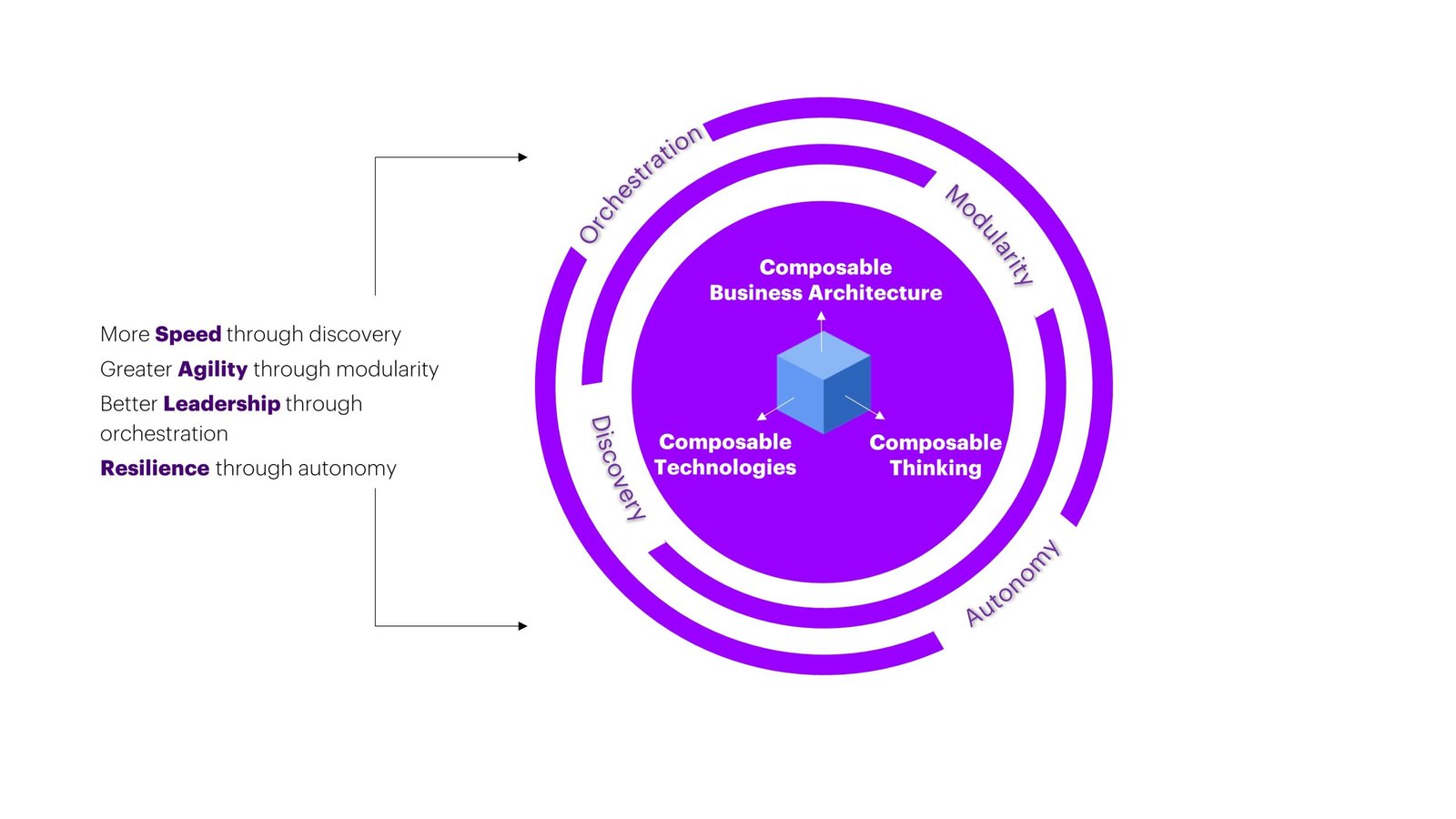
A composable enterprise uses modular architecture, reusable business capabilities, APIs, cloud technologies, and flexible business technology platforms to help organisations build and change digital solutions faster. Instead of relying on one large, tightly integrated system, businesses can assemble technology components according to their changing needs.
What Is a Composable Enterprise?
A Composable Enterprise is an organisation designed to rapidly adapt its business processes, applications, and technology capabilities by combining modular, reusable components.
The concept is based on the idea that technology should be assembled rather than permanently built into a rigid structure.
For example, instead of replacing an entire commerce platform to improve the customer checkout experience, a company could replace or upgrade only the relevant component. Other parts of the technology ecosystem can continue operating independently.
This approach creates a more flexible relationship between business strategy and technology.
A composable enterprise typically combines:
- Modular business capabilities
- API-first architecture
- Cloud-native technologies
- Microservices
- Reusable software components
- Data and integration platforms
- Automation and artificial intelligence
- Flexible business applications
Together, these capabilities enable organisations to respond to business requirements with greater speed and flexibility.
What Is Modular Architecture?
Modular architecture is a technology design approach in which a system is divided into smaller, independent components or modules.
Each module performs a specific function and can potentially be developed, updated, replaced, or scaled without requiring changes to the entire system.
Traditional enterprise technology often follows a tightly coupled model. A change to one part of the system can affect multiple dependent systems.
A modular architecture reduces this dependency.
Example of Modular Architecture
Consider an online retail business. Its technology environment might include separate modules for:
- Product management
- Customer management
- Payments
- Order management
- Inventory
- Marketing
- Customer service
- Analytics
With modular architecture, the organisation can improve or replace one capability without necessarily replacing the entire technology stack.
This makes technology more adaptable to changing business priorities.
How Composable Enterprise and Modular Architecture Work Together
Composable enterprise and modular architecture are closely connected, but they are not exactly the same concept.
Modular architecture describes how technology is structured.
Composable enterprise describes how an organisation uses modular technology and business capabilities to continuously adapt.
In simple terms:
Modular architecture provides the building blocks. A composable enterprise uses those building blocks to respond to business change.
This distinction is important because simply adopting microservices or APIs does not automatically make an organisation composable. Business processes, operating models, data, governance, and technology must work together.
Why Businesses Are Moving Toward Composable Technology
The traditional approach to enterprise technology can make change expensive and slow. Large platforms may contain multiple interconnected capabilities, making upgrades and integrations complex.
Composable technology aims to reduce these constraints.
1. Faster Business Innovation
Businesses can experiment with new technologies and capabilities without redesigning their entire technology environment.
A company can introduce a new customer experience, analytics capability, AI service, or digital channel using existing components and integrations.
2. Greater Technology Flexibility
Composable architecture makes it easier to select technologies based on specific business requirements.
Organisations are less dependent on a single monolithic platform and can create technology ecosystems from multiple specialised solutions.
3. Improved Scalability
Individual components can be scaled according to demand.
For example, an organisation experiencing a major increase in online transactions may be able to scale relevant commerce or payment capabilities without scaling every application in its environment.
4. Reduced Technology Lock-In
A modular technology ecosystem can make it easier to replace individual components.
This can give organisations more flexibility when evaluating vendors, platforms, and emerging technologies.
5. Better Customer Experiences
Composable technology enables businesses to adapt digital experiences more quickly.
Organisations can connect customer data, commerce capabilities, marketing platforms, AI services, and other systems to create more personalised and responsive experiences.
The Role of Business Technology in a Composable Enterprise
Business technology refers to technology used to support and enable business outcomes, rather than being treated purely as an IT function.
In a composable enterprise, technology decisions are increasingly connected to business objectives such as:
- Increasing revenue
- Improving customer experience
- Reducing operational costs
- Accelerating product development
- Improving employee productivity
- Entering new markets
- Creating new digital services
This means business and technology teams need to collaborate closely.
Instead of asking only, “What technology should we implement?”, organisations should also ask:
“What business capability do we need, and how quickly must we be able to change it?”
That shift in thinking is central to composability.
Key Technologies Behind the Composable Enterprise
Several technology approaches support composable enterprise architecture.
APIs
APIs allow different applications and services to communicate with one another. They are fundamental to creating connected and reusable business capabilities.
Microservices
Microservices divide applications into smaller services that can be developed and deployed independently. They can support modularity and scalability when implemented appropriately.
Cloud Computing
Cloud infrastructure provides flexible computing, storage, networking, and application services that can support rapidly changing technology requirements.
Headless Architecture
Headless approaches separate the presentation layer from backend functionality. This can make it easier to deliver the same business capabilities across websites, mobile applications, marketplaces, and other digital channels.
Event-Driven Architecture
Event-driven systems allow applications to respond to business events in real time. This can improve responsiveness across complex enterprise environments.
Artificial Intelligence
AI can become another composable business capability, allowing organisations to incorporate functions such as intelligent search, recommendations, automation, forecasting, and content generation into existing workflows.
Composable Enterprise vs. Traditional Enterprise Architecture
| Traditional Enterprise | Composable Enterprise |
|---|---|
| Monolithic systems | Modular capabilities |
| Tightly coupled components | Loosely coupled components |
| Large-scale technology changes | Incremental changes |
| Long implementation cycles | Faster experimentation |
| Strong platform dependency | Greater technology flexibility |
| Centralised technology decisions | Business and technology collaboration |
| Fixed processes | Adaptable business capabilities |
The goal is not necessarily to eliminate existing enterprise systems.
Instead, organisations can progressively introduce modular capabilities around their existing technology landscape.
How to Build a Composable Enterprise
Becoming composable is a strategic transformation rather than simply a technology implementation.
Step 1: Identify Core Business Capabilities
Start by identifying the capabilities that differentiate the organisation.
Examples include customer engagement, payments, supply chain management, product configuration, risk management, or digital commerce.
Step 2: Assess the Existing Technology Landscape
Map applications, integrations, data flows, dependencies, and legacy systems.
This helps identify tightly coupled systems and areas where modularisation could deliver the greatest value.
Step 3: Define Modular Boundaries
Determine which business capabilities can operate as independent modules.
Good modular boundaries generally align with clear business responsibilities and ownership.
Step 4: Prioritise APIs and Integration
A composable ecosystem requires reliable communication between components.
API management, event integration, data integration, and identity management should therefore be treated as strategic capabilities.
Step 5: Modernise Incrementally
Organisations do not need to transform everything at once.
A better approach is often to select high-value business capabilities, modernise them, and progressively expand the composable architecture.
Step 6: Establish Governance
Greater flexibility requires strong governance.
Organisations need standards for security, APIs, data, architecture, observability, compliance, and technology lifecycle management.
Challenges of a Composable Enterprise
Although composability offers significant advantages, it also introduces new challenges.
Integration Complexity
More components can mean more integration points. Without effective API and integration management, the architecture can become difficult to maintain.
Governance
Teams need clear standards to prevent technology fragmentation and uncontrolled proliferation of services.
Skills
Composable architecture requires expertise across cloud platforms, APIs, integration, security, DevOps, data, and modern application development.
Legacy Systems
Existing enterprise applications may not be designed for modular integration. Organisations may need an incremental modernisation strategy.
Architecture Management
Flexibility should not become unnecessary complexity. Businesses need architectural principles that balance independence with standardisation.
The Future of Business Technology Is Composable
The shift toward composable enterprise architecture reflects a broader change in how organisations think about technology.
Businesses increasingly need technology that can adapt as quickly as their strategies change.
Instead of building technology environments that remain fixed for years, organisations can create ecosystems of reusable capabilities that can be assembled, modified, and scaled as business requirements evolve.
The result is a technology model designed around adaptability, modularity, interoperability, and continuous innovation.
Conclusion
A Composable Enterprise combines modular architecture with business-focused technology capabilities to create a more adaptable organisation.
By using APIs, cloud platforms, microservices, reusable services, automation, AI, and modern integration approaches, businesses can reduce the limitations of tightly coupled technology environments.
However, composability is more than an architectural pattern. It is a way of designing the organisation so that business capabilities and technology can evolve together.
For companies looking to become more agile, resilient, and digitally competitive, adopting a modular and composable approach can provide a strong foundation for continuous transformation.




Leave a Reply