

Table of Contents
- Introduction: Why the Modern Data Stack Is Entering a New Phase
- What Is the Modern Data Stack?
- Why the Modern Data Stack Is Changing
- 10 Modern Data Stack Trends B2B Businesses Should Watch
- 1. The Rise of Data Lakehouse Architecture
- 2. AI-Native Data Infrastructure
- 3. The Growing Importance of Real-Time Data Processing
- 4. Open Data Formats and Interoperability
- 5. The Evolution of the Semantic Layer
- 6. Data Products Are Becoming Central to Data Architecture
- 7. Automated Data Engineering and AI-Assisted Workflows
- 8. Data Governance Is Becoming an AI Requirement
- 9. Hybrid and Multi-Cloud Data Architectures
- 10. The Emergence of Agentic Data Platforms
- Traditional Data Stack vs Modern Data Stack: What’s Changing?
- How the Modern Data Stack Impacts B2B Businesses
- How to Build a Future-Ready Modern Data Stack
- Step 1: Assess Your Existing Data Architecture
- Step 2: Define Clear Business Objectives
- Step 3: Establish a Strong Data Integration Foundation
- Step 4: Select the Right Storage Architecture
- Step 5: Introduce Data Quality and Governance
- Step 6: Develop Reusable Data Products
- Step 7: Introduce AI and Automation Gradually
- Step 8: Monitor Cost and Performance Continuously
- Technology Categories Shaping the Modern Data Stack
- Common Challenges B2B Businesses Should Prepare For
- Measuring the Success of a Modern Data Stack
- The Future of the Modern Data Stack: What Comes Next?
- Conclusion: Building a Data Foundation for the Next Generation of B2B Business
- Frequently Asked Questions (FAQs)
- 1. What is a modern data stack?
- 2. How is the modern data stack different from traditional data architecture?
- 3. What are the major trends shaping the modern data stack in 2026?
- 4. What is a data lakehouse?
- 5. Why is AI-ready data important for B2B businesses?
- 6. What is the role of a semantic layer in modern data architecture?
- 7. How do open data formats benefit enterprises?
- 8. Is real-time data processing necessary for every business?
- 9. How does data governance support modern data stacks?
- 10. How can a B2B business modernise its data stack?
- 11. What technologies are commonly used in the modern data stack?
- 12. What should businesses prioritise when selecting a modern data stack?
Introduction: Why the Modern Data Stack Is Entering a New Phase
Data has become one of the most important strategic resources for modern B2B organisations. From customer intelligence and financial reporting to supply chain optimisation and artificial intelligence, businesses increasingly depend on reliable information to make decisions and maintain a competitive advantage.
However, the technology infrastructure supporting these activities is changing rapidly.
Traditional data architectures were primarily designed to collect, store, transform, and analyse information for reporting and business intelligence. Modern data stacks introduced cloud-native platforms, scalable storage, automated data pipelines, and self-service analytics to make these processes more efficient.
Today, another major shift is underway.
The growing adoption of generative AI, predictive analytics, real-time decision-making, and autonomous AI agents is changing what businesses expect from their data infrastructure.
Organisations no longer need data platforms simply to generate dashboards and historical reports. They need infrastructure capable of delivering trusted, governed, and contextual information to analytics applications, machine learning models, and AI-powered business workflows.
This is driving the evolution of the modern data stack.
Businesses are exploring lakehouse architectures, open data formats, unified governance, semantic layers, automated data engineering, and real-time processing to build more flexible and AI-ready data environments.
At the same time, rising infrastructure costs, fragmented systems, vendor dependency, and data quality challenges are forcing organisations to reconsider how their data ecosystems are designed.
For B2B enterprises, understanding these developments is essential.
The future of data infrastructure will not be determined simply by how much information an organisation can store. It will depend on how effectively that information can be integrated, governed, accessed, and converted into business value.
In this article, we examine how the modern data stack is changing, the key trends B2B businesses should watch, and what organisations can do to prepare their data infrastructure for the next phase of enterprise transformation.
What Is the Modern Data Stack?
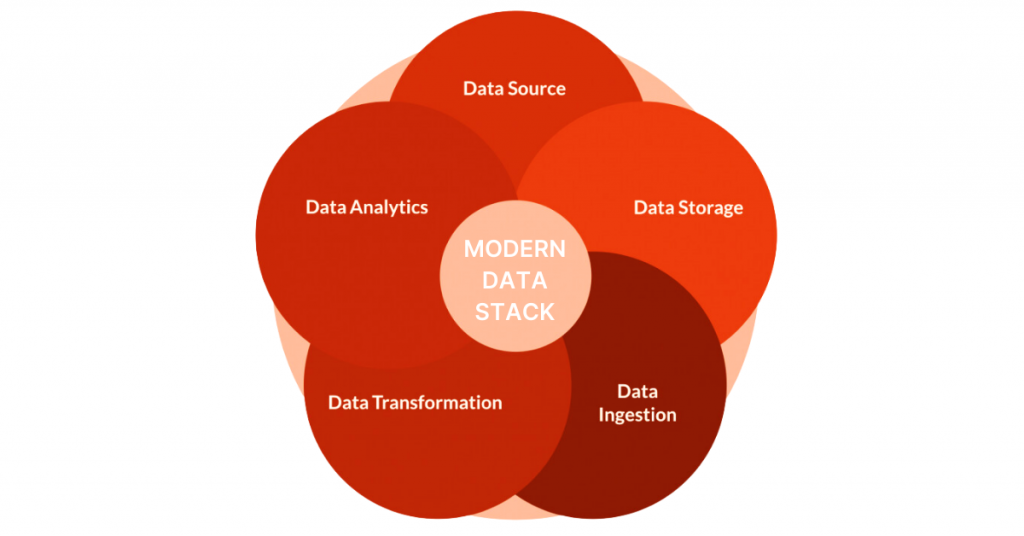
The modern data stack is a collection of technologies, platforms, and processes that organisations use to collect, integrate, store, transform, govern, and analyse data.
Unlike traditional data environments that often rely on on-premises infrastructure and manually maintained pipelines, modern data stacks generally use cloud-based, scalable, and automated technologies.
A typical modern data stack includes several interconnected layers.
1. Data Ingestion Layer
This layer collects information from different business systems and external sources.
Common sources include:
- Customer relationship management (CRM) platforms.
- Enterprise resource planning (ERP) systems.
- Marketing automation tools.
- Financial applications.
- Customer support platforms.
- Website and application analytics.
- IoT devices and operational systems.
- External business datasets.
Data can be collected through APIs, batch processing, event streaming, and other integration methods.
2. Data Storage Layer
The storage layer provides the infrastructure for maintaining enterprise information.
Common technologies include:
- Cloud data warehouses.
- Data lakes.
- Data lakehouses.
- Distributed storage systems.
- Operational databases.
The choice depends on data volume, workload requirements, performance expectations, security, and cost.
3. Data Transformation Layer
Raw information frequently needs to be cleaned, standardised, validated, and structured before it can support business analysis.
Transformation tools help convert source information into usable datasets and business-ready models.
This layer also supports reusable data models, automated testing, and consistent business definitions.
4. Data Governance and Management Layer
Governance ensures that enterprise information remains secure, reliable, discoverable, and appropriately accessible.
Important capabilities include:
- Data quality monitoring.
- Metadata management.
- Data lineage.
- Access control.
- Data cataloguing.
- Privacy management.
- Data ownership.
5. Analytics and Business Intelligence Layer
This layer enables users to access information through dashboards, reports, visualisations, and analytical applications.
Business intelligence tools help teams understand performance, identify trends, and make informed decisions.
6. Data Activation and AI Layer
Modern data stacks increasingly support the movement of insights into operational business systems.
This includes customer segmentation, predictive models, machine learning, AI-powered applications, and automated workflows.
The objective is to make trusted data useful across the organisation rather than restricting it to reporting environments.
Why the Modern Data Stack Is Changing
The evolution of the modern data stack is being driven by changes in business expectations, technology capabilities, and enterprise operating models.
Several factors are accelerating this transformation.
1. Growing Demand for AI-Ready Data
Businesses are moving beyond experimental AI applications and exploring ways to integrate artificial intelligence into everyday operations.
However, AI applications require more than access to large volumes of information.
They need data that is accurate, contextual, well-documented, secure, and consistently governed.
For example, an enterprise AI assistant supporting financial reporting must understand the meaning of revenue, customer, transaction, and reporting-period fields.
Without consistent definitions and reliable source information, AI-generated responses may be inaccurate or misleading.
This is increasing demand for data infrastructure that can support both traditional analytics and AI-driven applications.
2. Increasing Data Complexity
B2B organisations generate information across a growing number of applications, business units, partners, and customer touchpoints.
Data may exist in structured databases, documents, emails, PDFs, application logs, images, and streaming systems.
Traditional architectures often struggle to manage these different information types efficiently.
Modern data stacks are evolving to provide more unified ways to manage structured, semi-structured, and unstructured information.
3. Pressure to Reduce Infrastructure Costs
Cloud data platforms have made enterprise analytics more accessible, but they have also introduced new cost management challenges.
Growing data volumes, compute-intensive workloads, duplicate datasets, and AI processing requirements can increase infrastructure spending.
Businesses are therefore looking for architectures that optimise storage, compute, data movement, and workload allocation.
4. Demand for Real-Time Business Intelligence
Many business decisions depend on information that changes continuously.
Examples include customer interactions, inventory levels, financial transactions, shipment updates, and digital engagement.
Traditional batch-oriented data processing may not provide the speed required for certain operational use cases.
As a result, businesses are increasingly exploring streaming pipelines, event-driven architectures, and real-time analytics.
5. Greater Focus on Data Ownership and Governance
As data becomes more widely accessible across organisations, businesses need stronger accountability for its quality, usage, and security.
Data governance is evolving from a compliance-focused activity into a core architectural requirement.
This is particularly important when data supports automated decisions and AI-powered applications.
10 Modern Data Stack Trends B2B Businesses Should Watch
The modern data stack is evolving across multiple technology and operational areas.
The following trends are particularly important for B2B organisations planning their enterprise data strategies.
1. The Rise of Data Lakehouse Architecture
One of the most important developments in modern data infrastructure is the growing interest in data lakehouse architecture.
Traditionally, businesses used data warehouses for structured analytics and data lakes for storing large volumes of raw information.
Although both approaches serve important purposes, managing separate environments can introduce data duplication, integration complexity, and additional governance requirements.
A data lakehouse combines capabilities associated with data lakes and data warehouses within a more unified architecture.
It aims to provide:
- Flexible and scalable storage.
- Support for structured and unstructured information.
- Reliable data management.
- Transactional capabilities.
- Analytics and machine learning support.
- More unified governance.
For example, a B2B manufacturing enterprise could maintain production records, supplier information, equipment sensor data, and financial transactions within a lakehouse environment.
Different teams could then use the same governed data foundation for operational reporting, predictive maintenance, and business analytics.
The advantage is not simply consolidating storage. It is creating a more consistent foundation for multiple data workloads.
What businesses should watch: Evaluate whether a lakehouse can simplify existing data architecture, reduce unnecessary data duplication, and support both analytical and AI workloads.
2. AI-Native Data Infrastructure
AI is becoming an important consumer of enterprise data.
Traditional data infrastructure was primarily designed to support reporting, dashboards, and analytical queries.
AI applications introduce additional requirements, including:
- Access to structured and unstructured data.
- Vector search and semantic retrieval.
- Metadata and contextual information.
- Model evaluation.
- Data quality validation.
- Governed access to enterprise knowledge.
- Integration with AI application frameworks.
For example, a B2B organisation building an internal AI assistant may need to connect customer records, product documentation, support knowledge bases, and financial information.
Its data infrastructure must provide appropriate access to these sources while maintaining security and consistent definitions.
This is encouraging businesses to build AI-ready data environments rather than treating AI as an independent application layer.
What businesses should watch: Prioritise data platforms that can support analytics, machine learning, retrieval-augmented generation (RAG), and enterprise AI applications without creating unnecessary data silos.
3. The Growing Importance of Real-Time Data Processing
Real-time analytics is becoming increasingly relevant as businesses seek to respond to operational changes more quickly.
Traditional batch processing collects and transforms information at scheduled intervals.
While this approach remains suitable for many reporting requirements, certain business scenarios benefit from faster data availability.
Examples include:
- Fraud detection.
- Inventory monitoring.
- Customer activity tracking.
- Shipment visibility.
- Financial transaction monitoring.
- Equipment performance monitoring.
- Digital customer engagement.
For example, a logistics company can use streaming data from shipment tracking systems to identify delivery delays and update customer-facing applications.
Similarly, a B2B SaaS company can analyse product usage events to identify significant changes in customer engagement.
Real-time data infrastructure can support faster decision-making, provided the business case justifies the additional technical complexity and cost.
What businesses should watch: Identify processes where data freshness directly influences business outcomes. Not every dataset needs real-time processing.
4. Open Data Formats and Interoperability
Vendor dependency has become an important consideration in enterprise data architecture.
When organisations rely heavily on proprietary storage formats, metadata systems, or platform-specific integrations, migrating workloads can become difficult.
Open data formats and interoperability standards aim to improve flexibility.
Technologies and standards attracting attention include:
- Apache Iceberg.
- Delta Lake.
- Apache Parquet.
- Apache Arrow.
- Open table formats and metadata standards.
These technologies support different aspects of data storage, management, and interoperability.
For example, open table formats can help organisations access shared datasets through compatible query engines without requiring every analytical workload to maintain a separate copy.
This can improve architectural flexibility and support more diverse data processing environments.
However, open formats do not automatically eliminate vendor lock-in. Organisations must also evaluate catalogues, metadata management, governance, access controls, and operational tooling.
What businesses should watch: Assess open formats and interoperable architectures when evaluating long-term platform flexibility, migration requirements, and multi-engine data strategies.
5. The Evolution of the Semantic Layer
One of the challenges in enterprise analytics is that different departments may interpret the same business metric differently.
For example, marketing and finance may use different definitions of customer acquisition cost. Sales and finance may calculate revenue using different reporting rules.
These inconsistencies can create confusion in dashboards and AI-generated insights.
A semantic layer addresses this challenge by defining business concepts, metrics, relationships, and calculation rules in a consistent way.
It provides a shared interpretation of enterprise information.
For example, an organisation can define:
- What qualifies as an active customer.
- How annual recurring revenue is calculated.
- What constitutes a qualified lead.
- How customer churn is measured.
- Which transactions contribute to recognised revenue.
These definitions can then be reused across analytics tools and supported AI applications.
A semantic layer is particularly valuable when business users interact with enterprise information through natural language interfaces.
What businesses should watch: Develop consistent business definitions and reusable semantic models before expanding AI-powered analytics across departments.
6. Data Products Are Becoming Central to Data Architecture
The traditional approach to data management often focuses on building datasets for individual analytical requirements.
However, organisations are increasingly adopting a product-oriented approach to enterprise information.
A data product is a governed, documented, reusable data asset designed to serve specific business needs.
For example, a customer data product may combine CRM records, transaction history, support interactions, and subscription information.
Sales, marketing, finance, and customer success teams can consume the same trusted resource.
This reduces duplicated engineering work and improves consistency across business functions.
Data products also provide a structured foundation for AI applications because they include defined ownership, quality expectations, documentation, and access policies.
What businesses should watch: Move beyond isolated datasets and dashboards. Establish reusable data products with clear business ownership and measurable performance expectations.
7. Automated Data Engineering and AI-Assisted Workflows
Data engineering teams traditionally spend considerable time building pipelines, writing transformation code, debugging failures, and maintaining data quality checks.
AI-assisted development is beginning to change these workflows.
AI capabilities can help engineers:
- Generate SQL and transformation code.
- Document datasets.
- Suggest pipeline improvements.
- Identify potential data anomalies.
- Assist with troubleshooting.
- Generate test cases.
- Explain complex queries.
According to dbt Labs’ 2026 State of Analytics Engineering report, 72% of surveyed respondents prioritise AI-assisted coding in their development workflows.
The same report highlights that governance and trust remain important concerns as AI-driven development expands.
This indicates that automation is increasing the speed of analytics engineering, but human review and validation remain essential.
What businesses should watch: Introduce AI-assisted engineering tools while maintaining code review, testing, access controls, and clear accountability for production data pipelines.
8. Data Governance Is Becoming an AI Requirement
Data governance has traditionally been associated with compliance, security, and information management.
In AI-driven environments, it is becoming even more important.
AI systems can access and process information at scale. If that information is outdated, incorrectly classified, or poorly governed, the resulting outputs may create operational and compliance risks.
Modern data governance increasingly includes:
- Data ownership.
- Data lineage.
- Metadata management.
- Access policies.
- Data quality monitoring.
- Privacy controls.
- Data classification.
- Retention management.
- AI-specific usage policies.
The 2026 dbt Labs report highlights the growing importance of trust in enterprise data, with 83% of respondents identifying trust in data and data teams as an important priority.
This reinforces the need to treat governance as part of data infrastructure rather than a separate administrative process.
What businesses should watch: Embed governance into ingestion, storage, transformation, analytics, and AI consumption layers.
9. Hybrid and Multi-Cloud Data Architectures
Many enterprises operate across multiple cloud platforms, on-premises infrastructure, and specialised business applications.
This is driven by regulatory requirements, existing technology investments, data residency, performance needs, and business continuity considerations.
A hybrid data architecture allows organisations to distribute workloads across different environments.
For example:
- Sensitive financial records may remain in a controlled private environment.
- Large-scale analytics may run on a cloud data platform.
- Operational processing may occur closer to the source system.
- AI workloads may use specialised infrastructure depending on performance and cost requirements.
Modern platforms are increasingly focusing on interoperability and flexible data access across these environments.
Zero-copy data access is another area of interest. It allows compatible systems to query shared data without creating unnecessary additional copies, although performance and governance considerations still apply.
What businesses should watch: Evaluate hybrid and multi-cloud strategies based on security, data residency, workload portability, performance, and total cost of ownership.
10. The Emergence of Agentic Data Platforms
The next phase of modern data infrastructure is likely to involve greater automation through AI agents.
Traditional data platforms depend heavily on engineers and analysts to monitor pipelines, investigate issues, manage metadata, and perform repetitive maintenance activities.
Agentic capabilities may support tasks such as:
- Monitoring data pipeline health.
- Identifying unusual data patterns.
- Suggesting schema changes.
- Generating documentation.
- Investigating data quality failures.
- Recommending resource optimisation.
- Assisting with data discovery.
For example, an AI agent could identify that a critical customer dataset has not been refreshed according to its expected schedule and provide an initial investigation of the affected pipeline.
More advanced systems may recommend corrective actions, subject to appropriate approval and control mechanisms.
The objective is to make data operations more proactive and less dependent on repetitive manual intervention.
What businesses should watch: Explore agent-assisted data operations while ensuring that sensitive changes, access decisions, and production modifications remain subject to appropriate permissions and human oversight.
Traditional Data Stack vs Modern Data Stack: What’s Changing?
The evolution of data infrastructure is not simply about replacing old technologies with new ones.
It reflects a broader shift in how organisations collect, manage, govern, and use enterprise information.
| Traditional Data Stack | Evolving Modern Data Stack |
|---|---|
| Primarily focused on reporting | Supports analytics, AI, and operational workflows |
| Separate data lakes and warehouses | Greater adoption of unified lakehouse approaches |
| Batch-oriented processing | Batch and streaming capabilities |
| Manual pipeline development | AI-assisted and automated engineering |
| Department-specific datasets | Reusable, governed data products |
| Limited business metric standardisation | Greater use of semantic layers |
| Centralised, periodic governance | Embedded and automated governance |
| Proprietary platform dependencies | Greater interest in open formats and interoperability |
| Primarily human-driven analytics | Human and AI-assisted data consumption |
| Historical performance analysis | Predictive and real-time intelligence |
The modern approach aims to make enterprise information more accessible, reusable, trustworthy, and useful across business operations.
How the Modern Data Stack Impacts B2B Businesses
The evolution of data infrastructure has implications beyond technology departments.
It can directly influence how organisations manage customers, optimise operations, evaluate performance, and develop new business capabilities.
1. Better Customer Intelligence
By connecting CRM, marketing, sales, and customer support information, organisations can develop a more complete view of customer relationships.
This supports customer segmentation, account prioritisation, retention analysis, and personalised engagement.
2. More Effective Revenue Operations
A modern data stack can provide the foundation for connecting marketing performance, sales pipeline activity, and customer success information.
This enables better revenue forecasting, lead qualification, and account intelligence.
3. Improved Operational Efficiency
Integrated data infrastructure can support business process mining, predictive analytics, and workflow automation.
Organisations can identify operational bottlenecks and use reliable information to improve business processes.
4. Faster Business Decision-Making
Self-service analytics, semantic models, and real-time data access help business teams obtain relevant information without relying on manual reporting processes for every requirement.
5. Greater AI Readiness
A governed and well-integrated data stack provides a stronger foundation for generative AI, predictive models, and enterprise AI assistants.
6. Reduced Data Duplication
Reusable data products and interoperable platforms can reduce unnecessary duplication across departments and analytical systems.
7. Improved Business Scalability
Modern architectures can support growing data volumes, additional applications, new business units, and more complex analytical requirements without requiring a complete redesign for every new use case.
How to Build a Future-Ready Modern Data Stack
B2B businesses do not need to adopt every emerging technology to modernise their data infrastructure.
The right approach is to build an architecture that aligns with business priorities and can evolve as requirements change.
Here are eight practical steps.
Step 1: Assess Your Existing Data Architecture
Begin by reviewing the current data environment.
Identify:
- Existing data sources.
- Storage platforms.
- Integration tools.
- Transformation workflows.
- Analytics applications.
- Governance capabilities.
- Infrastructure costs.
- Existing technical dependencies.
This assessment helps identify architectural limitations and unnecessary complexity.
Step 2: Define Clear Business Objectives
Modernisation should begin with business outcomes rather than technology selection.
Possible objectives include:
- Improving customer intelligence.
- Reducing reporting delays.
- Supporting AI applications.
- Improving operational analytics.
- Reducing data infrastructure costs.
- Strengthening governance.
- Enabling real-time decision-making.
Prioritise objectives based on measurable business value.
Step 3: Establish a Strong Data Integration Foundation
Identify the systems that need to share information.
Develop reliable integration patterns using APIs, batch ingestion, event streaming, or other appropriate methods.
Ensure that customer, product, transaction, and operational identifiers remain consistent across connected systems.
Step 4: Select the Right Storage Architecture
Evaluate whether your organisation requires a cloud data warehouse, data lake, lakehouse, or hybrid environment.
Consider:
- Data volume.
- Workload requirements.
- Performance.
- Security.
- Data residency.
- Scalability.
- Cost.
- Vendor flexibility.
Avoid selecting architecture based only on industry trends.
Step 5: Introduce Data Quality and Governance
Establish clear ownership, metadata standards, data quality rules, lineage tracking, and access policies.
These capabilities should be implemented as part of the architecture rather than added after deployment.
Step 6: Develop Reusable Data Products
Identify datasets that support multiple business functions.
Transform them into documented and governed data products that can be reused across analytics, operational applications, and AI workflows.
Step 7: Introduce AI and Automation Gradually
Begin with practical applications such as automated data validation, predictive analytics, AI-assisted SQL development, or natural language analytics.
Evaluate the accuracy, reliability, security, and business value of these capabilities before expanding their use.
Step 8: Monitor Cost and Performance Continuously
Track infrastructure spending, compute utilisation, pipeline performance, query efficiency, data quality, and user adoption.
Modernisation should create measurable improvements in both technical performance and business outcomes.
Technology Categories Shaping the Modern Data Stack
The modern data stack is an ecosystem rather than a single platform.
Different technology categories address specific requirements.
| Technology Category | Purpose | Example Technologies |
|---|---|---|
| Cloud data warehouses | Enterprise data storage and analytics | Snowflake, Google BigQuery, Amazon Redshift |
| Data lakehouse platforms | Unified data management and analytics | Databricks, Microsoft Fabric |
| Data integration | Connecting enterprise systems | Fivetran, Airbyte |
| Data transformation | Cleaning and modelling information | dbt |
| Data processing | Distributed data computation | Apache Spark |
| Streaming | Real-time event processing | Apache Kafka, Apache Flink |
| Data cataloguing | Discovery and metadata management | Collibra, Alation |
| Business intelligence | Reporting and visual analytics | Power BI, Tableau, Looker |
| Data governance | Quality, access, and policy management | Microsoft Purview, Collibra |
| AI and machine learning | Predictive and generative applications | MLflow, cloud AI platforms |
These are examples rather than a recommended vendor combination.
The right technology choices depend on an organisation’s existing infrastructure, business requirements, technical capabilities, and total cost of ownership.
Common Challenges B2B Businesses Should Prepare For
Modernising the data stack can create significant opportunities, but it also introduces implementation challenges.
1. Legacy System Complexity
Many enterprises rely on older systems that were not designed for modern integration or real-time data exchange.
Solution: Modernise incrementally and prioritise high-value integration requirements rather than replacing every legacy platform at once.
2. Rising Cloud and Compute Costs
Scalable cloud infrastructure can become expensive when workloads are poorly optimised or unnecessary data copies accumulate.
Solution: Implement cost monitoring, workload optimisation, storage lifecycle management, and appropriate compute allocation.
3. Poor Data Quality
AI and analytics applications can produce unreliable results when source information is incomplete or inconsistent.
Solution: Establish data quality standards, automated testing, and accountable data ownership.
4. Vendor Lock-In
Overdependence on proprietary technologies can restrict migration and increase long-term costs.
Solution: Evaluate open formats, standard interfaces, workload portability, and interoperability when selecting platforms.
5. Shortage of Data Engineering Skills
Modern architectures require expertise in data modelling, cloud infrastructure, security, governance, and AI integration.
Solution: Invest in technical training, documentation, reusable development standards, and cross-functional collaboration.
6. Governance and Compliance Risks
Expanding access to enterprise information increases the importance of privacy, security, and regulatory compliance.
Solution: Introduce clear data classification, access controls, auditability, retention policies, and governance automation.
7. Technology-First Modernisation
Businesses may adopt new tools without identifying the problems they are intended to solve.
Solution: Connect every major architectural investment to a measurable business objective.
Measuring the Success of a Modern Data Stack
Modernisation should be evaluated through measurable technical and business outcomes.
Important KPIs include:
| Measurement Area | KPI | What It Indicates |
|---|---|---|
| Data quality | Accuracy and completeness | Information reliability |
| Data freshness | Data latency | Timeliness |
| Pipeline performance | Successful pipeline execution rate | Operational stability |
| Data availability | Platform uptime | Reliability |
| Infrastructure efficiency | Cost per query or workload | Cost optimisation |
| Data adoption | Active users and consuming teams | Business usage |
| Reusability | Number of downstream data consumers | Data product value |
| Governance | Policy compliance and lineage coverage | Data accountability |
| Analytics productivity | Time required to deliver datasets | Engineering efficiency |
| AI readiness | Percentage of critical data assets with documented ownership and quality controls | AI infrastructure maturity |
For example, an enterprise modernising its analytics environment may track how much time data engineers spend maintaining pipelines compared with developing new data products.
It may also measure whether improved data integration reduces reporting delays and duplicated datasets.
The objective is to determine whether the modern data stack is helping the organisation make better use of its information and technology investments.
The Future of the Modern Data Stack: What Comes Next?
The next phase of data infrastructure will be shaped by the convergence of artificial intelligence, data engineering, governance, and enterprise automation.
Several developments are likely to influence the direction of the modern data stack.
1. AI Agents as Data Consumers
AI agents will increasingly interact with enterprise data platforms to retrieve information, analyse patterns, and support business workflows.
This will increase the importance of reliable metadata, semantic definitions, and governed access.
2. More Autonomous Data Engineering
AI-assisted systems will increasingly help with pipeline development, testing, monitoring, and troubleshooting.
Human oversight will remain important for validating outputs and managing production changes.
3. Unified Data and AI Environments
Organisations will increasingly look for platforms that can support data engineering, analytics, machine learning, and AI applications through connected infrastructure.
4. Greater Emphasis on Data Products
Reusable and governed data products will become increasingly important as multiple business applications and AI systems consume the same enterprise information.
5. Stronger Focus on Interoperability
Open standards and portable architectures will help organisations maintain flexibility as data and AI technology ecosystems evolve.
6. Governance Embedded Into Infrastructure
Data governance will increasingly be enforced through automated policies, metadata controls, lineage, and continuous monitoring.
7. Cost-Aware AI and Analytics
As AI workloads increase, organisations will pay greater attention to compute efficiency, storage optimisation, workload placement, and the cost of delivering analytical services.
The future modern data stack will therefore be defined not just by its technical capabilities but also by its ability to balance speed, reliability, flexibility, security, and cost.
Conclusion: Building a Data Foundation for the Next Generation of B2B Business
The modern data stack is undergoing a significant transformation.
What started as a cloud-driven evolution of traditional data warehousing and business intelligence is expanding into a broader enterprise architecture designed to support AI, real-time analytics, automation, and reusable data products.
For B2B organisations, this shift creates opportunities to improve customer intelligence, strengthen operational efficiency, optimise revenue processes, and accelerate digital transformation.
However, adopting new platforms alone will not create a future-ready data environment.
Businesses need to focus on the fundamentals: reliable data integration, strong governance, consistent business definitions, scalable architecture, and clear ownership.
They must also make technology decisions based on actual business requirements rather than following every emerging industry trend.
The modern data stack is no longer just about moving data into the cloud. It is about creating a trusted, flexible, and intelligent data foundation that connects enterprise information with business outcomes.
Organisations that invest in this foundation will be better positioned to support AI-driven innovation, respond to changing market requirements, and turn enterprise data into a long-term strategic asset.
Frequently Asked Questions (FAQs)
1. What is a modern data stack?
A modern data stack is an integrated collection of cloud-based and automated technologies used to collect, store, transform, govern, and analyse enterprise information. It supports business intelligence, advanced analytics, machine learning, and AI applications.
2. How is the modern data stack different from traditional data architecture?
Traditional data architectures often rely on separate systems, manual integrations, and batch-oriented reporting. Modern data stacks generally use scalable cloud infrastructure, automated pipelines, reusable data models, stronger governance, and support for multiple analytical workloads.
3. What are the major trends shaping the modern data stack in 2026?
Key trends include lakehouse architecture, AI-ready data infrastructure, real-time analytics, open data formats, semantic layers, reusable data products, AI-assisted data engineering, automated governance, hybrid cloud environments, and agentic data platforms.
4. What is a data lakehouse?
A data lakehouse is a data architecture that combines capabilities associated with data lakes and data warehouses. It aims to support scalable data storage, reliable data management, analytics, and machine learning within a more unified environment.
5. Why is AI-ready data important for B2B businesses?
AI applications require accurate, contextual, secure, and well-governed information. AI-ready data infrastructure helps businesses provide reliable information to predictive models, generative AI applications, and automated workflows.
6. What is the role of a semantic layer in modern data architecture?
A semantic layer defines common business metrics, relationships, and terminology. It helps different departments and analytical applications use consistent definitions when accessing enterprise information.
7. How do open data formats benefit enterprises?
Open data formats can improve interoperability, support multiple processing engines, and reduce dependency on proprietary storage technologies. They can also make it easier to share and access data across different platforms.
8. Is real-time data processing necessary for every business?
No. Real-time processing is valuable when decisions depend on immediate information, such as fraud detection, inventory monitoring, and shipment tracking. Batch processing remains appropriate for many reporting and analytical workloads.
9. How does data governance support modern data stacks?
Data governance ensures that enterprise information is accurate, secure, discoverable, and appropriately accessible. It supports data quality, lineage, privacy, compliance, and reliable AI applications.
10. How can a B2B business modernise its data stack?
Businesses should begin by assessing existing infrastructure, identifying business priorities, improving data integration, selecting appropriate storage architecture, implementing governance, developing reusable data products, and gradually introducing AI and automation.
11. What technologies are commonly used in the modern data stack?
Common technologies include Snowflake, Databricks, Google BigQuery, Amazon Redshift, Microsoft Fabric, dbt, Apache Spark, Apache Kafka, Fivetran, Airbyte, Power BI, Tableau, and data governance platforms.
12. What should businesses prioritise when selecting a modern data stack?
Businesses should evaluate scalability, data security, governance, interoperability, performance, infrastructure costs, integration capabilities, technical skills, and alignment with long-term business requirements.



Leave a Reply