


Introduction
As organisations adopt hybrid and multi-cloud architectures, traditional perimeter-based security models have become insufficient. The expansion of cloud services across public, private, and edge environments exposes enterprises to dynamic risks and expands the attack surface. In this context, Zero Trust for Multi-Cloud Environments has emerged as a practical, resilient framework to defend against modern threats and ensure secure access across diverse platforms.
This roadmap provides IT leaders, security architects, and DevOps teams with actionable guidance for implementing Zero Trust principles across multi-cloud ecosystems, aligning technology, process, and governance for stronger protection.
Why Multi-Cloud Demands Zero Trust
Multi-cloud strategies allow organisations to optimise performance, reduce vendor risk, and enhance scalability. However, they also introduce complexity:
- Diverse identity systems
- Disparate security controls
- Inconsistent policy enforcement
- Increased lateral movement risks
Zero Trust requires that no user, workload, device, or network segment is inherently trusted, whether inside or outside the corporate network. In multi-cloud environments, where boundaries are fluid, this approach becomes foundational rather than optional.
Core Principles of Zero Trust
Before implementing a roadmap, it is essential to understand the core tenets:
- Verify Explicitly
Validate identity and context for every access request based on risk signals. - Least Privilege Access
Grant only the minimum permissions required for roles and tasks. - Assume Breach
Operate with the assumption that breaches can occur and contain them rapidly. - Continuous Monitoring
Assess behaviour and threats in real time to adjust policies dynamically.
These principles guide decisions across identity, access control, network segmentation, and application security.
Step-by-Step Roadmap for Zero Trust in Multi-Cloud
1. Establish a Unified Identity Foundation
Identity is the new perimeter. Begin by consolidating identity and access management across cloud environments. Integrate Identity Providers (IdPs) such as Azure AD, Okta, or AWS IAM with central policy controls. Enforce strong authentication with Multi-Factor Authentication (MFA) and incorporate device posture checks.
Focus Areas:
- Unify identity stores
- Implement MFA across all cloud access
- Use Single Sign-On (SSO) for seamless identity management
Outcome: Reduced credential misuse and consistent access control.
2. Define and Enforce Least Privilege Policies
In multi-cloud environments, privileges can proliferate unchecked. Adopt role-based access control (RBAC) or policy-based access control (PBAC) models tailored to cloud services. Continuously review permissions to eliminate excessive rights.
Best Practices:
- Audit access frequently
- Use just-in-time (JIT) privileges
- Implement attribute-based access control (ABAC)
Outcome: Minimized blast radius for compromised accounts.
3. Micro-Segment Networks and Workloads
Zero Trust requires breaking large network zones into smaller, controlled segments. Use cloud native tools, such as AWS Security Groups, Azure network security groups, or Kubernetes network policies, to isolate workloads and restrict lateral movement.
Action Steps:
- Define trust zones based on risk
- Apply policy templates per environment
- Monitor inter-segment communication
Outcome: Improved containment and risk isolation across environments.
4. Real-Time Visibility and Contextual Monitoring
Visibility across all cloud assets is critical. Leverage cloud security posture management (CSPM) and cloud workload protection platforms (CWPP) to track configuration drift, anomalous behaviour, and compliance deviations. Combine this with SIEM and UEBA systems to gain contextual threat insights.
Tools to Consider:
- CloudTrail, GuardDuty, Security Hub
- Azure Sentinel, Log Analytics
- GCP Cloud Security Command Center
Outcome: Faster detection of threats and more accurate risk assessment.
5. Automated Response and Remediation
Manual processes are too slow for multi-cloud dynamics. Implement automated response frameworks that can quarantine compromised workloads, revoke access tokens, or enforce policy changes in response to detected threats.
Approaches:
- Event-driven automation (e.g., AWS Lambda, Azure Functions)
- Playbooks triggered by SIEM alerts
- Integration with SOAR systems
Outcome: Reduced dwell time and faster containment.
6. Continuous Policy Validation and Governance
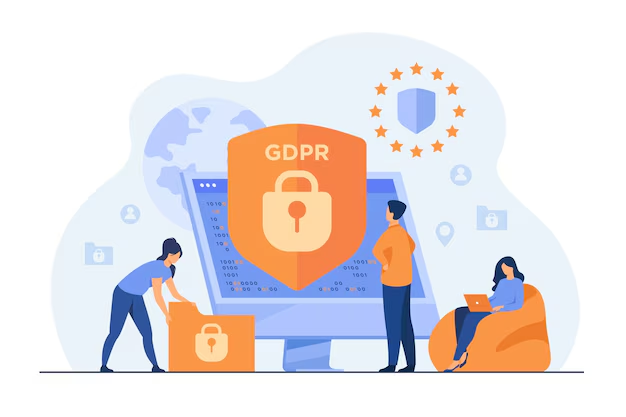
Zero Trust is not a one-time project. Regular testing, validation, and refinement of policies are essential. Use automated compliance tools to ensure alignment with internal and regulatory requirements (e.g., SOC 2, ISO 27001, GDPR).
Tasks:
- Conduct periodic risk assessments
- Map cloud controls to compliance standards
- Perform simulated attack exercises
Outcome: Policy resilience and ongoing assurance.
Common Challenges and How to Overcome Them
Challenge 1: Tool Fragmentation
Organisations often struggle with disparate security tooling across clouds.
Solution: Adopt unified platforms that aggregate telemetry and enforce central policies.
Challenge 2: Cultural Resistance
Shifting from perimeter trust to Zero Trust can face organisational resistance.
Solution: Educate stakeholders on risk reduction and business value, and start with pilot workloads.
Challenge 3: Skill Gaps
Zero Trust for multi-cloud requires expertise in identity, networking, and cloud security.
Solution: Invest in training, certifications, and managed security services where needed.
Measuring Success
To understand the impact of your Zero Trust initiative, track clear performance indicators:
- Reduction in privilege escalation events
- Decrease in lateral movement incidents
- Time to detect and respond to threats
- Coverage of least privilege policies
- Remediation automation rates
- Compliance posture improvements
These metrics align security outcomes with operational goals and provide continuous feedback for optimisation.
Conclusion
Zero Trust for multi-cloud environments is not theoretical jargon. It is a strategic necessity for organisations seeking stronger security, operational resilience, and trust in their digital initiatives. By building a clear roadmap that emphasises identity, least privilege, segmentation, monitoring, automation, and governance, enterprises can create a security foundation that supports innovation without compromising protection.
At Spire ITES, we help organisations navigate this transformation with proven frameworks, expert guidance, and integrated implementation support. Building a resilient multi-cloud operational strategy based on Zero Trust principles positions your business to excel in security, compliance, and competitive resilience.


Leave a Reply